
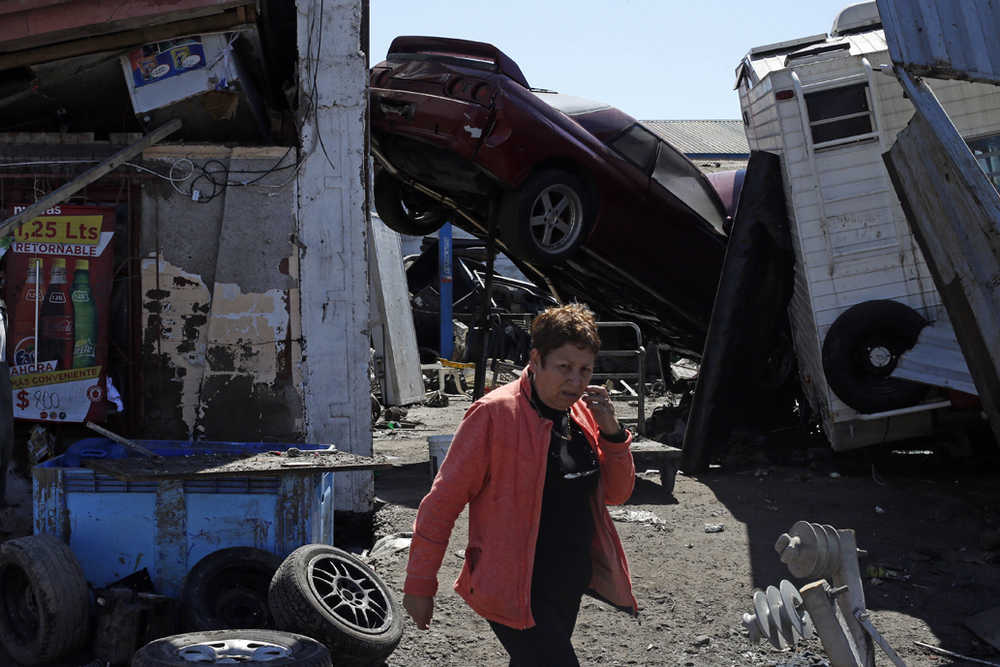
COQUIMBO, Chile — Parts of this port city were a disaster zone Thursday after an 8.3-magnitude quake hit off the coast, killing at least 11 people and likely causing billions in damage. Overturned cars and splintered boats sat mud next to furniture, toppled adobe homes and fishing nets tangled in trees.
The most stunning thing about Wednesday night’s earthquake, however, may be the relatively low amount of havoc caused by such a powerful shake.
While the quake led more than 1 million to evacuate coastal areas and no doubt caused much anxiety, seismologists said Chile’s heavy investment in structural reinforcement of buildings and constant refinement of its tsunami alert system helped prevent what would have been a catastrophe in less prepared nations.
“Chile has good codes and good compliance, which together have reduced the vulnerabilities of their building stock over the decades,” said Richard Olson, director of Florida International University’s Extreme Events Institute. “I would rather be there in one of their cities than in many other countries in an earthquake.”
Living in one of the world’s most seismically active places, the Andean nation’s 17 million people have little choice but to become experts in earthquakes. The strongest earthquake ever recorded happened in Chile: a magnitude-9.5 tremor in 1960.
After another major earthquake in 1985, authorities began implementing strict construction codes similar to those used for highly seismic regions in the United States such as California, said Kishor Jaiswal, a civil engineer with the U.S. Geological Survey.
Most buildings in urban areas of Chile are designed to withstand both the vertical forces of gravity and the horizontal jolts that an earthquake inflicts. Building methods in many other developing countries can withstand gravity and wind but have limited resistance against very strong earthquakes.
Wednesday’s quake struck just offshore in the Pacific at 7:54 p.m. and was centered about 141 miles (228 kilometers) north-northwest of Santiago. The quake was 7.4 miles (12 kilometers) below the surface.
It lasted a nerve-shattering three minutes, swayed buildings in the capital, Santiago, and prompting authorities to issue a tsunami warning for the country’s entire Pacific coast. People sought safety in the streets of inland cities, while others along the shore took to their cars to race to higher ground. Several coastal towns were flooded from small tsunami waves.
The fortified constructions were evident in Coquimbo, a port city that was one of the closest to the epicenter. While adobe houses and some small concrete structures collapsed, the vast majority of buildings were intact.
A small area of the city, which neighbors La Serena, was covered in mud left by inrushing waves. Boats and cars were overturned, and dead fish were mixed in with debris.
“It looks like a war zone here,” said Marcelo Leyea, a mechanic carrying a duffel bag with tools he was able to salvage from his collapsed shop. “But we were more prepared than during the 2010 earthquake.”
Even fortified infrastructure didn’t prevent a high death toll in 2010, when a magnitude-8.8 quake in south-central Chile killed more than 500 people, destroyed 220,000 homes and washed away docks, riverfronts and seaside resorts.
To be sure, the 2010 quake was 5.6 times more powerful in terms of energy released, according to the U.S. Geological Survey. And while the 2010 quake hit in the middle of the night, Wednesday’s tremor hit during an evening when many Chileans were outside for barbecues and other celebrations ahead of the country’s Independence Day on Friday.
People were also more prepared. Schools increasingly have earthquake drills and society is filled with creative solutions to quakes, such as restaurant owners who nail wood railings to shelves to keep glasses and liquor from crashing down.
Many argue, however, that the biggest problem in 2010 was human error. That quake hit just 11 days before the end of President Michelle Bachelet’s first term and the government’s national emergency office failed to issue a tsunami warning to evacuate the coast after the quake struck near the southern city of Concepcion.
Bachelet and emergency officials made no such mistakes Wednesday, issuing tsunami alerts soon after the quake hit and keeping them in effect until after 6 a.m. Thursday.
Classes across the country were canceled for Thursday, a measure aimed to keep people from putting themselves at risk.
Residents said they received evacuation orders on their cellphones minutes after the quake hit.
“The alerts worked well. We had enough time” to evacuate before the tsunami waves came, said Patricio Farria, a fisherman whose shop close to the coast was wrecked. “Two people died here, but there could have been many more. I think Bachelet learned her lesson.”
“Everyone who felt Wednesday’s earthquake had the experience of 2010,” said Paulina Gonzalez, a civil engineer who teaches building design for earthquakes at the University of Chile in Santiago. “Many went to higher ground even before the official evacuation alerts.”
___
Associated Press writer Luis Andres Henao reported this story in Coquimbo and AP writer Eva Vergara reported from Santiago. AP writer Peter Prengaman in Buenos Aires, Argentina, contributed to this report.
