
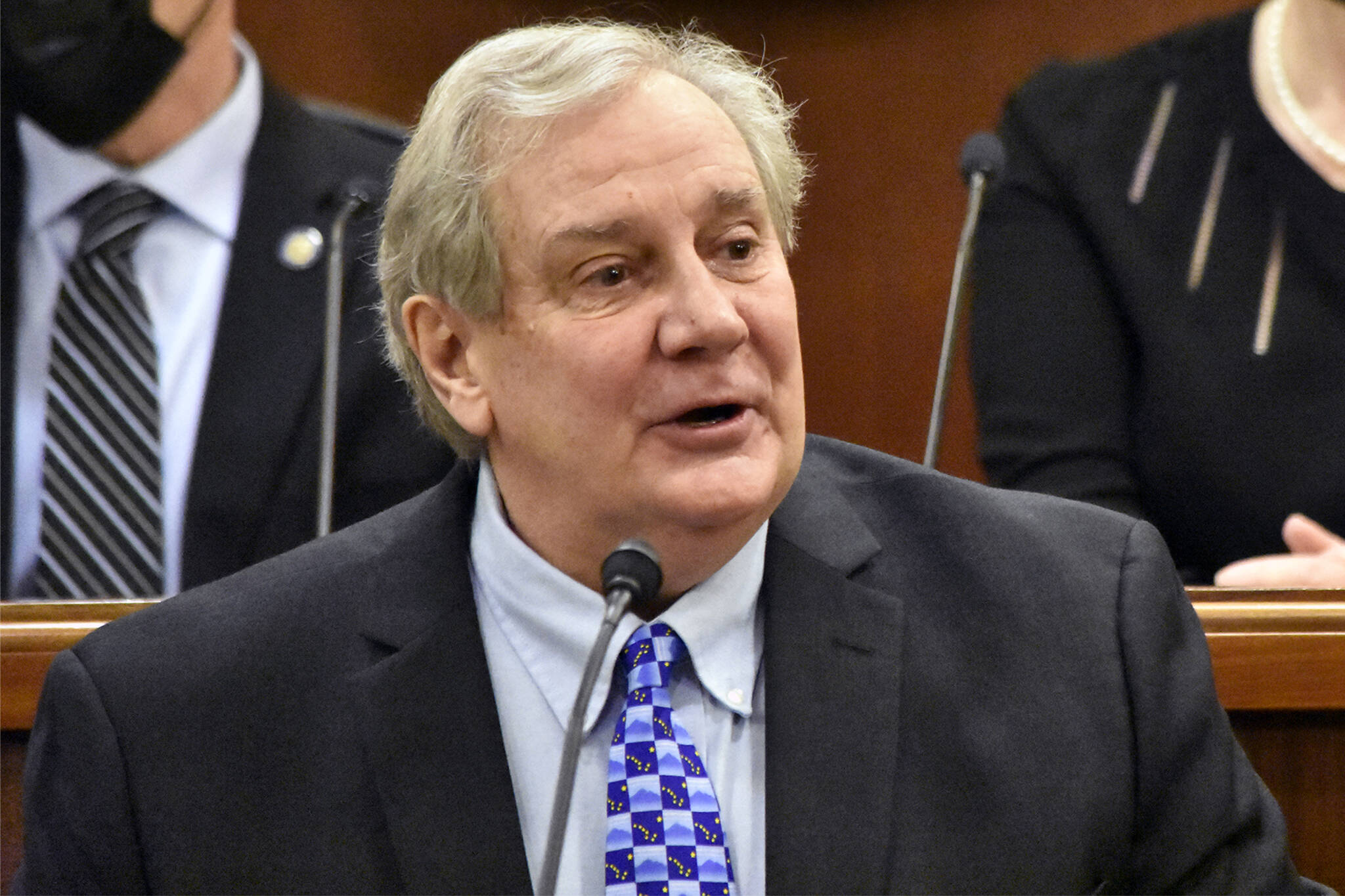
In his first —and potentially last —State of the Judiciary address to the Legislature, Chief Justice of the Alaska Supreme Court Daniel Winfree emphasized to lawmakers the importance of an independent judiciary.
“We must never, in the midst of the politics of the day, fail to respect and maintain the long-term institutional integrity of the state’s political branches,” Winfree said.
The address may be his last, Winfree told the body, as age requirements mean he must retire next February. Throughout his speech Winfree noted that politics change, but democracy relies on the rule of law.
“It’s a real strength that the branches of government have separate duties and separate methods for fulfilling them. But we have important common ground,” Winfree said. “All three branches strive for fair and predictable government, equitable law enforcement, and respectful resolution of disputes. These are the linchpins of a functional government.”
Winfree was appointed in July 2021, and he is the first chief justice to have been born in Alaska, which at the time was still a territory. Before becoming a lawyer he was a truck driver and construction worker on the Trans-Alaska Pipeline.
Winfree drew comparisons between the current political climate of tension and division in the country to when he was a teenager in the late 1960s and early 1970s, at time when the country was similarly divided.
[Crewing the cutters: Pandemic complicated recruiting, says Coast Guard]
“The federal Civil Rights Act was in its early years, but many remained vehemently and violently opposed. A civil rights icon was assassinated, and a few months later a presidential candidate was assassinated. There was the so-called War on Crime, seemingly focused on the poor and minorities and raising concerns about constitutional rights violations,” Winfree said.
He likened that era to today.
“Today. I acknowledge our country is undergoing a great deal of turmoil,” Winfree said. “Public divisions, focusing on national and state elections rather than wars overseas, are just as vehement. There is apprehension about lawlessness, but there are differing views on who the lawless might be. And people young and old are critical of the establishment about racial, economic, and environmental injustice.”
But the country’s foundational institutions remained, Winfree said, and stressed that he and other judges strove to decide cases based on the facts before the court, not on the political whims of the day.
Alaska’s judicial selection system has been criticized by some in the state who argue the process is too tightly controlled by the Alaska Bar Association. Currently, the governor is allowed to only appoint judges to the Supreme Court that have been approved by the Alaska Judicial Council, a seven-member body with three bar association-chosen attorneys and the chief justice.
Last year, Sen. Mike Shower, R-Wasilla, submitted a bill that would allow the governor to appoint magistrates and judges that haven’t been approved by the AJC. That bill has sat in the Senate Finance Committee since March 2021.
Winfree said the pandemic had forced the court system to scale back its operations and change how it interacts with the public. But he told lawmakers the court system had still upheld its duties. Courts shifted to remote hearings and other social distanced methods of conducting hearings. In 2021, Winfree said, judges held more than 327,000 court hearings in criminal cases, close to the number of cases heard before the pandemic in 2019.
Jury trials have been suspended off and on due to the various waves of COVID-19 strains, first the Delta and then Omicron variants, but jury trials resumed last month, according to Winfree.
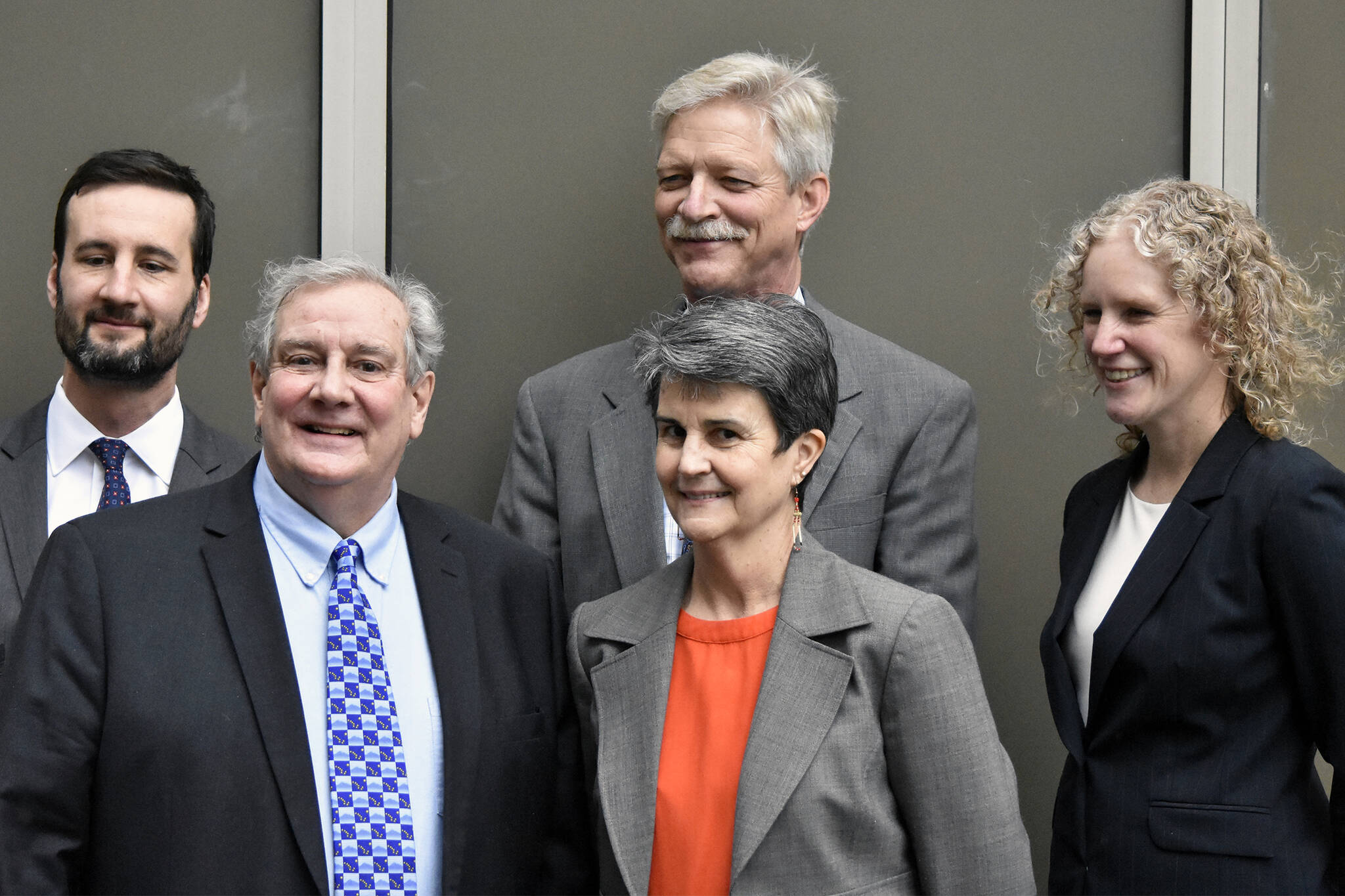
Justices of the Alaska Supreme Court gathered for a photo outside the Dimond Courthouse building in downtown Juneau on Wednesday, Feb. 9, 2022, following Chief Justice Daniel Winfree’s State of the Judiciary address to the Alaska State Legislature. From left to right: (Back row) Justices Dario Borghesan, Peter Maassen and Jennifer Henderson. (Front row) Chief Justice Daniel Winfree and Justice Susan Carney. (Peter Segall / Juneau Empire)
Winfree’s visit to the Legislature included requests for additional funding for the court system’s needs. The courts are requesting an additional $1.8 million in supplemental appropriations, Winfree told lawmakers, which was meant to help with the backlog of criminal cases. The courts were also requesting another $136,000 for therapeutic courts in Kenai, Palmer and Anchorage.
“Our courthouses need substantial technology upgrades, and we also plan to temporarily use some off-site spaces for trials needing more space than we have available in courtrooms,” Winfree said. “One upgrade example is purchasing an electronic evidence management system to display digital evidence during trial. Another is implementing livestreaming of nearly all court hearings and trials.”
Winfree made two additional budget requests, both for “a bit over $1 million.’”
The first was for securing the court’s computer networks, Winfree said. The state court system was the victim of a cyberattack last year, which Winfree said was quickly contained with minimal fiscal damage and no personal information being accessed. The second request was to reopen courts on Friday afternoons, which Winfree said have been closed for six years.
“Funding the added staff hours will mean that the public can return to conducting routine business at the courthouse on Friday afternoons and that case processing will move more rapidly and effectively,” Winfree said.
At several points in his speech, Winfree mentioned the fluctuations of political leaders, saying he had lived through governors and Legislatures controlled by various political parties and philosophical beliefs. But the courts striving for impartiality and independence had remained a central pillar of the state’s political system.
“Just as you take seriously your responsibility to talk to constituents, and perhaps even survey your district before you vote, we take just as seriously our duty to decide cases uninfluenced by our personal views,” Winfree said. “By views from the political left, center, or right, or by prevailing public sentiment. That’s what the rule of law is all about.”
• Contact reporter Peter Segall at psegall@juneauempire.com. Follow him on Twitter at @SegallJnuEmpire.
