
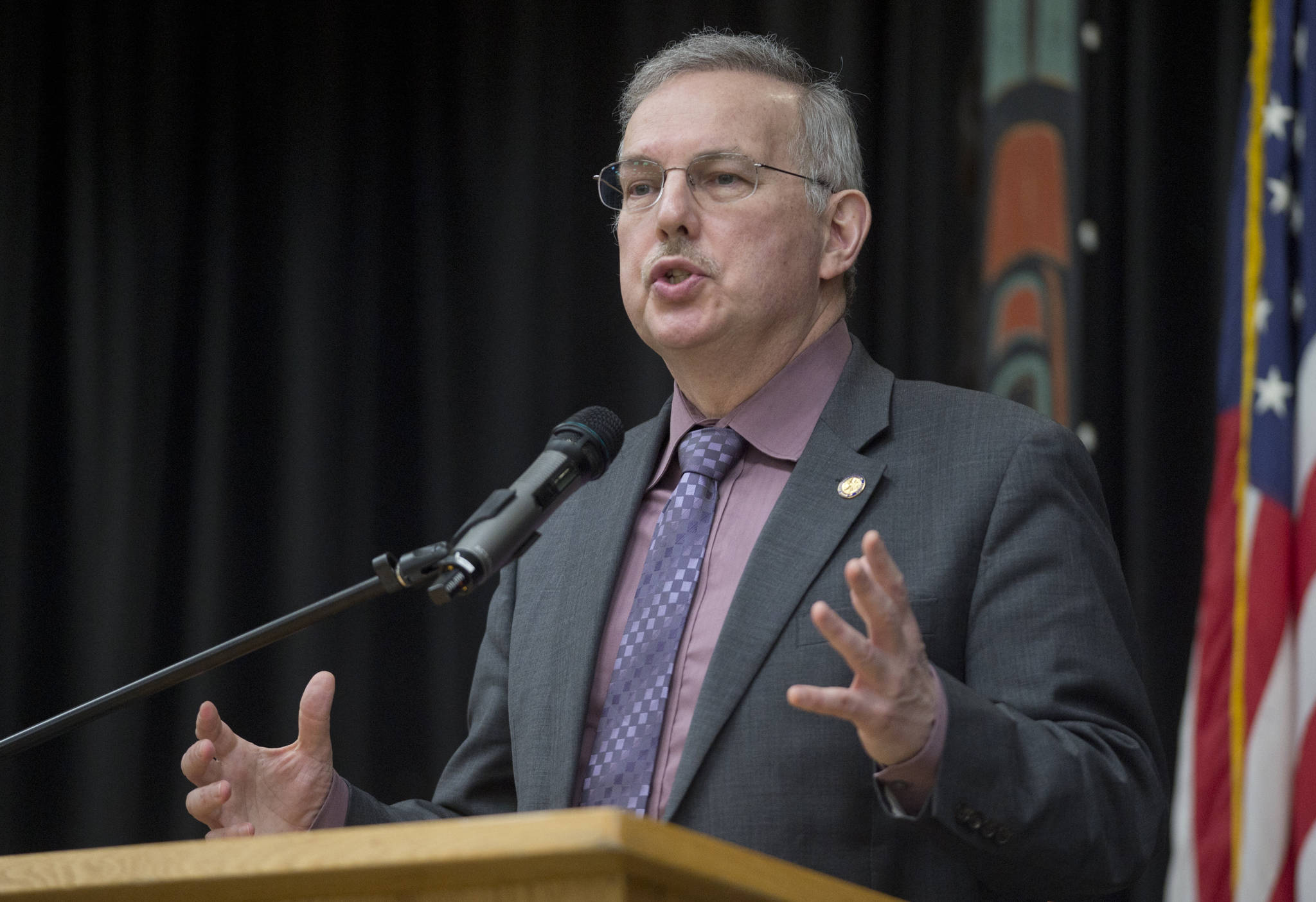
There aren’t many crowds in Alaska that will cheer for an income tax.
In a lunchtime address, the state’s first Alaska Native Speaker of the House, Rep. Bryce Edgmon, was loudly applauded at the weekly Tlingit and Haida Native Issues Forum.
Attendees weren’t applauding because of who he is, but because of what he had to say.
“I think we as Alaskans are awakening to the fact that it’s our future we’re talking about in the state, and we’re going to have to pay a little more to keep it the way we have it today,” he said.
Edgmon, leader of a coalition that includes Democrats, Republicans and independents, is urging passage of House Bill 115, a deficit-fighting measure that includes an income tax and spending from the earnings of the Permanent Fund.
“Let’s get ahead with conducting the business of the state,” he said, indicating his belief that the Legislature should pass HB 115 in order to get on with other important matters, such as stabilizing the Alaska Pioneer Homes and health care system.
That’s a popular message in Juneau, where 34 percent of all jobs are state or local government jobs funded by state revenue. Eliminating Alaska’s $2.8 billion deficit — a goal of HB 115 — would stabilize Juneau’s economy.
It’s popular through the rest of Southeast Alaska as well. Polling by the Alaska Chamber of Commerce in late February and early March found Southeast Alaskans support an income tax by a 51-49 margin. That was within the range of error, but far greater than any other region of the state.
During a question period that followed Edgmon’s prepared remarks, Juneau resident Paul Beran him a straightforward question: “Why is state income tax not seen as a reasonable means to raise money?”
Edgmon responded that different parts of the state see things almost in a split screen. Alaska has 741,000 residents, but there is a “churn” of almost 50,000 people leaving and entering the state per year.
“I see the middle part of the state that is a lot more transient than our smaller communities,” Edgmon said, referring to the people represented Thursday.
He said he feels Southeast Alaskans and rural Alaskans aren’t going to pack up and move. They’re willing to pay to keep what they have and stay where they are.
While the crowd Thursday clearly agreed with HB 115, not everyone else does. On Wednesday night, the House Finance Committee heard public testimony on HB 115. That testimony, which came from all corners of the state, was 7:5 against the bill.
Edgmon told his audience that if they talk to “a legislator from the Mat-Su,” they will be told that cuts are the answer to the state’s deficit. He added that he frequently hears from others who say that “we in the smaller communities, in the villages, in many people’s minds across the state, we’re on the government dole. … Boy, that makes me angry.”
He added, speaking directly to Beran, that the answer to his question won’t come with HB 115 alone.
“Your question is the question of the moment and the question we’re going to hotly debate until this session comes to a close,” Edgmon said, “and probably for years after.”
• Contact reporter James Brooks at james.k.brooks@juneauempire.com and call 419-7732.
