
Eliminating the four-year degree requirement for most state jobs was ordered Tuesday by Gov. Mike Dunleavy, who says it will help remedy a severe workforce shortage. But which specific jobs and how many of them will actually have new hiring requirements is unknown, and legislative and union leaders called it a small step that doesn’t address the core problem of poor wages, benefits and morale among state employees.
The administrative order by Dunleavy resembles similar actions in Pennsylvania and Maryland during the past eight months, in addition to numerous private employers nationwide dropping four-year degree requirements due to the widespread shortage of workers in the wake of the COVID-19 pandemic.
“At present, there are not enough qualified applicants to fill all the state’s job vacancies,” Dunleavy’s order states. “This unprecedented demand for labor throughout the State of Alaska requires the government to be flexible in recruiting, hiring, and retaining a talented and able workforce.”
There were 418 Alaska state government vacancies listed Tuesday afternoon in the database at governmentjobs.com. Many of the listings ranging from accountants to election clerks to community care licensing specialists already use phrases such as “any combination of education and/or experience” in listing qualifications.
The order requires the state Department of Administration to identify which state jobs currently require a four-year degree, review when practical experience is an appropriate substitute and present proposed amendments of relevant hiring rules to the state’s Personnel Board. Inquiries to the governor’s office and Department of Administration about the number of jobs potentially affected and the length of the review process were not immediately answered.
Mixed reactions to the order were expressed by leaders of the state Senate’s bipartisan majority during a press conference Tuesday. Sen. Bill Wielechowski, an Anchorage Democrat, said that while the workforce shortage is among the majority’s top issues of the legislative session, the governor’s approach doesn’t address the magnitude of the problem.
“It may help around the edges, but fundamentally I think you have to look at what is the root cause of not being able to hire state employees, and the fact is we’re not competitive with other states and places around the country in our wages and benefits,” Wielechowski said.
Numerous bills restoring pensions and otherwise benefiting state employees have been introduced this session, with a primary concern among many of their sponsors being employees who leave after a few years for other state and/or employers offering more enticing terms.
“It’s certainly not going to help the fact that we don’t have public defenders in Nome, and they’re no longer hearing felony cases,” Wielechowski said about Dunleavy’s order, referring to a crisis in recent weeks affecting Nome and Bethel. “It’s not going to help the problem with the lack of teachers, because teachers need to have a four-year degree.”
Eliminating degree requirements may help in critical areas such as the Division of Public Assistance, which is suffering months-long backlog in processing food stamp and Medicaid applications, said state Sen. Cathy Giessel, an Anchorage Republican. Agency leaders have stated a lack of people qualified to program and operate outdated technology is a large reason for the backlog, which Giessel said is an area where people with practical experience on such systems can outweigh the value of a degree.
“Not every job in government requires a college degree,” she said. “A very diligent person can do that work.”
However, when asked about a state such as Pennsylvania that might eliminate the degree requirement for more than 90% of its state employees, Giessel said the same percentage may not be applicable in Alaska due to the high number of natural resource jobs such as scientific researchers.
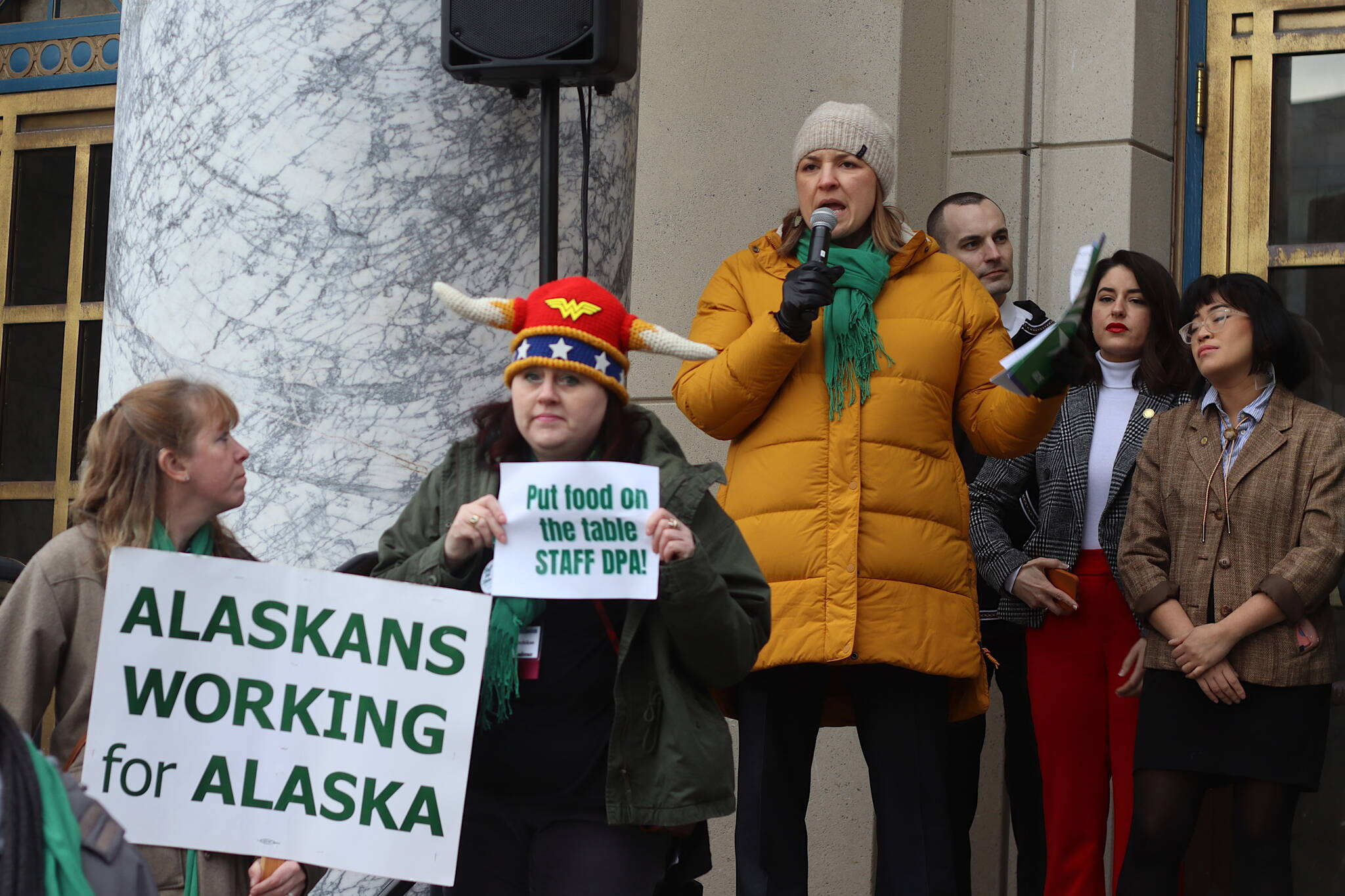
Similarly qualified support for Dunleavy’s order was expressed by Heidi Drygas, executive director of the Alaska State Employees Association, which represents about 8,000 of the state’s 14,000 public employees. She said the order “has some appropriate sidebars” in guiding the administration department through its evaluation process and it’s a “commonsense response to the challenges we are all facing.”
But, like Wielechowski, she also doesn’t see it as the answer to the primary issues involved.
“There’s a bunch of different levels we can pull,” she said. “Some are going to be bigger than others. This is a small lever.”
Drygas, who said she wasn’t asked about or notified of the order before it was announced publicly, said she hopes the ASEA and other union entities will be involved with any discussions about changes to hiring for specific positions once they are proposed. She also doesn’t want the removal of the degree requirement to add to the problems of low wages and benefits.
“I would want to make sure when we remove some of these degree requirements there is not likewise a reduction in wages or a reduction in classification,” she said.
• Contact Mark Sabbatini at mark.sabbatini@juneauempire.com
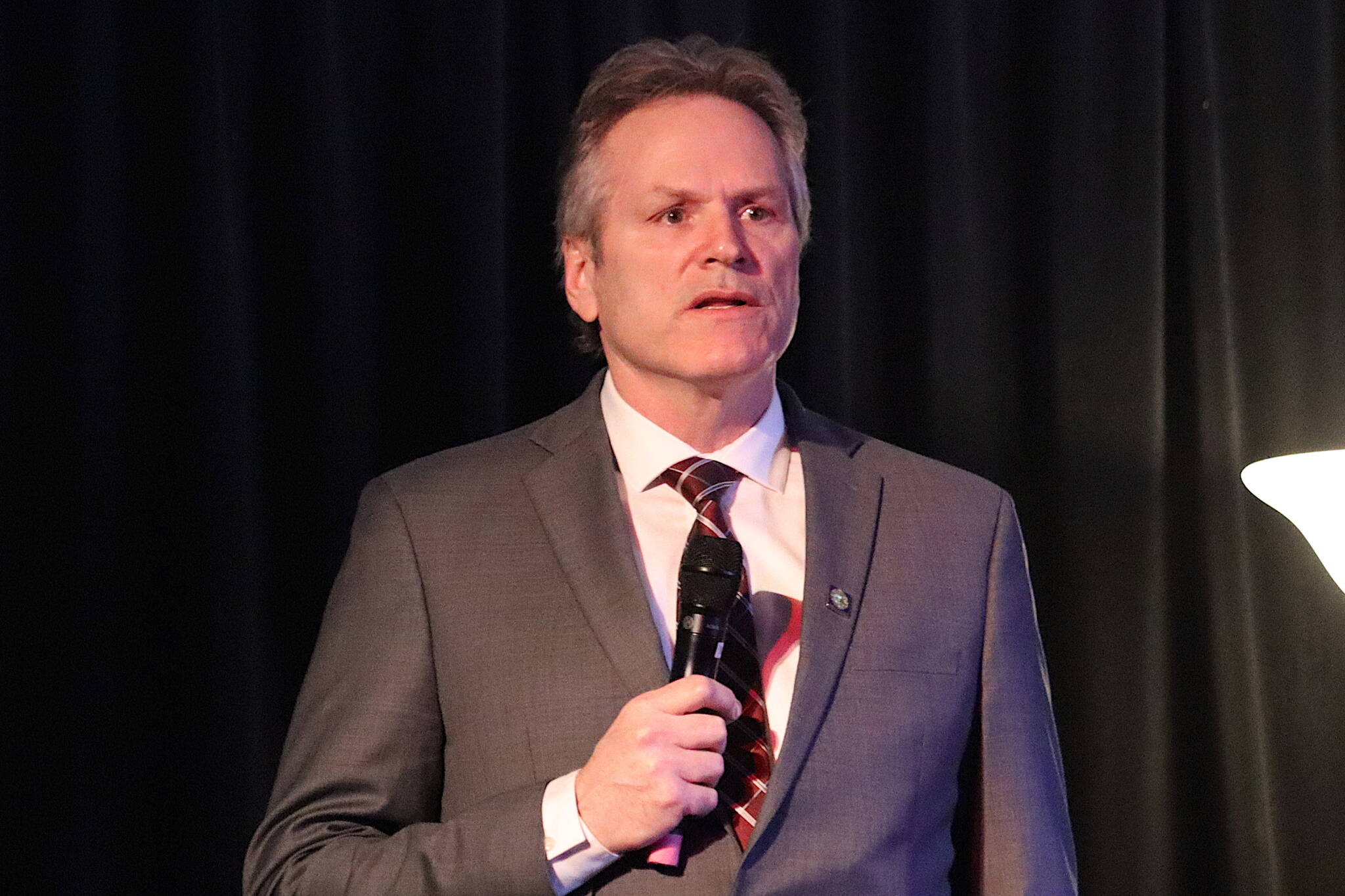
Gov. Mike Dunleavy addresses supporters and state lawmakers at an inaugural event in Juneau on Jan. 20. The governor on Tuesday issued an administrative order that eliminates the four-year college degree requirement for most state jobs, although the specific positions are yet to be determined. (Mark Sabbatini / Juneau Empire)
