
10:55 a.m.
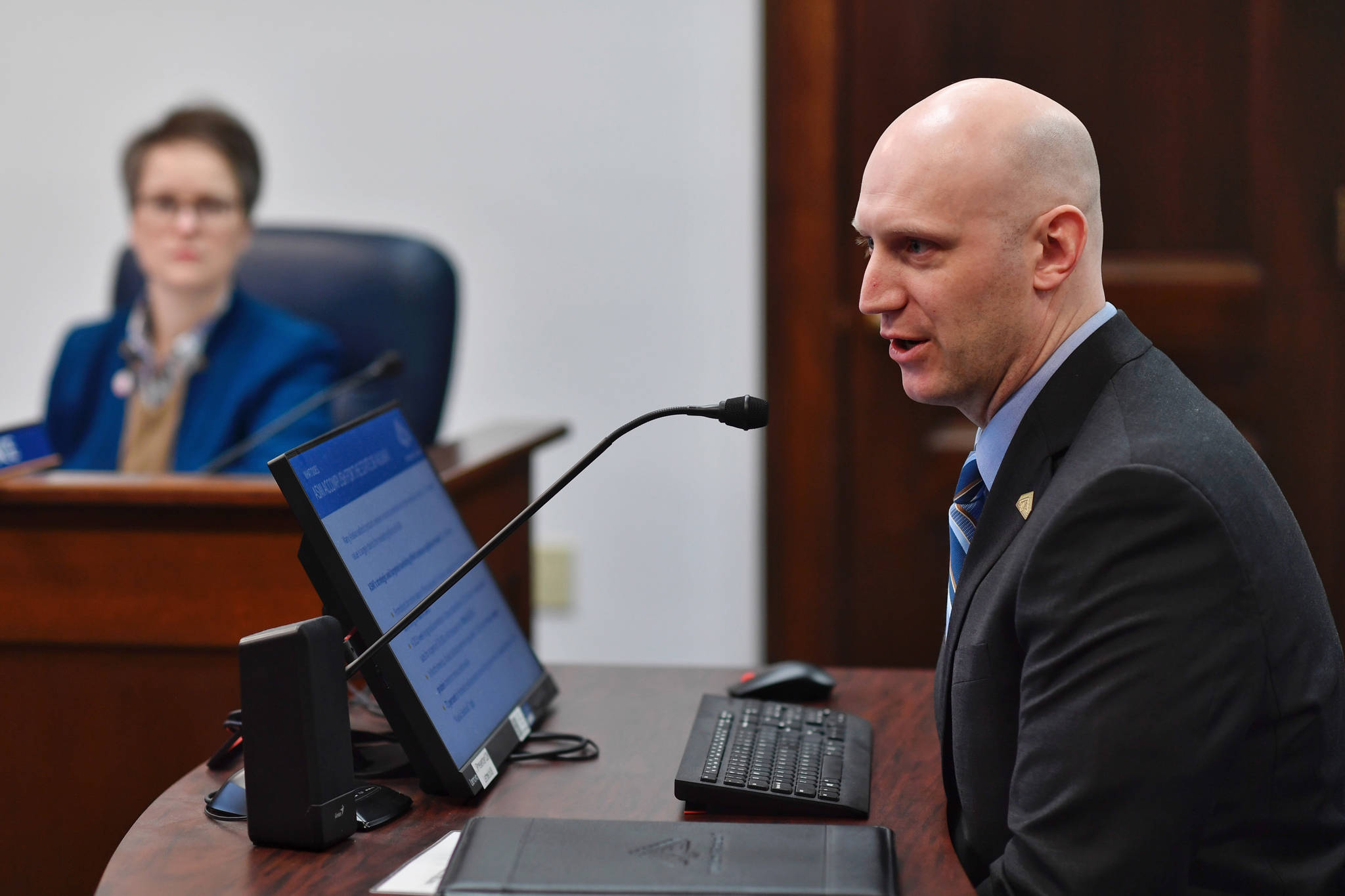
Rep. Lance Pruitt, R-Anchorage, says he would hate to see the Alaska Seafood Marketing Institute experience the same fate as the state, as ASMI continues to use its savings to fund its operations.
ASMI Interim Executive Director Jeremy Woodrow says ASMI brings in about $13 – $13.5 million a year between federal and industry funding, but ASMI spends more than that to market Alaska seafood each year.
“We can’t continue to spend at the same pace,” Woodrow said.
— Kevin Baird
10:45 a.m.
Fun facts are abundant as the Alaska Seafood Marketing Institute’s Jeremy Woodrow, ASMI’s interim executive director, delivers a presentation to the House Special Committee on Fisheries.
Here’s a quick sampling of Alaska seafood facts.
• Alaskans don’t buy much Alaska seafood because they catch their own. Ukraine is an emerging market with a promising future.
• Although crab only makes up about 1 percent of the total harvest volume, crab makes up about 12 percent of Alaska seafood value after it leaves the ship.
• The fishing industry is the largest private sector employer with 60,000 workers annually.
— Kevin Baird
10:26 a.m.
A slide from a budget presentation to to the Senate Finance Committee at the Capitol on Tuesday, Feb. 26, 2019.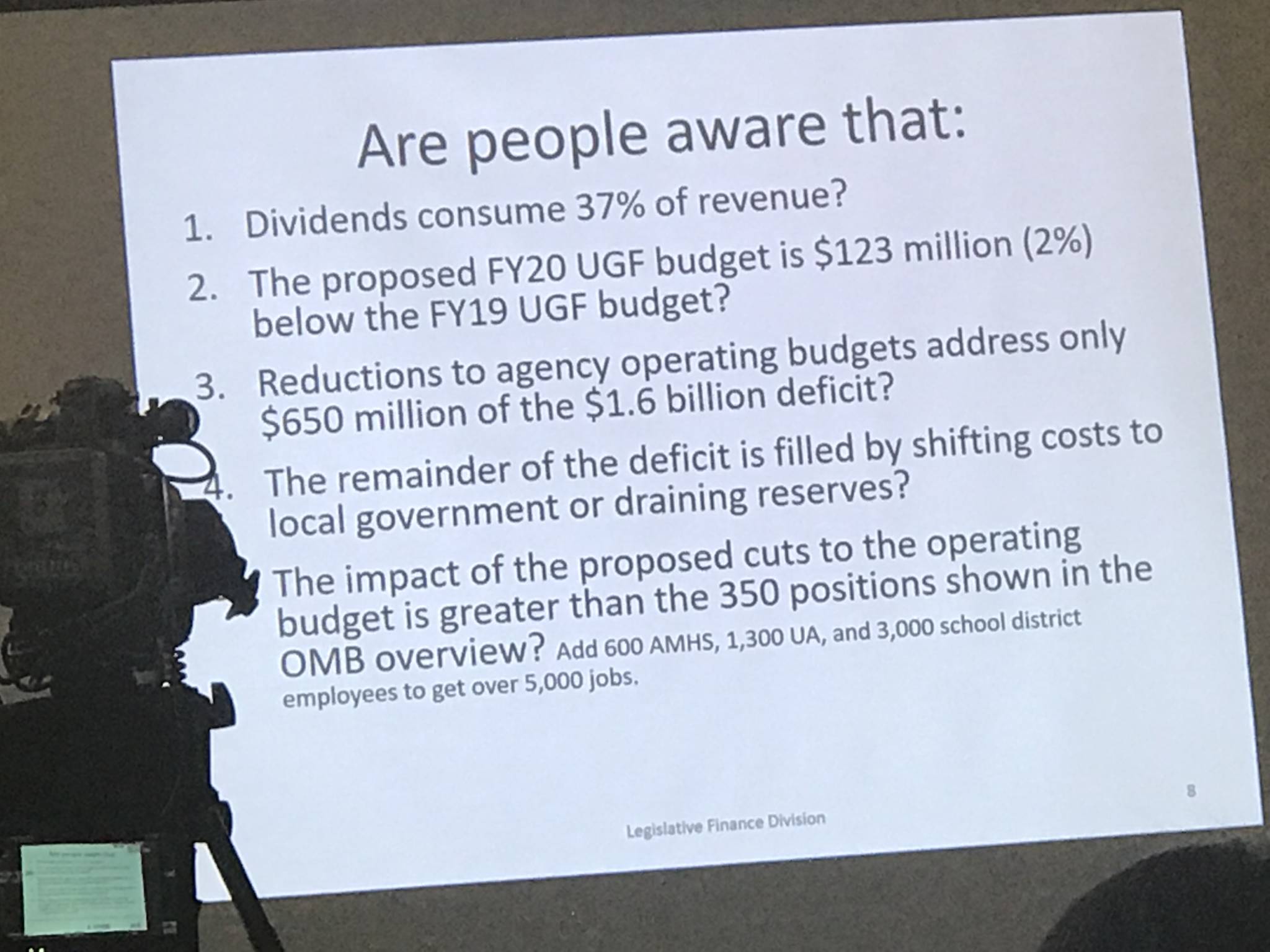
Teal is saying that Alaska is really looking at losing about 5,000 jobs, not the roughly 700 number that OMB originally gave the day of the budget release.
“I consider government to be state, local and school districts, because schools are funding by the government,” Teal says. “You’re looking at significant job loss. And I don’t know when the economists are coming, but it will be interesting.”
Teal listed some initial questions in the slide above.
“I would say that we still have a fairly weak understanding on where the budget intends to take the state and whether the budget proposals will be able to stand up to scrutiny.”
— Mollie Barnes
10:14 a.m.
“Maybe creating chaos is just a clever way to force a conversation that needs to happen to move forward,” says Teal. “Maybe people are going to see these budget reductions that are required to pay a $3,000 dividend, and they’re going to come in and plead to reduce the dividend to avoid the consequences of the budget cuts.”
— Mollie Barnes
9:56 a.m.
“You may ask whether the remainder of the budget proposal was consistent with the governor’s principles,” Teal says.
He says there’s a $520 million shift from state governments through proposed petroleum property tax, shared taxes, school debt reimbursement and debt service.
— Mollie Barnes
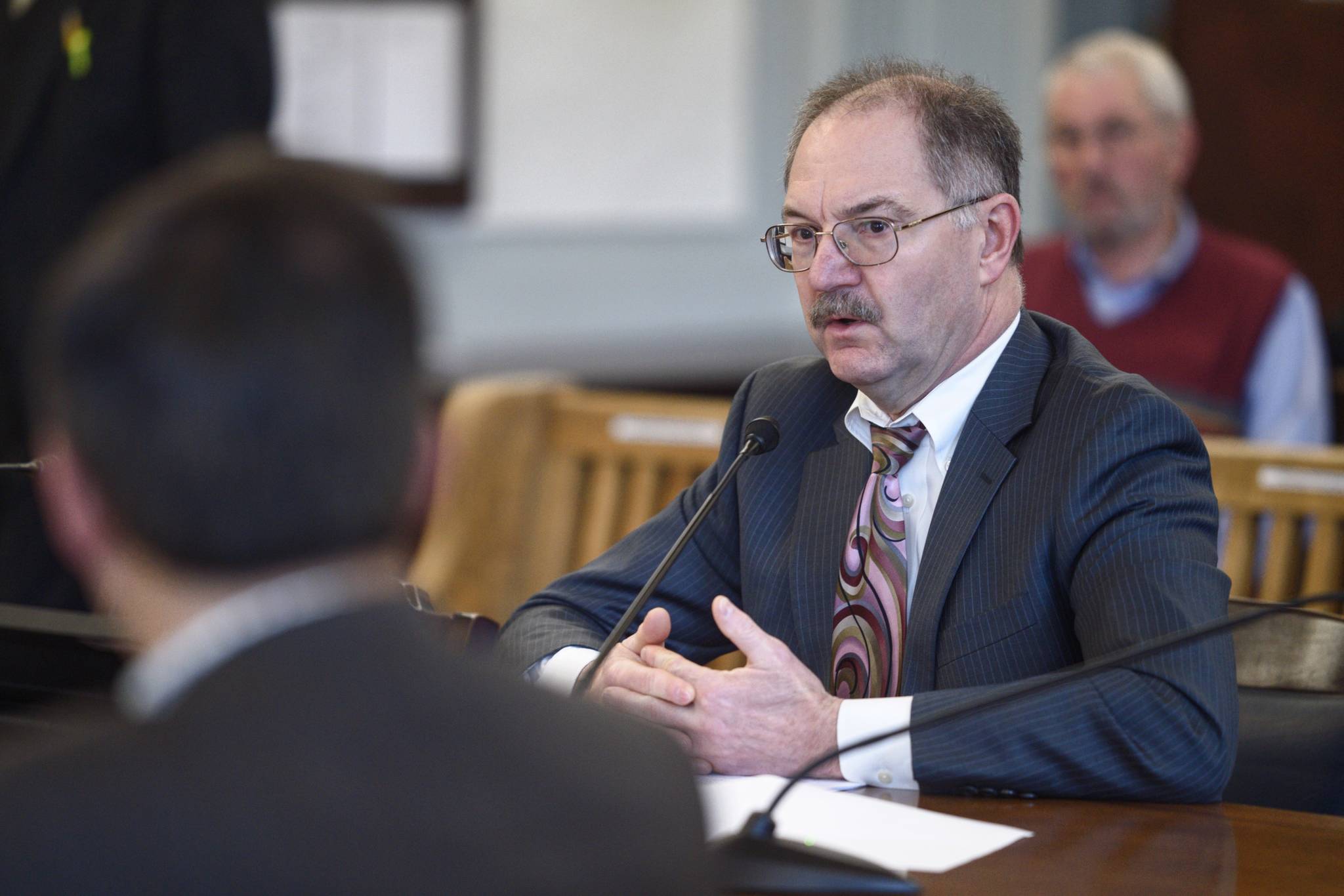
David Teal, Director of the Legislative Finance Division, gives his analysis of Gov. Mike Dunleavy’s state budget to the Senate Finance Committee at the Capitol on Tuesday, Feb. 26, 2019. (Michael Penn | Juneau Empire)
9:40 a.m.
Now they’re talking about the proposed ferry system cuts.
“The ferry system has stopped taking reservations after Sep. 30,” says Sen. Bill Wielechowski, D-Anchorage. “Can the governor just do that on his own? We’re the appropriating body,” he says, noting they haven’t passed any legislation to stop funding the ferries.
Teal says whether or not Gov. Mike Dunleavy can, he did.
— Mollie Barnes
9:34 a.m.
The committee has clarified the governor has until June 30 to distribute the $20 million legally. At that point, if the money is not sent to school districts, he would be breaking the law, unless the legislature approves redacting that $20 million and appropriates the money elsewhere.
— Mollie Barnes
9:30 a.m.
Committee members ask if the governor is required to spend all the money appropriated to departments by the legislature.
“The governor doesn’t have to spend all the money,” Teal says. “For example, the Village Public Safety Officer program.”
Teal says the VPSO program says they received the grants and weren’t able to use them all, so this would be an instance when the governor did not have to spend all the money that was appropriated by the legislature for this purpose.
— Mollie Barnes
9:24 a.m.
Now they’re discussing the FY19 supplemental budgets, specifically the $20 million for K-12 education that was supposed to go out in January to school districts, and the $30 million for next year.
Teal says there was no ‘trigger’ for the money to go out, the reason it hasn’t gone out is a policy flaw, and the governor is waiting for the legislature to take some action on the proposed supplemental budget.
“I think the expectation (from school districts) was that it would go out along with formula money,” he says. “I don’t know exactly what happened, but for some reason the administration withheld the $20 million…I guess you could argue that is fine, but the money has to go out before June 30. But I don’t know why you would withhold it until June 30.”
— Mollie Barnes
9:15 a.m.
“We think Permanent Fund Dividends should be treated as a revenue item,” he says.
He says the public deserves to be aware of all revenue sources, and the PFD is one revenue source for the state.
“Despite campaign statements that $200 million or more could be cut with no impact, I believe that cutting $200 million from agency operations would be a big stretch,” Teal says. “The governor exceeded my expectations, he cut $260 million, which is far more than I expected, but it’s also far less than $1.6 billion.”
— Mollie Barnes
9:10 a.m.
“It seems many of you share my disappointment in the lack of analysis done to support the government’s proposals. I think budget shouldn’t simply be a math problem…you cannot make good policy or budget decisions without full information. All cuts are not equal,” Teal says, noting that the OMB has justified many of the cuts by stating it is a necessary cut to fix the deficit.
He says much of the balancing of the budget comes by shifting the burden to municipalities.
“If revenue is volatile, how will the budget be more predictable than oil prices themselves?” Teal asks. “Are we going to cut the budget every time revenue from oil falls? I don’t see how saying expenditures equal revenue makes the budget any more predictable. It seems to me the governor took two of the three normal budget balancing tools off the table.” Those two things being adding revenue or to pull more money from reserves, according to his presentation.
— Mollie Barnes
9:05 a.m.
“I’ve never seen a budget roll out quite like this one,” says David Teal. “When I say the roll out’s different what I mean there is the Senate Finance committee has spent more time in much more detail than I can ever recall.”
He says it will be beneficial to take a step back and look at the policies and principles that drive the governor’s budget proposals.
The governor’s Office of Budget and Management has laid out five principles that the governor says drove the budget decisions. Those are:
- expenditures cannot exceed existing revenue;
- the budget is built on core functions that impact a majority of Alaskans;
- maintaining and protecting our reserves;
- the budget does not take additional funds from Alaskans through taxes or the PFD;
- it must be sustainable, predictable and affordable.
— Mollie Barnes
8:55 a.m.
The legislature is gearing up for round two of the overview of the governor’s budget. Senate and House finance committees both have presentations by David Teal, the director of the Legislative Finance Division today. The governor will also be meeting with reporters later this morning to answer questions. Let us know in the comments, on Facebook or on Twitter @JuneauEmpire if you have questions you think we should be asking.
— Mollie Barnes
