
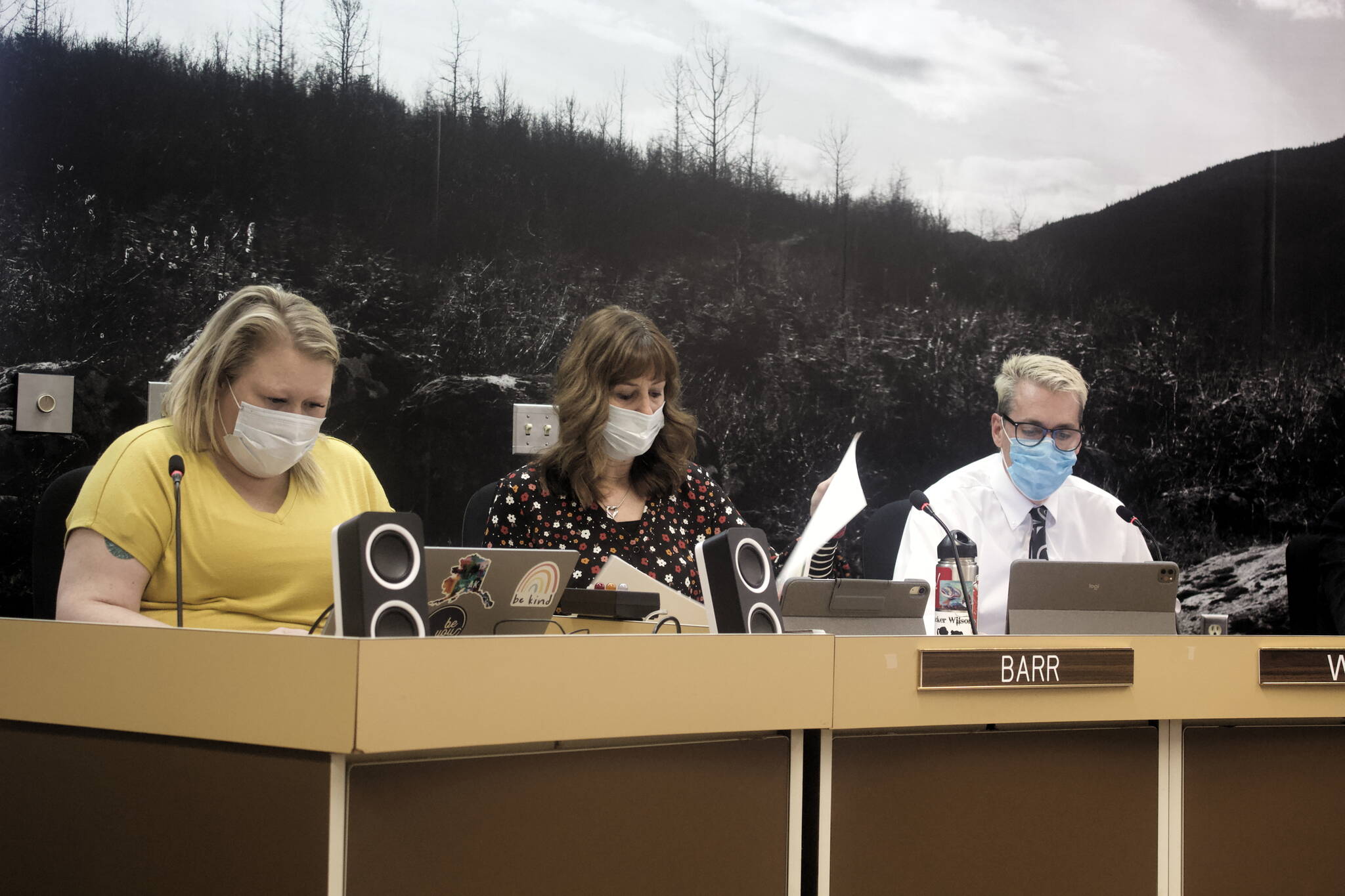
The next step in figuring out next year’s city budget included discussing actual steps, with “Band-Aid” patches instead of proper repairs to downtown’s many decaying outdoor staircases illustrating the real and metaphorical struggles facing officials reviewing spending plans for schools and capital improvement projects Wednesday night.
“I know stairs are problematic because downtown moves around and so do the stairs,” Assembly member Michelle Hale said during the second of seven scheduled weekly meetings by the assembly’s Finance Committee to review and finalize the budget. “Is there a mechanism for the public to say ‘Hey, I live downtown and these stairs are dangerous?’”
The problem is while the public can contact the public works department and its employees routinely inspect stairs, an attempt to hire a contractor this spring received no bids due to lack of availability, John Bohan, chief engineer of the city’s capital improvement program, told the committee. As a result “we’re in a catch-22 situation. We’re trying to move forward to address that problem as well as address small needs.
“We’re going to be doing Band-Aid repairs as opposed to full rebuilds, which is what most of those stairs require.”
Insufficient funding for everything desired — admittedly a constant of government budgeting — along with problems related to COVID-19 including personnel/supply shortages and high inflation are among the complications facing policymakers even though a rosier overall economy is expected as the pandemic wanes.
That led to the wish-vs.-reality discussions about the stairs, extracurricular student programs, increasing parking in recreation areas and plenty of other line items during Wednesday’s meeting.
The Juneau School District, for example, is breaking from custom by spending some of its one-time federal and other funding normally intended for facility improvements on “people-dependent” upgrades, said Superintendent Bridget Weiss. Those include keeping class sizes as small as possible and compensating for services lost when in-person learning was canceled during the pandemic.
“We look at high school students and say ‘They really have missed a lot of counseling time,’” she said, noting an adviser is added for that purpose in the proposed budget. Similar boosts are sought for the high school recovery and summer school programs “to make sure they have what they need when they leave us.”
The district is also planning an evaluate-and-adjust approach to the RALLY before-and-after school care program, which was trimmed from six sites to four during the past year to reduce debt incurred due to pandemic-caused vacancies, Weiss said. Similarly, efficiencies are being sought in the school transportation budget by combining bus routes and other measures.
“Every year that changes just a little bit,” she said. “Our plan is not to turn it over upside-down.”
Big numbers
There’s two big numbers to keep in mind for the district’s budget next year. The first is $86.7 million in total proposed spending for the district, a decrease of $5.7 million (6.2%) from this year, according to the city’s finance department.
“This decrease primarily reflects one-time expenditures in FY22 associated with the Elementary and Secondary School Emergency Relief Fund grant to address the impacts of the COVID-19 pandemic on students, as well as a reduction to the Public Employees’ and Teacher retirement systems on-behalf contributions,” a summary published by the department notes.
The second big number is, within that spending, the school district is proposing an operating budget next year of nearly $62.7 million, about $908,000 more than the current year.
The district’s request projects there will be 1.1% less in state funding and is therefore requesting 4.6% more in city funding, which to some extent is due to a higher required local contribution due to higher assessed property values. It’s also a complication related to decreased enrollment during the pandemic, which state funding is largely based on, creating what Weiss calls an odd situation since there is an expected — but not certain — enrollment increase next year.
“Projecting next year’s enrollment is fraught with many uncertainties,” Weiss states in a letter to the committee summarizing the budget. “The district is projecting an enrollment of 4,313 students next year, with an increase of 79 students over the current year.”
The district also estimates 180 students will continue in the HomeBridge correspondence program and 94 students will receive intensive special education services.
Among the other budget projections:
— Per-student spending of $101 for pre-school/elementary, $127 for middle school and $132 for high school.
— Student/teacher ratios of 23.5-to-1 for kindergarten through third grade, 28-t0-1 for fourth and fifth grade, 25-to-1 for sixth through eighth grades and 26-to-1 for ninth through twelfth grade.
— Average teacher cost of $108,000 (including substitutes), average special education paraeducator cost of $65,500, fuel costs of $3.15 a gallon (with 254,000 gallons purchased) and electricity rates remaining at an average of 12 cents per kilowatt hour.
— Retaining a surplus fund balance of about $622,000 after it was zeroed out during the pandemic, which Weiss said “is not really a great practice to do that long term.”
Capital suggestions
The district’s presentation was followed by a review of the capital improvement projects budget, which at $36.5 million for next fiscal year is a decrease of $32.3 million (47%) from the current year.
“This decrease is a result of significant supplemental appropriations made in FY22 to the capital budget, as well as (Bartlett Regional Hospital) issuing $20 million in revenue bonds for which the proceeds were fully appropriated to capital projects,” the finance department’s summary states.
Put simply, next year’s proposed budget “is mostly maintenance,” Katie Koester, the city’s director of engineering and public works, told the finance committee.
“Mostly taking care of old buildings, old stairs, sidewalks and systems,” she said. “That is the nature of running an organization with all those facility needs.”
A new requirement for city departments this year is sustainability be considered for all proposed projects, which is a factor in repairing existing facilities since “anytime you fix an old roof or anything you’re improving the energy efficiency of the building,” Koester said.
The capital improvements budget includes $22.7 million in sales tax-funded projects including parks and other recreational maintenance, street repairs, and utility maintenance. Of that $1.3 million is for green and sustainability projects, including electric chargers for city buses and upgrading street lighting with LED fixtures.
While the public works department has a long list of projects prioritized on a six-year plan, many are omitted including improvements to docks and harbors, and adding parking spaces at sites such as the Hank Harman Rifle Range in response to insufficient capacity, Koester said.
In addition to the weekly finance committee meetings, an assembly meeting is scheduled at 7 p.m. April 25 for the public to comment on the overall operating budget, school district’s operating budget, capital improvement plan and proposed 0.1 percent increase in the property tax mill levy rate.
• Contact Mark Sabbatini at Mark.Sabbatini@juneauempire.com.
