
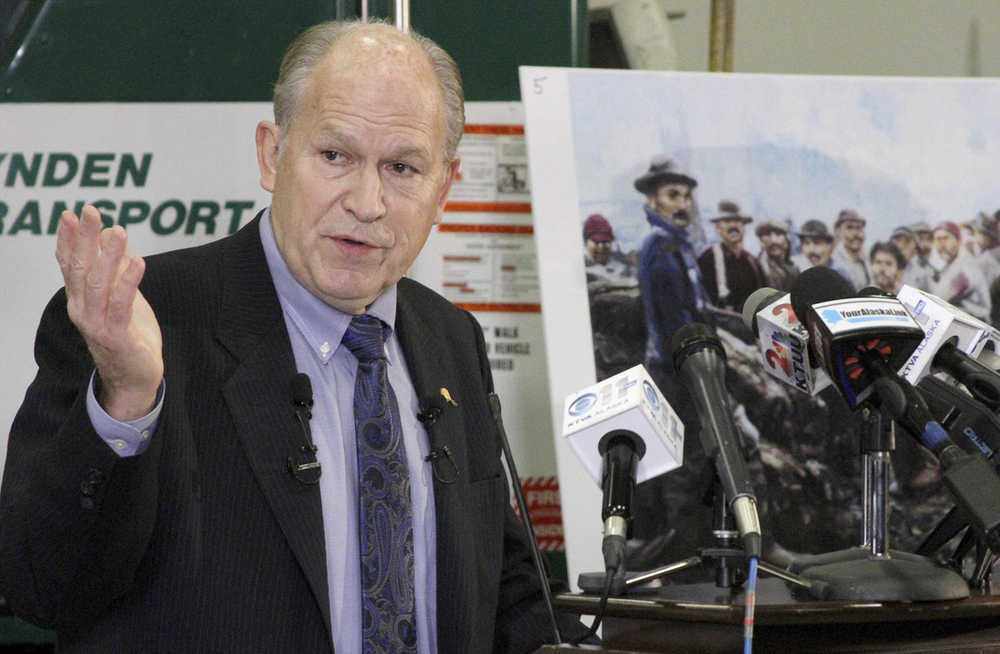
In this Dec. 9, 2015 photo, Alaska Gov. Bill Walker speaks at a news conference about his plan for the state budget in Anchorage, Alaska. Walker has proposed sweeping changes to help reduce the state's billion budget deficit, including instituting a state income tax for the first time in 35 years. (AP Photo/Mark Thiessen)

In this Dec. 9, 2015 photo, Alaska Gov. Bill Walker speaks at a news conference about his plan for the state budget in Anchorage, Alaska. Walker has proposed sweeping changes to help reduce the state's billion budget deficit, including instituting a state income tax for the first time in 35 years. (AP Photo/Mark Thiessen)

Budget plan shows deficit for 2016

JUNEAU — Budget details released by Gov. Bill Walker’s office show a deficit of about $427 million next year, a drastic change from the half-billion dollar surplus projected when he announced his budget plans last week.

The fiscal summary released last week mistakenly showed oil production tax revenue and royalties going into the general fund, where it showed up as revenue the state had available to spend, Walker budget director Pat Pitney said. Instead, that money will go into the earnings reserve account of the Alaska Permanent Fund under Walker’s plan, she said. A summary released late Tuesday afternoon reflected that change.

“We’re making so many changes to the normal course of business in developing this plan,” Pitney said. The shift in where the oil money is deposited is one of them, and Pitney said she didn’t catch it right away.

Alaska faces an estimated $3.5 billion budget deficit amid chronically low oil prices, and Walker’s plan to fill that gap is complicated. It involves draws from savings for a transitional fund for oil and gas tax credits and beefing up the earnings reserve account.

The administration is proposing a $1.2 billion transitional fund as Walker seeks to turn the tax-credit system into a loan program. His office has said the state will honor existing commitments for credits.

The administration also is proposing putting oil tax revenue and half of mineral royalties into the permanent fund and using money generated from the fund to provide an estimated $3.2 billion annually to help finance state government. The earnings reserve would need to be fattened with a $3 billion transfer from savings to provide a starting balance the administration sees as needed for a sustainable draw.

Walker’s plan — which also includes an income tax and increases in other taxes — is far from a done deal, with Republican legislative leaders seeking deeper budget cuts than Walker is proposing and some Democrats saying they’re concerned about the effect on working-class Alaskans.

The administration is proposing moving money from the constitutional budget reserve, which generally requires a three-quarter vote of each the House and Senate to tap, to the easier-to-access statutory budget reserve, which is currently depleted. Support from minority Democrats was needed earlier this year in the House to reach the three-quarter threshold to use money from the constitutional budget reserve to help balance the budget. There was a drawn-out fight that took two special sessions to resolve.

Going forward, Pitney said the administration hopes to draw about $135 million from earnings on savings outside the earnings reserve account that could be put toward the budget. If the money is going to be used that way, the administration doesn’t want it to be subject to a three-quarter vote every year, she said. Having the money in the statutory budget reserve “avoids an extraordinary action every year for what is now our ordinary way of doing business,” Pitney said.

The target for a balanced budget under Walker’s plan is fiscal year 2019, which begins July 1, 2018.

More in News

A residence stands on Tuesday, Dec. 23 after a fatal house fire burned on Saturday, Dec. 20. (Mari Kanagy / Juneau Empire)
2 house fires burn in 3 days at Switzer Village

Causes of the fires are still under investigation.

A house on Telephone Hill stands on Dec. 22, 2025. (Mari Kanagy / Juneau Empire)
Court sets eviction date for Telephone Hill residents as demolition plans move forward

A lawsuit against the city seeks to reverse evictions and halt demolition is still pending.

A Douglas street is blanketed in snow on Dec. 6, 2025. (Mari Kanagy / Juneau Empire)
Precipitation is forecast later this week. Will it be rain or snow?

Two storm systems are expected to move through Juneau toward the end of the week.

Juneauites warm their hands and toast marshmallows around the fire at the “Light the Night" event on winter solstice, on Dec. 21, 2025. (Mari Kanagy / Juneau Empire)
A mile of lights marked Juneau’s darkest day

Two ski teams hosted a luminous winter solstice celebration at Mendenhall Loop.

A Capital City Fire/Rescue truck drives in the Mendenhall Valley in 2023. (Clarise Larson / Juneau Empire file photo)
Juneau man found dead following residential fire

The cause of the fire is still under investigation.

CBJ sign reads “Woodstove burn ban in effect.” (City and Borough of Juneau photo)
Update: CBJ cancels air quality emergency in Mendenhall Valley Sunday morning

The poor air quality was caused by an air inversion, trapping pollutants at lower elevations.

A dusting of snow covers the Ptarmigan chairlift at Eaglecrest Ski Area in December 2024. (Eaglecrest Ski Area photo)
Update: Waterline break forces closure at Eaglecrest Friday, Saturday

The break is the latest hurdle in a challenging opening for Juneau’s city-run ski area this season.

Patrick Sullivan stands by an acid seep on July 15,2023. Sullivan is part of a team of scientists who tested water quality in Kobuk Valley National Park’s Salmon River and its tributaries, where permafrost thaw has caused acid rock drainage. The process is releasing metals that have turned the waters a rusty color. A chapter in the 2025 Arctic Report Card described “rusting rivers” phenomenon. (Photo by Roman Dial/Alaska Pacific University)
Ecosystem shifts, glacial flooding and ‘rusting rivers’ among Alaska impacts in Arctic report

NOAA’s 2025 report comes despite Trump administration cuts to climate science research and projects

The U.S. Capitol in Washington, D.C., on Oct. 1, 2025. (Photo by Jennifer Shutt/States Newsroom)
Moderate US House Republicans join Dems to force vote on extension of health care subsidies

WASHINGTON — Republican leaders in the U.S. House will face a floor… Continue reading

Most Read