
This article has been updated to provide clarification on which members of the Alaska Judicial Council are appointed by elected officials.
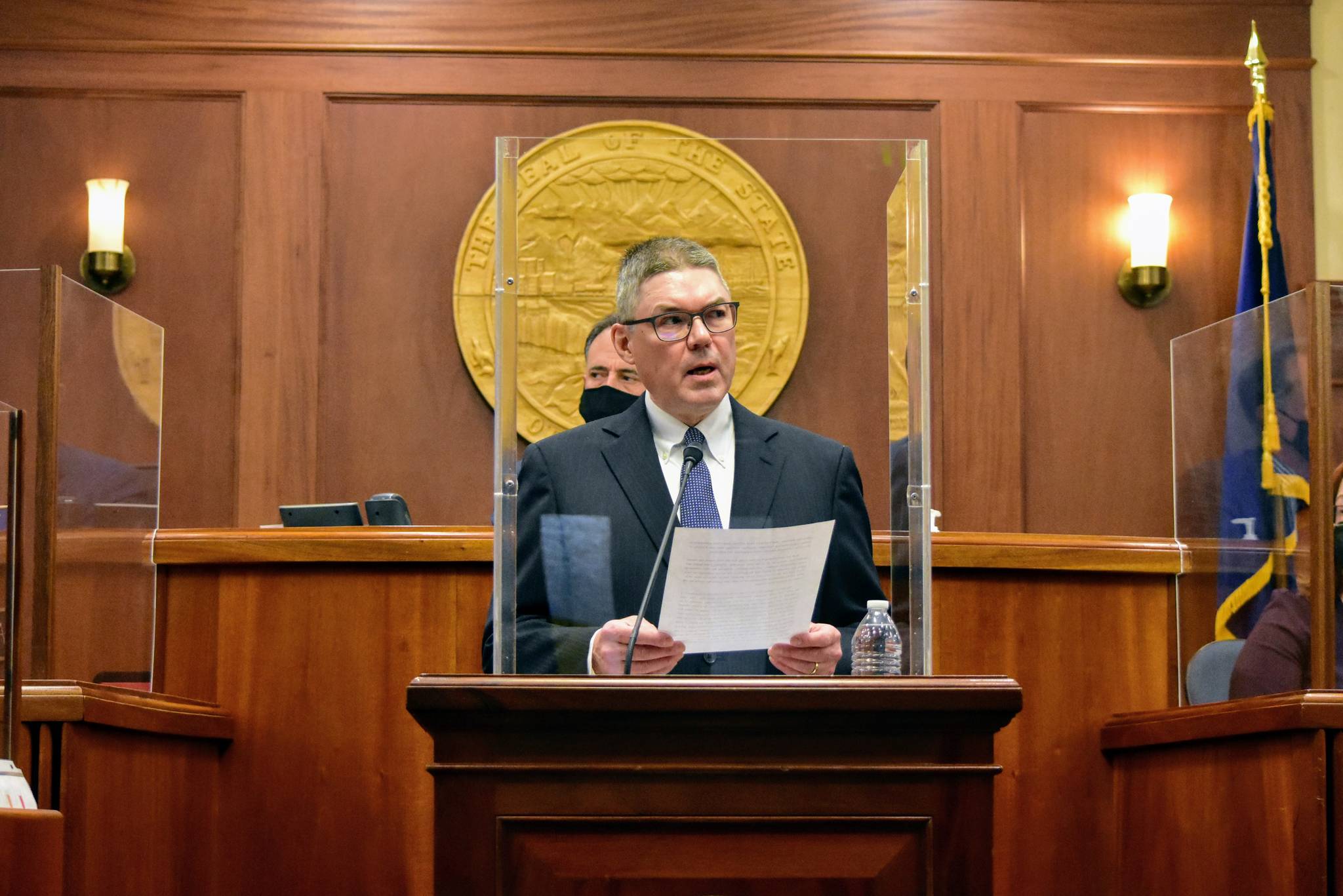
Alaska’s court system remained resilient through the pandemic, Chief Justice Joel Bolger told lawmakers Wednesday, and independence from politics is critical for the state’s courts moving forward.
Bolger will retire at the end of June after serving on the Alaska Supreme Court since 2013 and as an Alaskan judge since 1997.
In his last State of the Judiciary speech he said the court system had learned to conduct trials during the pandemic and courts were operating like never before. Many proceedings have gone digital, he said, saving on time and paperwork.
In some cases, judges and perhaps court staff, were the the only people actually present in the court. All other parties were able to join by video. Specially programmed tablets were distributed to remote areas so rural jurors didn’t have to travel.
“Particularly in this environment, I will assure that the court system is committed to continuing to balance our obligation to provide timely resolution of criminal cases and all other court proceedings,” Bolger said. “Our responsibility as a branch of the state government to avoid endangering the public’s health and safety.”
The difficulty was in criminal trials, Bolger said, as the U.S. Constitution provides that a defendant be able to face their accuser, and jurors must see defendants, witnesses and other parties in order to give a reliable verdict, he said.
[Mask policy, suspended jury trials remain in place for state’s courts]
Beginning March 15, Bolger said presiding district judges will be able to decide whether to hold jury trials in person based on the circumstances of the case.
Pandemic-related changes have so far been covered by CARES Act money, he said, but he did request additional funding for a 1% pay increase for non-judge court staff.
Not all Alaskans are pleased with the courts — in particular how judges are selected. Currently, judges are selected by the non-partisan Alaska Judicial Council, a seven-member body made up of the chief justice, three attorneys and three non-attorneys. Attorney members are selected by the Alaska Bar Association and only non-attonerney members are selected by the governor and approved by the Legislature.
But critics say the council is dominated by the Alaska Bar Association whose members are unelected officials.
“The Judicial Council is structured to give a permanent majority of bar members the control of who gets to be a judge or Justice,” Sen. Mike Shower, R-Wasilla, wrote in his sponsor statement for his Senate Bill 14, which would allow the governor the ability to appoint magistrates and judges who haven’t been approved by the AJC.
“With judicial elections deemed ‘nonpartisan’ virtually no political effort or mechanism to mount such effort, is ever directed toward educating the public about activist judges during their retention election,” the statement says.
The AJC was even the subject of a Wall Street Journal editorial last year, saying the body was “an unelected seven-member body dominated by the liberal Alaska Bar Association. The Governor may only choose judges from candidates approved by the Council, a system that guarantees left-leaning courts.”
Bolger said in his 24 years as a judge, he’s come to believe that Alaska’s method of judge selection is the best in the country. Keeping politics out of the courts was what gave them their strength, he said.
“The process that keeps politics out of the selection process is the most important,” he said, speaking to reporters following his address.
Furthermore, Bolger said, courts don’t decide which cases are brought before them.
“The cases are brought by either private party or by state agencies and the judge has to decide whether or not to grant the relief that is requested,” Bolger said. “Now in many cases that means that one side of the case will be disappointed, and I can understand that because some of these cases involve very difficult and very emotional matters but it doesn’t change the fact that in each case the judge is required to make the decision.”
• Contact reporter Peter Segall at psegall@juneauempire.com. Follow him on Twitter at @SegallJnuEmpire.
