
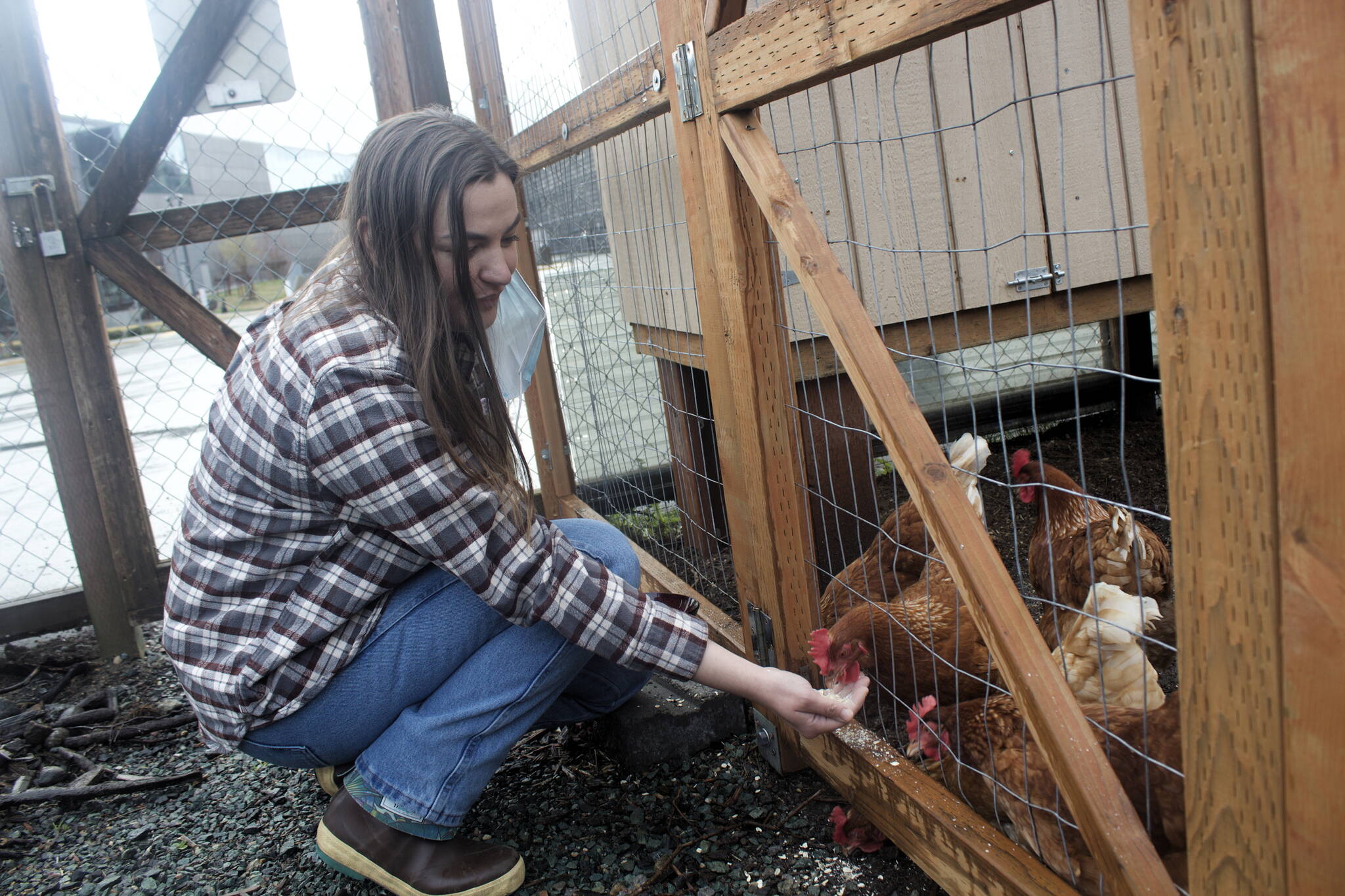
A global outbreak of bird flu that has killed more than 36 million chickens and turkeys since late last year officially reached Alaska last week in the Matanuska-Susitna Borough, but Anne Bonino-Britsch said she isn’t too concerned yet while feeding the six chickens at the Zach Gordon Youth Center on Friday.
“I am not concerned right now just because of what we know right now about bird flu,” she said, referring to the fact the Mat-Su infections remain the only ones known in the state a week after they were confirmed.
But Bonino-Britsch, and other staff and youths at the center, are taking all of the precautions recommended by health officials.
“In a cross-contamination situation if I was going to visit any other birds today I would change my clothes,” she said.
Other organizations working with domesticated and wild birds in Juneau expressed similar thoughts about their level of concern and precautions being taken, but they also agreed the potential for the virus known as Eurasian H5N1 avian influenza is heightened with the summer migration season underway.
“Juneau is going to probably end up getting it eventually,” said Kathy Benner, manager of Juneau Raptor Center, adding “we just have to keep an eye out for the symptoms and then go from there.”
The center, a volunteer nonprofit operation that typically provides treatment to more than 150 sick and injured birds annually, is continuing to respond to reports of distressed birds and rescue them as usual, Benner said. Unlike some larger raptor centers elsewhere, the Juneau center can provide treatment without risk to the center’s three “ambassador” birds that are housed off-site.
“Because we are a small center if we do get a bird that’s sick we can take it to our clinic because we don’t have any other birds there, and we will eval the situation,” she said.
The virus has a near-100% mortality rate among infected poultry. Humans are considered at low-level risk of infection, but it can be fatal if a person becomes sick.
The first Alaska case was confirmed last Friday in a non-commercial flock of chickens and ducks in the Matanuska-Susitna Borough, said Sarah Coburn, assistant state veterinarian for the Alaska Division of Environmental Health. While there are no other reported cases since, migration of birds from elsewhere is of extra concern since Alaska is different than most of the Lower 48 states because birds from both there and Asia make their way to the Last Frontier during the warmer months, creating additional potential for intermingling of species.
“We certainly have a lot of poultry owners throughout Southeast Alaska so it’s a consideration,” she said.
Local bird owners don’t need to unduly panic, but sensible precautions are urged, Coburn said.
”I think what we would want people to know is that it’s out there and there are some things people can do to protect their birds, and it will protect them from other diseases as well,” she said. “The main thing is keeping wild birds from domestic.”
That means if there’s wetlands or parks nearby “it’s not a time for free-ranging (domestic birds) if there is wild fowl around,” Coburn said.
Other general precautions include good hygiene (“especially with kids”) such as washing hands after handling or feeding birds (“especially with kids”), designated coop-only footwear and immediately reporting suspected illnesses, she said.
Jorden Nigro, manager at Zach Gordon Youth Center, said Coburn visited several weeks ago to test all of the chickens for bird flu and gather data for tracking purposes.
“We just really work to make sure everything is clean, make sure the staff wash their hands, make sure the kids wash their hands after feeding them,” Nigro said.
The same approach is being taken by the IGNITE Club at Juneau-Douglas High School: Yadaa.at Kalé, a Future Farmers of America-like organization, Caplan Anderson, a math teacher and the club’s adviser, stated in an email interview.
“We monitor birds for symptoms daily, as part of our husbandry routine,” he wrote. “Our birds are at comparatively low risk of contracting communicable diseases due to multiple factors like: small numbers, low stocking densities, proper nutrition, good sanitation, vaccinations as chicks, and most importantly, isolation from other birds – both wild and domestic.”
New birds are acquired from USDA-inspected commercial hatcheries and quarantined for 30 days prior to being introduced to other birds, according to Anderson.
“I personally am pretty obsessive about preventing possible disease transmission (even carefully tracking potential fomites) as I have a 30-year-old parrot at home that I hope to keep healthy for another 30 years,” he wrote.
• Contact reporter Mark Sabbatini at mark.sabbatini@juneauempire.com.
