
This story has been corrected to state Corey Ahkivgak attacked, rather than stabbed, two women prior to his stabbing of Angela Harris.
The Alaska Legislature is moving quickly on a bill allowing the state to involuntarily hold people in psychiatric facilities for up to two years if a person is determined to have a history of violence or could be a danger to the public or themselves.
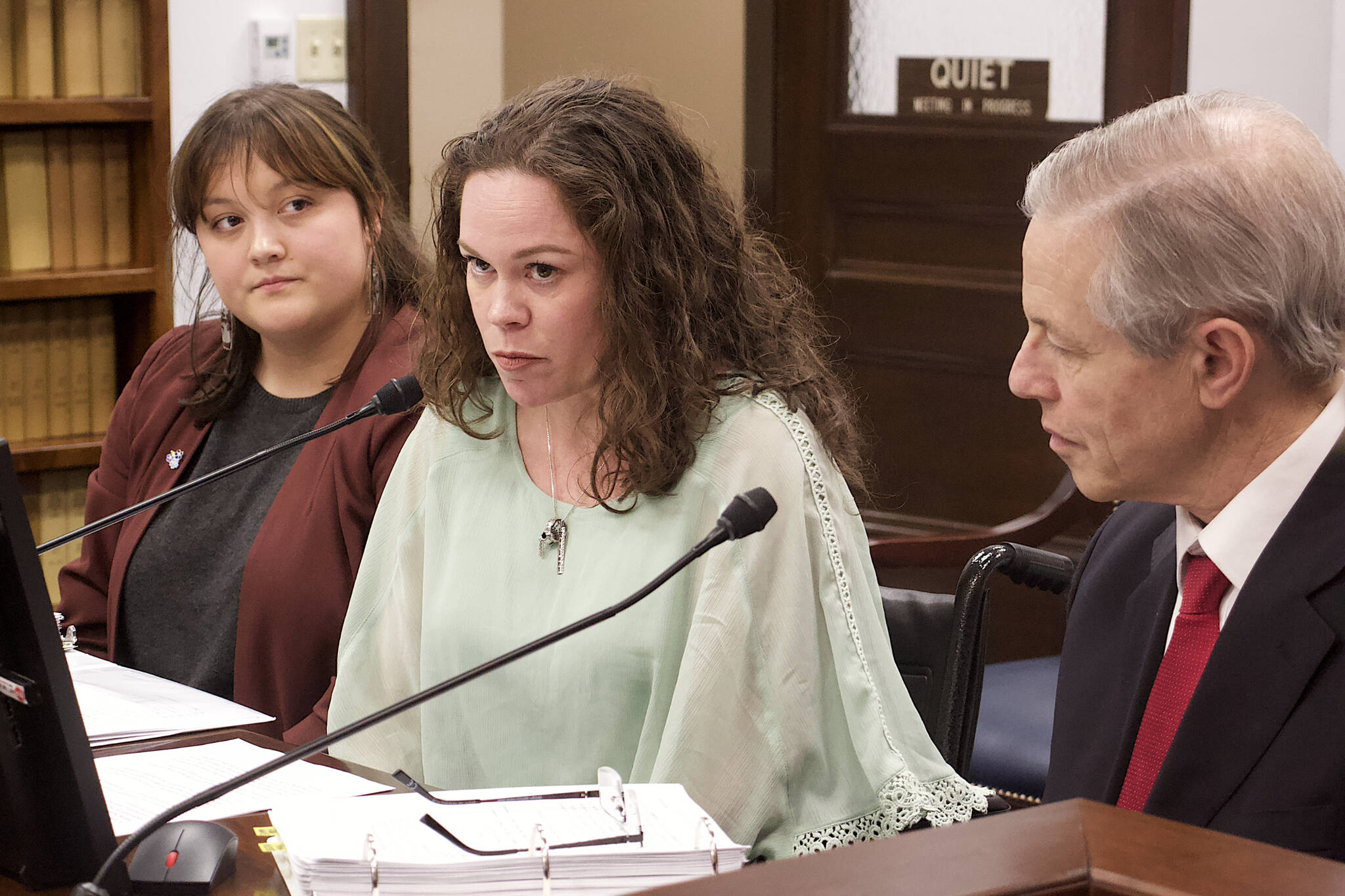
The state Senate passed the bill 14-6 on Monday, sending it to the House where it received an expedited initial hearing Wednesday by the House Judiciary Committee, featuring testimony from a woman who uses a wheelchair whose stabbing by a man ruled incompetent to stand trial is a central focus of the proposal.
“The urgency I approach this bill with is a concern about what could happen to another Alaskan if we don’t act right now,” Angela Harris, who was paralyzed by the stabbing outside an Anchorage library last year, told the committee.
Her assailant, Corey Ahkivgak, was a known offender who attacked two other women in Anchorage two months earlier but was released because of his incompetence to face criminal charges. Harris said she believes the state needs better mental health treatment and facilities, but not at the expense of victims.
“It is my belief that jail is an inappropriate place for Mr. Ahkivgak given his severe mental illness,” she said. “As a survivor, I also believe the community is an inappropriate place for his placement.”
What determines the legitimacy of the mandated stay against the person’s will would be up to the state if the bill passes. The state will be required to petition individuals to be committed if they are found to have committed violent felony offenses defined in the bill and have been found incompetent to stand trial. The person does not have to be convicted of the crimes to be committed.
Juneau Sen. Jesse Kiehl, a Democrat, voted against the bill, despite successfully amending the bill from a 5-year commitment down to a 2-year commitment when it was heard last week by the Senate Finance Committee. He said he supported the bill until its sponsor added an amendment during floor debate mandating a person “may not be detained for more than 10 days while awaiting transportation to a crisis residential center or evaluation facility unless a court extends the detention.”
The introduction of an amendment led to a lengthy closed-door meeting of Senators, during which Kiehl said “I quickly called some attorneys. They had serious concerns.”
Kiehl and other senators opposing the amendment said existing case law requires an immediate transport of a person detained at a medical or other facilities to a crisis residential center or evaluation facility, but changing the language to “promptly” transport and allowing 10 days creates potential uncertainties.
“It is very possible people who are a threat to our communities, who are a danger to our communities, might be set free on technicalities,” said Sen. Bill Wielechowski, an Anchorage Democrat.
Kiehl said he does still believe “there are some excellent provisions in the bill.”
“I’m really glad it makes it somebody’s specific job to file for civil commitment, so someone like that library stabber can be tried.”
He also supports a change to the original bill involving the burden of proof.
“The government has to prove you’re dangerous, not the other way around,” he said.
But Kiehl and others concerned about the last-minute amendment said they are hoping the issues will be resolved during the committee process in the House.
The bill’s sponsor, Sen. Matt Claman, an Anchorage Democrat, argues the bill is needed for public safety and to close loopholes that allow people who have been found incompetent to stand trial.
“Senate Bill 53 is a clear straightforward solution to closing a gap between our criminal justice system and our behavioral health system when a person is incompetent to stand trial and should be involuntarily committed to the Alaska Psychiatric Institute,” he said.
While on the floor Monday, Claman referred to Harris, who is openly sharing her story and struggles as a prominent advocate for the bill.
“The man who stabbed Angela should not have been released when they dismissed his criminal case,” Claman said. “Instead a petition for an involuntary commitment should have been filed based on his history of violence and psychiatric condition that made him a danger to our community.”
Claman said the bill would protect people in Alaska, such as Harris, who were survivors of violent crimes committed by people who have been found incompetent to stand trial.
However, Faith J. Meyers, a longtime advocate for better treatment of psychiatric patients in Alaska, told the Empire Wednesday afternoon that she is concerned that could put nonviolent people with mental illness at risk.
[Opinion: House Bill 80 and Senate Bill 53 do not protect psychiatric patients]
“I’m concerned because while they’re taking violent people off the streets, which I’m all for, I’m worried they will put those offenders in with nonviolent mentally ill people,” she said. “There’s not enough staff supervision to prevent harm and injury for the people there trying to quietly recover from their own crises.”
In response to Meyers’ concern, Claman told the Empire, “That’s always been a part of their work.”
“Psychiatric facilities today have to cope with people with violent tendencies, he said.
When asked about concerns regarding API’s quality of care for such patients, he said “this bill doesn’t address that.”
• Contact reporter Clarise Larson at clarise.larson@juneauempire.com or (651)-528-1807. Contact Mark Sabbatini at mark.sabbatini@juneauempire.com.
