
Gov. Mike Dunleavy much-publicized proposal to make carbon credits a cornerstone of the state’s revenue stream received much of the focus during a lunchtime presentation before business leaders.
He also discussed matters ranging from spending caps to tourism and focused on some other long-term development ideas such as “small nukes” — as in miniature nuclear power facilities — in his noon-hour remarks to the Alaska Chamber of Commerce who were fed a Filipino feast in a packed ballroom at the Baranof Hotel in downtown Juneau.
As he has throughout and since his successful reelection campaign, Dunleavy emphasized a theme of looking ahead to the next 50 years rather than just what’s needed to get a budget and other necessary state legislative matters completed this year. He said the current session is occurring as the state is still dealing with reverberations from the COVID-19 pandemic, but during the past year he has spent considerable time meeting with industry officials in the Lower 48 to discuss gas line, farmland and water resources.
“Of course the issue of carbon has really been dropped in our lap,” he said.
A commonly expressed concern carbon credits will “lock off the forests” isn’t accurate, Dunleavy said. A Canadian timber company, for instance, has proposed taking over management of some Alaska’s forests for up to 75 years, during which they’d pay for the deadfall and other wood harvested as well as carbon offsets.
“It’s how the contracts are structured,” he said. “It’s not one size fits all.”

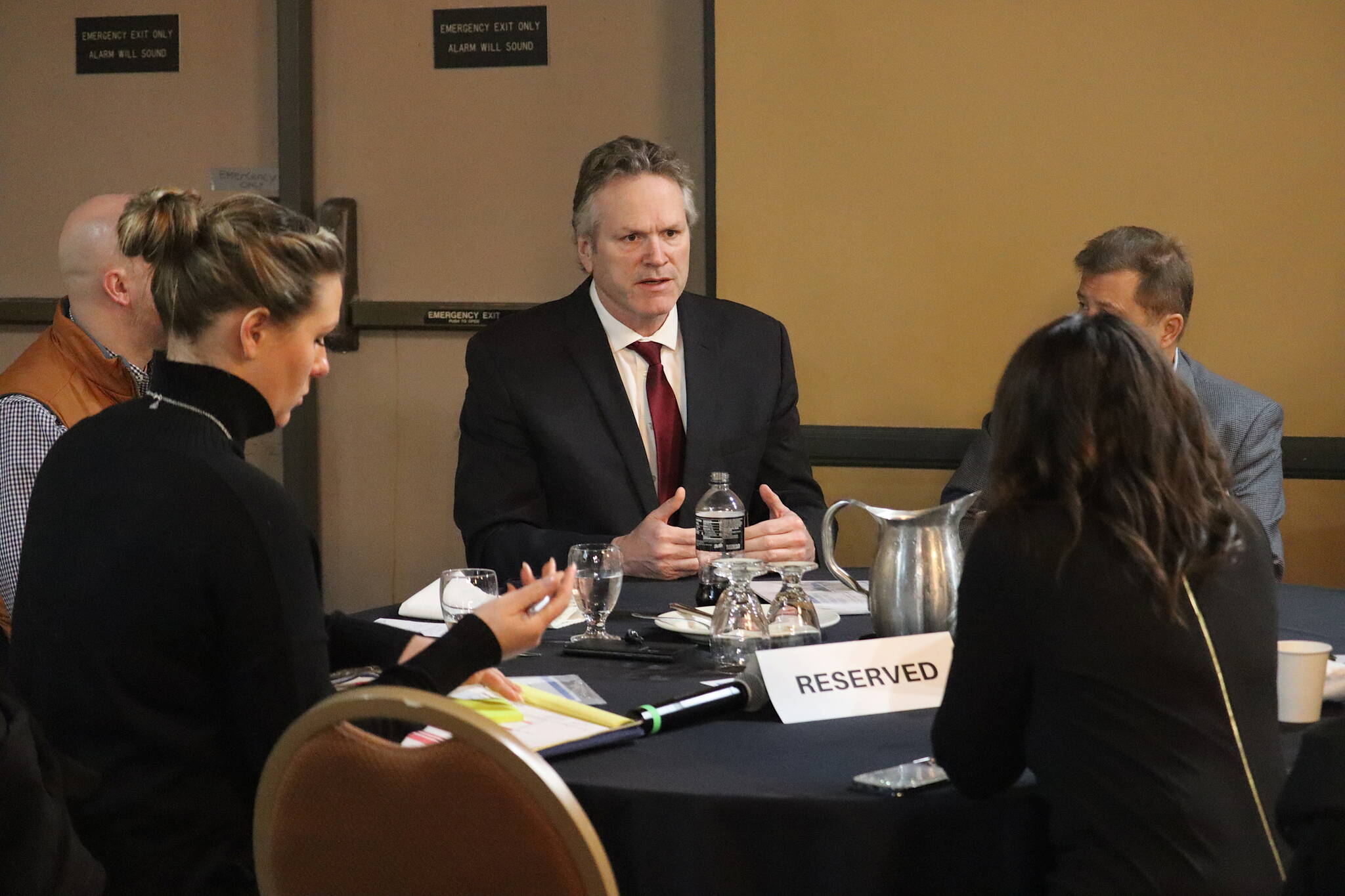
Mark Sabbatini / Juneau Empire Members of the Alaska Chamber of Commerce eat a Filipino lunch during the Juneau Chamber’s weekly luncheon Thursday at the Baranof Hotel prior to Gov. Mike Dunleavy appearance as the week’s featured speaker.
Dunleavy’s promotion of carbon offsets as a Republican comes as members of his party nationally are declaring war on companies such as Microsoft for announcing changes to its Xbox to reduce the gaming console’s carbon impact. It also comes at the same time he is continuing to push for maximizing the state’s resource development and attacking the Biden administration for actions such as reimposing the Roadless Rule in the Tongass National Forest.
But the governor is largely focusing on the revenue aspect of carbon credit possibilities — which beyond environmental preservation measures such as leaving forests intact could also include carbon storage in place such as Cook Inlet — and told the chamber audience a carbon plan could ultimately be beneficial to Alaska’s oil companies because it’s production has fewer environmental impacts than many other areas.
“That’s why you’ll see some folks on the far, far far left not like it,” he said.
Another “game changer” the governor said can help rural areas in particular are nuclear microreactors, following his signing of a bill during last year’s legislative session making it easier to obtain permits. He said it could be a sustainable and safe — at least in terms of deaths occurring to date from nuclear power compared to mining-related deaths — source for remote communities such as Nome as well as small enough to provide the power for a greenhouse.
State Chamber of Commerce leaders noted their foremost priority in a stable fiscal plan for the state is a spending cap, and asked what Dunleavy is doing this year to implement one. The governor said he supports a cap and is again working with legislators who feel the same way, but suggested his executive powers — including a line-item veto — are the most realistic current approach.
“Probably the most effective spending cap the past few years has been myself,” he said.
Dunleavy also used the question to reiterate ways his carbon plan can help, noting income from that can lessen the need to rely on oil prices and thus put the state’s income stream on more reliable footing.
When asked about education priorities, Dunleavy began his reply with a question of his own: “outcomes or funding?” They are, he said, two sides of the same coin for a system that right now is struggling with things likes standardized test scores.
“It was (originally) a system to assimilate immigrants, but now with technology we need people who can think on their feet well, we need people who can read well and we need people who can do math well,” said Dunleavy, whose proposed budget essentially flat-funds education next year. When it comes to legislative proposals “if it’s just about funding we want discussions about performance as well.”
Capital city concerns
A few Juneau-related issues were raised during the governor’s 40-minute appearance, split between his speech and answering questions submitted in writing, since the event was part of the Juneau Chamber of Commerce’s weekly Thursday luncheons with feature guest speakers. Among those questions was what he is doing “to track a healthy visitor industry.”
Dunleavy said efforts since the worst of the pandemic have included reaching out throughout Canada and the rest of the U.S. with video ads and other material “to lure visitors here coming out of COVID.”
“We’re going to do everything we can to work with the tourism industry, see what barriers remain,” he said.
The governor also noted Juneau at one time was also more widely known as a mining, logging and fishing town.
“It can be all of these things,” he said.
He also found yet another way to work in yet another reference about how “in a way it’s like carbon” when it comes to tourism.
“You’re not severing a resource and taking it out,” he said. “You’re bringing in folks from outside.”
Dunleavy was also asked about his stance on a road linking Juneau to the outside world as well as a possible ferry terminal at Cascade Point, which he said he is still reviewing with transportation department leaders.
“The idea is to get that road in,” he said. “Cascade Point may be a part of it.”
• Contact reporter Mark Sabbatini at mark.sabbatini@juneauempire.com
