
By Tuesday night, Juneau will have a newly declared mayor, Assembly representatives and school board members. But getting there is a huge undertaking.
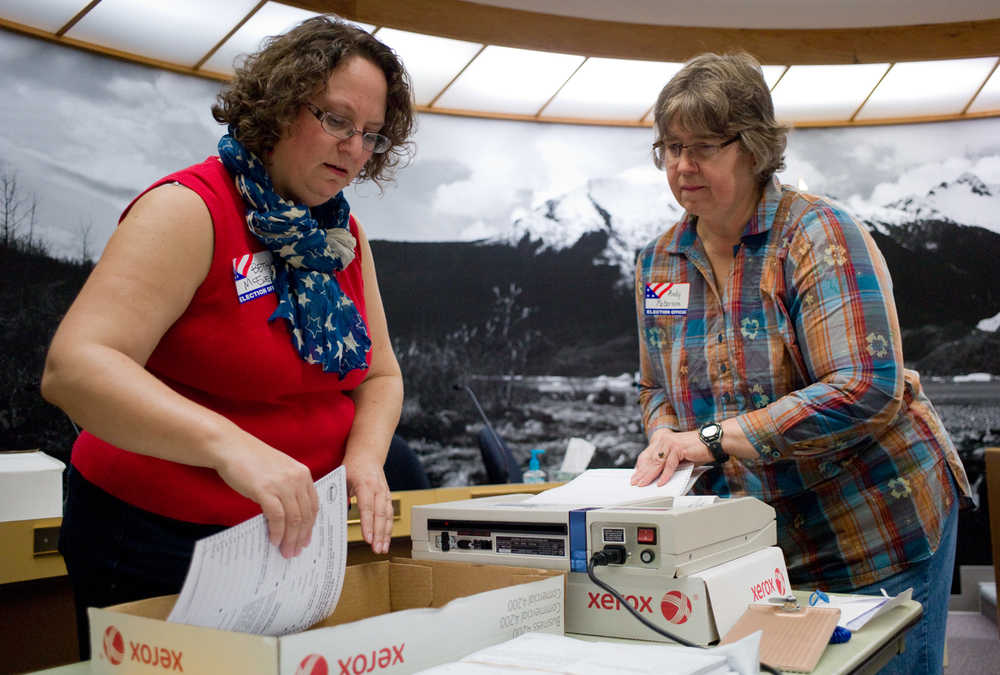
The process of putting on a municipal election is a massive time-consuming effort. It’s largely done by city staff and volunteers, who work to make it happen.
“We couldn’t run an election without our precinct chairs and our volunteer workers,” City Clerk Laurie Sica said.
About 100 volunteers in all will have spent hundreds of hours making sure today’s election runs as smoothly as possible, Sica said.
Facilitating a local election is also a costly effort. By the time it’s over and the results are verified, the city will have spent anywhere between $30,000 and $35,000, Sica said.
Here’s a little bit more about what goes on behind the ballot:
Building an election
Sica, who is also the city’s election official, and Beth McEwen, the deputy city clerk, have been at the heart of all 15 municipal elections since 2000. For them, election season starts early.
They begin putting out the call for candidates in the summer. Three Assembly seats open each year, along with two to three school board seats. (The specific number depends on the election cycle.)
“First, you have to have things to put on the ballot,” Sica said.
Second, she said, is making sure the city has everything it needs to get the ballots to the voters. That means securing volunteers to run polling places, training the volunteers, borrowing voting machines from the state Board of Elections and printing the ballots out.
Getting the ballot in hand, however, is not as simple as running down to Alaska Litho or Capitol Copy. Once the candidate-filing period closes in August, the city sends the list of candidates and any other ballot items to the ballot programmer. The programmer works with a printer based out of Homer to assemble and print the ballots. They then have to be shipped back to Juneau in time for the start of early voting, which begins two weeks before election day.
Sica has to decide how many ballots to order. At 50 cents a piece, they may seem relatively inexpensive, but when buying for a whole city, it adds up. Given Juneau’s historically low voter turnout (19 and 29 percent, respectively, in the past two municipal elections), Sica doesn’t buy one for every one of the 24,000 registered voters in the capital city. She orders enough to cover a 50 percent turnout, which saves the city about $7,000. Fifty percent, though, may be a little overly optimistic, she noted.
“I would encourage everyone to vote tomorrow because I don’t want to have to throw away any money on ballots,” Sica said Monday.
In the event that more than 12,500 voters head to the polls and there aren’t enough ballots, the city has a contingency plan: use sample ballots or hand count the results.
Sica said soliciting volunteers isn’t always easy work, either. There’s not much to entice them, given the low pay of $10 an hour.
Luckily, Sica said, the city has a few faithful poll workers, such as Stuart Sliter, the Douglas Precinct chair.
“I’m not even sure how long I’ve been doing this — over 20 years,” Sliter said. “It’s been a long time.”
Combating voter apathy
Sliter volunteers year after year because she enjoys the work, and because she sees it as a part of her civic duty. She said she wished more people would turn out to vote.
“People just don’t seem to care,” she said. “They don’t realize the importance of their votes.”
For those who think their vote doesn’t count for much, McEwen has something to show them: a list of close elections. Included on her list is the election of Rutherford B. Hayes, who won by a single vote. There was also a local school board race that was decided by just four votes, she said.
Judy Andree, an early voting poll worker, has hope that more people will turn out in this year’s election than in years past. Andree has been working at the Mendenhall Mall early voting site for more than 50 hours per week for the past two weeks. So far, she thinks that the turnout has been better than the past two years.
Sica’s early voting numbers, down slightly from last year’s, don’t support Andree’s conclusion, but Sica’s numbers are only current through Wednesday. Andree said she has noticed and uptick in voters since then, including the 60 voters she saw on Monday, which she said was the most she has seen on an early voting day in the three years she has volunteered.
“It’s not too late to vote to vote. The polls are still open,” she said Monday, encouraging anybody who has not yet voted. “This local election has the most effect on the city in which you live, she added. The presidential elections are glamorous, but the local elections have the greatest impact.”
Polls open today at 8 a.m. and close at 8 p.m. For polling locations and candidate profiles, visit juneauempire.com/elections.
