
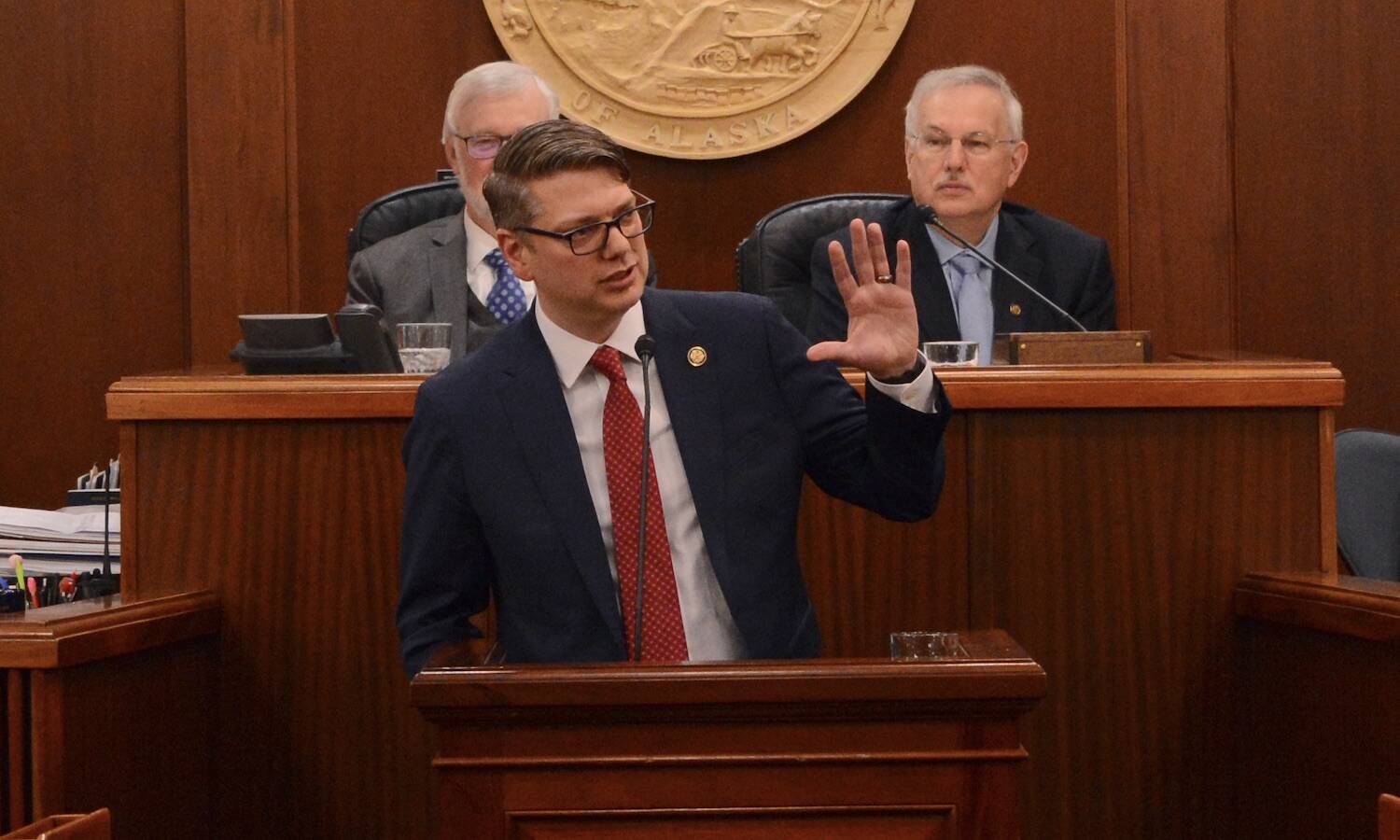
Rep. Nick Begich, R-Alaska, joined congressional Republicans in a 214-212 vote Thursday to claw back $1.1 billion in previously approved federal funding for public broadcasting, including tens of millions of dollars intended for radio and TV stations in Alaska.
The clawback, formally known as a rescission vote, was requested by President Donald Trump and does not take effect unless also approved by the U.S. Senate within 45 days.
The rescission would be enormously significant for Alaska’s public broadcasters, particularly those in rural Alaska. High Country News has reported that many of Alaska’s rural public radio stations are heavily dependent upon funding from the federal government.
A rescission would be even more significant than a budget cut, because it would instantly affect funding that has already been approved and included in local budgets. If Congress were to cut budgets going forward, stations might have at least some time to adapt.
Stations on St. Paul Island, in Unalakleet, Sand Point and Talkeetna are among those that receive more than 70% of their funding from the Corporation for Public Broadcasting, the federally funded agency targeted by Thursday’s vote.
Stations in Sitka, Ketchikan, Petersburg and Haines are among those that receive at least a third of their support from the CPB.
At KUCB-FM in Unalaska, the station would instantly lose nearly half of its funding and would have to eliminate original programming. The same would take place at KYUK-FM in Bethel, which stands to lose almost 70% of its revenue.
On June 6, Alaska Public Media published a listing of knock-on effects, including the loss of the only local reporters in many rural parts of the state.
Even in the state’s urban centers, the funding loss would have devastating effects.
KNBA-FM in Anchorage could have to stop production of National Native News and Native America Calling, two nationally syndicated programs that broadcast Alaska Native and American Indian news.
In Juneau, the loss of funding would affect Gavel Alaska, the public broadcasts that cover legislative hearings in the state Capitol and elsewhere.
Begich, in a written statement, said the rescissions package is “a necessary step for restoring fiscal responsibility in our nation.”
During his election campaign last year, Alaska’s lone member of the U.S. House of Representatives said reducing the national deficit was a priority. He recently voted for a bill that increases the national debt by an estimated $2.4 trillion.
In Thursday’s statement, Begich said that “while rural communities have in the past been indirectly supported through state-sponsored media, we must acknowledge how far we have come in terms of connectivity since the birth of radio more than 120 years ago. Alaskan residents have embraced today’s pervasive cellular, satellite, and wireline technologies, connecting rural communities to critical information and resources in rich and compelling ways. Importantly, however, emergency management funding from these budgets that is directed to rural communities has been preserved.”
In addition to the impact on public broadcasters, the rescissions package eliminates billions of dollars in foreign aid.
“This rescissions package primarily targets ideologically-shaped foreign spending at USAID. Under both the Obama and Biden Administrations, USAID funding was misused to promote political and socially left policies abroad. This package helps refocus our support in ways that are consistent with America’s core values, rather than promote the agendas of international bureaucracies and ideological NGOs,” Begich wrote.
“America has been built on principles of freedom of expression, self-determination, sovereignty, personal responsibility, and limited government. This package supports those values by rescinding $9.4 billion from programs that do not reflect the will of the taxpaying public,” his statement said.
A poll commissioned by PBS earlier this year found that 65% of the public believes the public broadcaster is either adequately funded or underfunded.
In the Senate, a simple majority vote will be needed to approve the rescissions package. Republicans occupy 53 seats in that chamber and Vice President J.D. Vance would cast any tiebreaking vote, meaning that four Republicans would have to oppose the funding reduction for it to fail.
U.S. Sen. Lisa Murkowski, R-Alaska, has said she supports funding public broadcasting. U.S. Sen. Dan Sullivan, R-Alaska, while critical of NPR, has supported public broadcasting, particularly in rural Alaska.
Trump has said that the rescissions request is the first of several that the White House budget office plans to submit.
• James Brooks is a longtime Alaska reporter, having previously worked at the Anchorage Daily News, Juneau Empire, Kodiak Mirror and Fairbanks Daily News-Miner. This article originally appeared online at alaskabeacon.com. Alaska Beacon, an affiliate of States Newsroom, is an independent, nonpartisan news organization focused on connecting Alaskans to their state government.
