
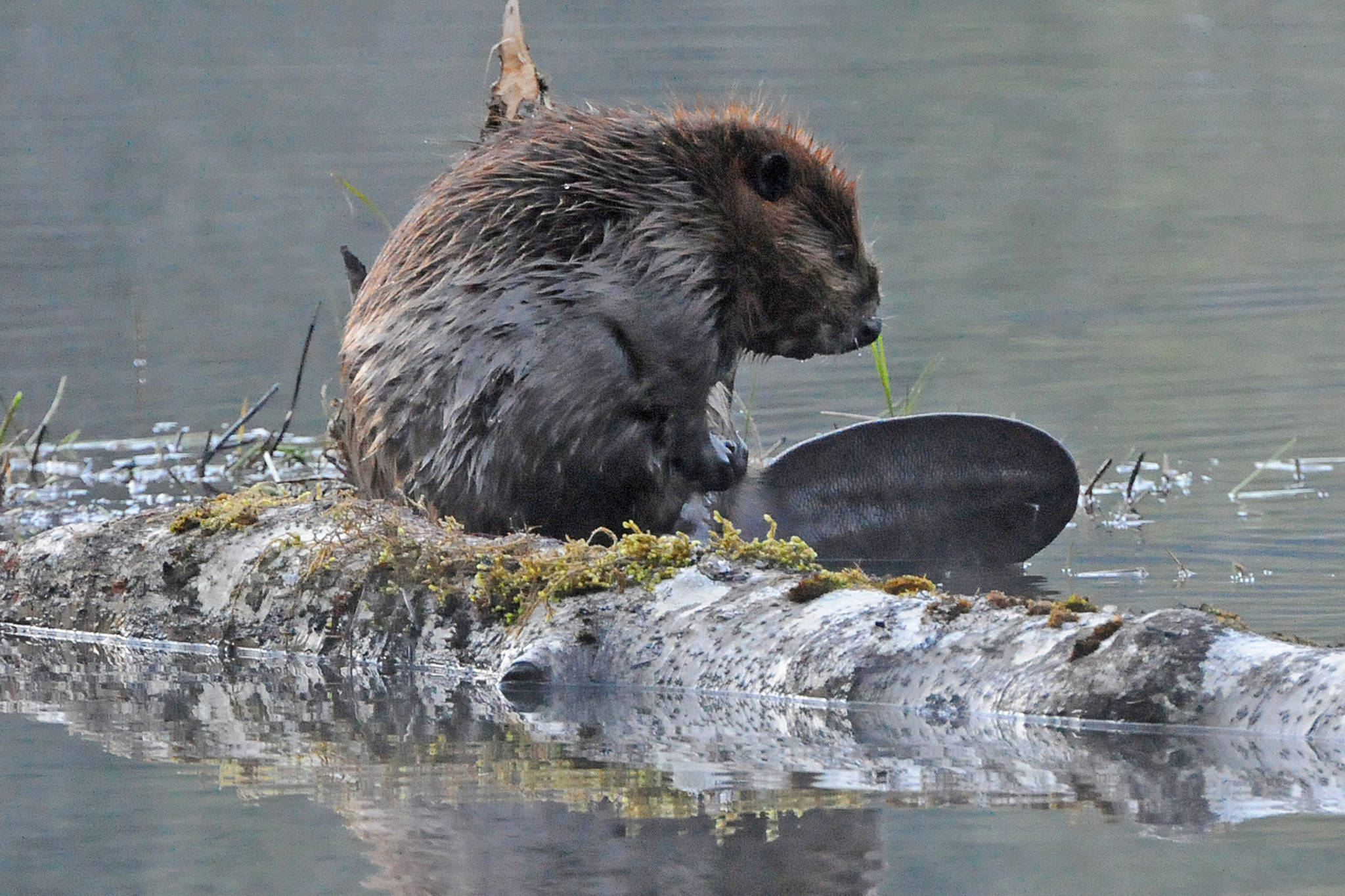
North American beavers were very nearly exterminated from the entire continent by European trappers and settlers. The near-absence of beavers for over 200 years changed the face of the landscape dramatically, not necessarily for the better. As humans took over the landscape and modified it to suit their real or imagined needs, they generally treated the few remaining beavers as intruders into the human domain, to be eliminated one way or another. That attitude still prevails.
To give local examples from my experience: one fellow said he hated beavers because one beaver chewed on a tree in his yard (serious profiling! Not politically correct). And a woman shrieked maledictions upon me, saying that beavers should be killed because they kill trees. The Department of Transportation worries if pond levels rise along a roadbed or under-road culverts are clogged. Walkers complain if trails are flooded. And so it goes. For some reason, the usual first level of response is kill them!
But although beavers so often get a bad rap, they are not all bad. In fact, they do some very good work. For instance, in the western lower 48 states, their dams help reduce erosion, trap sediments, control floods and raise the water table, resulting in better grazing for ranchers’ herds and better stream quality for fish. Recognizing this, agencies and ranchers have begun to re-introduce beavers in some areas, to the benefit of humans, as well as fish and wildlife.
People often assume that beaver dams block salmon from coming in to spawn, to the detriment of our fish runs. However, adult coho and sockeye can usually jump or slither over most small beaver dams, if there is enough water below the dam to let them gather momentum. Furthermore, the adults are fully capable of waiting for days and days, until rains raise the water levels enough for easy upstream passage. So the common assumption of blockage is often just that — an untested assumption.
Furthermore, scientific research has shown that the ponds formed by beaver dams are superb habitats for juvenile sockeye and coho salmon: they grow bigger and faster there than in other possible sites, so they go to sea in better shape and survive better, and therefore more of them can return as spawners. In fact, in many cases, the size of a run is limited by the amount of suitable rearing habitat for juveniles and juvenile survival. For this reason, fisheries biologists in the Pacific Northwest have reintroduced beavers to some stream drainages, to help restore the waning salmon runs.
Ecologists also observe that beaver ponds are good habitat for nesting ducks, some shorebirds and songbirds, moose, and amphibians. Migrating swans and geese use them regularly. Standing dead trees are used by woodpeckers, chickadees and certain species of duck. All this research and observation strongly suggest that we humans should take a less simplistic, more multi-factorial approach to beavers and their activities, in fact, an ecosystem-level approach.
Land managers in agencies and private concerns are learning that it is often possible to manage the effects of beaver activity rather than reflexively killing the beavers. There are now beaver-management specialists who offer solutions to many perceived problems — finding ways to keep the benefits of beavers while ameliorating or eliminating the problems. Among the techniques they use are devices known as pond levelers of several designs, diversion dams, exclusion fences of various sorts, baffles to prevent culvert clogging, step pools to facilitate fish passage. Trails can be raised or re-routed. Sometimes all that is needed is making and maintaining notches in dams for water and fish passage while lowering water levels somewhat.
In short, it is often possible to balance the “bad” with the good and find a win-win solution.
• Mary F. Willson is a retired professor of ecology. “On The Trails” is a weekly column and appears every Friday. Her essays can be found online at onthetrailsjuneau.wordpress.com.
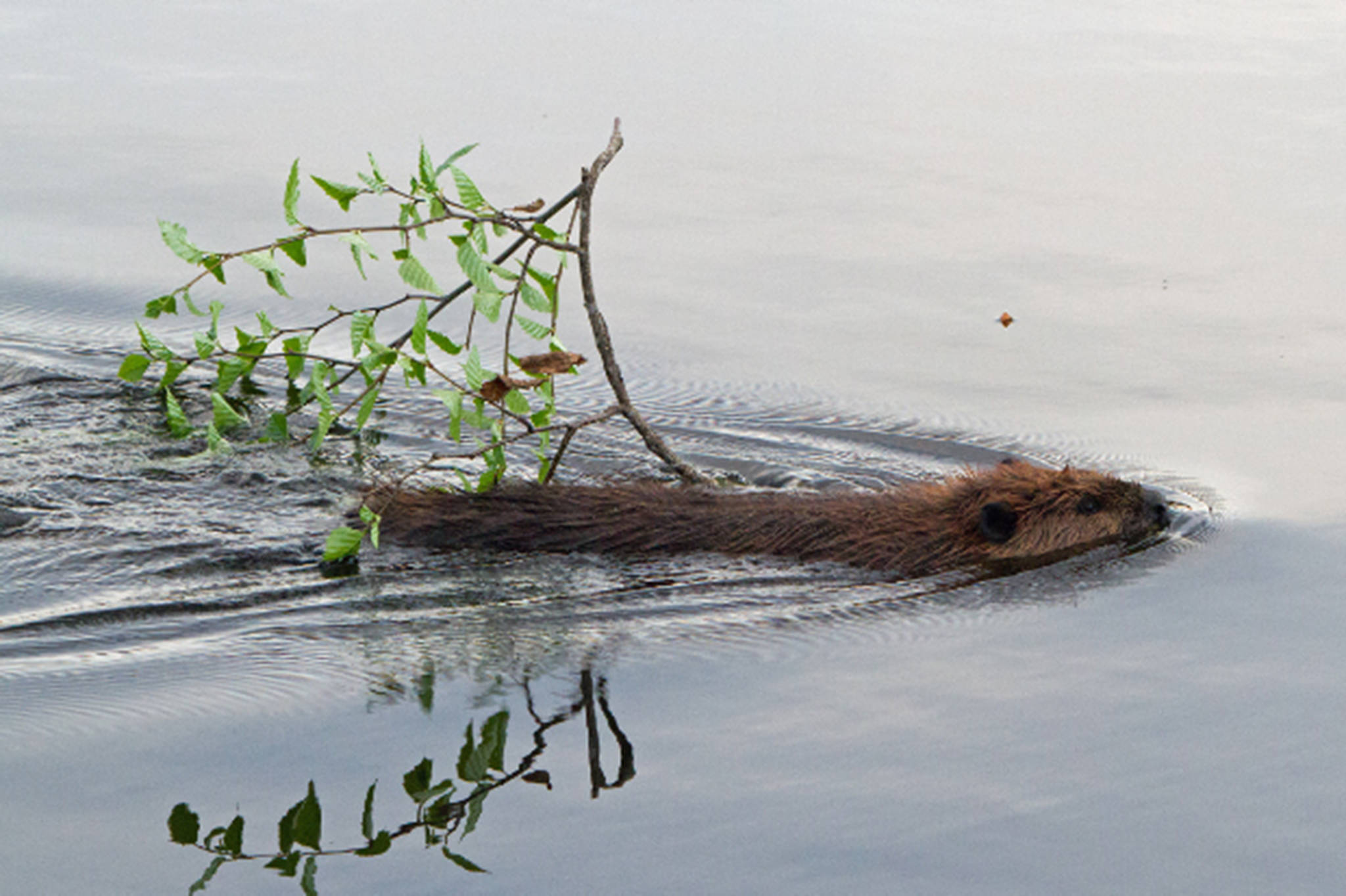
A beaver tows a small branch toward a convenient lunch spot. (Courtesy Photo | Jos Bakker)
