
In 1959, at a meeting of the American Petroleum Institute, physicist Edward Teller told oil executives that burning fossil fuels would someday warm the planet, melt Arctic ice and raise sea levels. The industry later confirmed the warning in a private report but kept quiet as it continued to expand production.
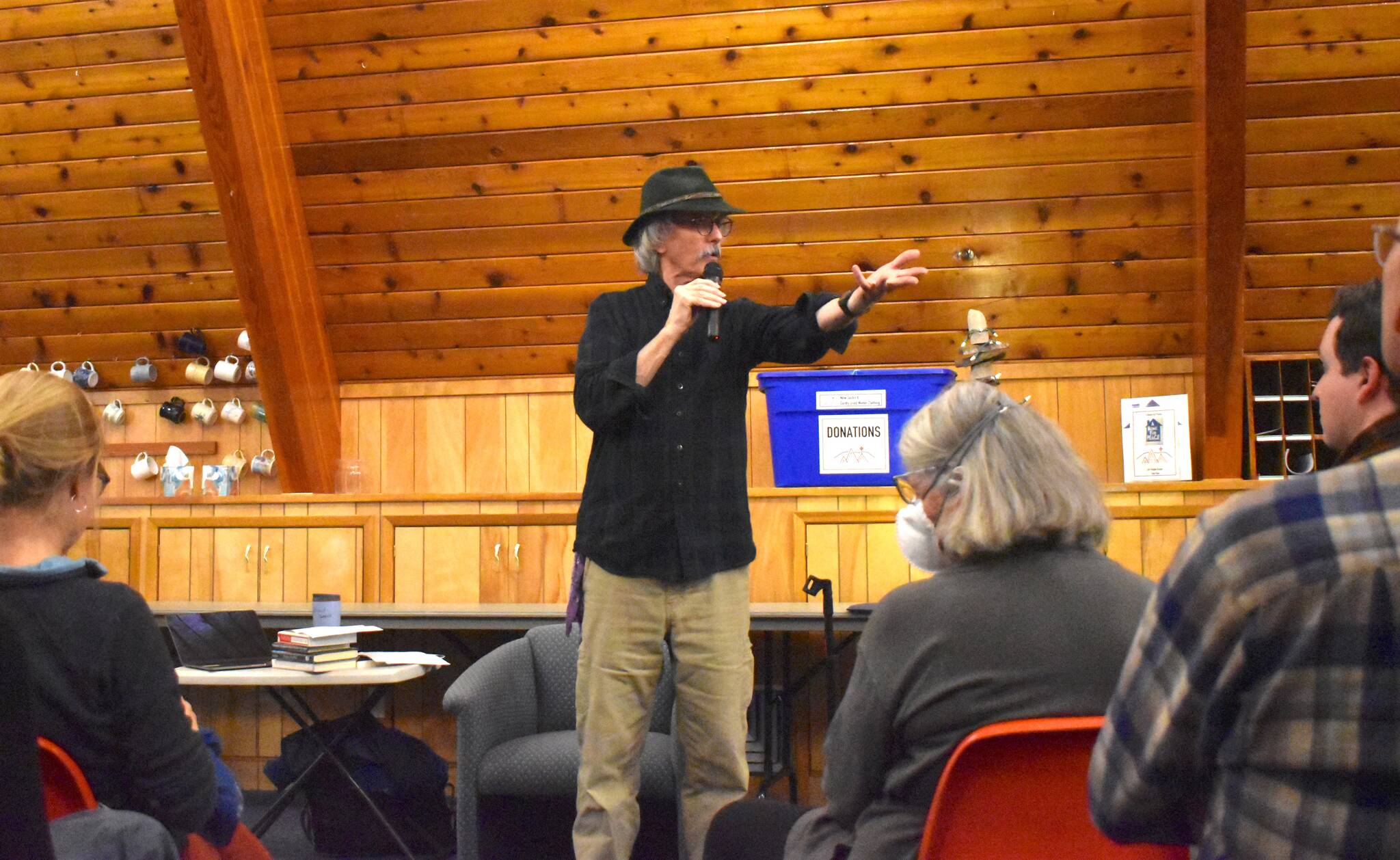
Author Kim Heacox brought this and many stories before a group of about 100 people at Ḵunéix̱ Hídi Northern Light United Church on Wednesday, Dec. 3. The event, hosted by the climate advocacy group 350Juneau, focused on the role of storytelling in communicating the severity of the climate crisis.
Heacox has spent years writing about Alaska, and many years before that as a park ranger in Glacier Bay National Park. His work, from novels to memoirs to biographies, often draws connections between his experiences or perspectives and scientific realities. In “The Only Kayak,” he paddles through Glacier Bay while grappling with what it means to bear witness to change.
“These are extraordinary times,” he told the crowd on Wednesday. “And we get to decide if we are going to step into that extraordinariness and partake of it or steer around it.”
In Northern Alaska, melting permafrost and climate-driven storms have impacted communities, especially in Native villages. Long before these became familiar headlines, Heacox came across people who were trying to find ways to show what climate change may become.
He remembered a day in 1987, when he attended the Island Institute’s Sitka Summer Writing Symposium. Heacox described the scene in an opinion piece in “What’s it going to be, hard truths or appealing lies?” in the Anchorage Daily News.
“I have a vision of the future,” historian Carolyn Merchant said before the group of writers. “I see a headstone in Prudhoe Bay, half-drowned by a rising, warming, acidic ocean. It reads: ‘BURNING OIL: SEEMED LIKE A GOOD IDEA AT THE TIME.’”
Numbers today portray their own warning. In 2024, atmospheric carbon dioxide rose by 3.75 parts per million, the largest recorded single-year increase. As temperatures rise and frozen ground thaws, methane escapes into the atmosphere, creating feedback loops that accelerate warming even more, Heacox described.
When it comes to writing about this and other climate facts, Heacox advised the audience Wednesday night, sometimes a narrative can smooth the landing of sharp data.
“A few numbers, and put it in the middle of your piece, and then you get back to storytelling,” he said. “And they’ll swallow it. You’re putting a pill in the yogurt.”
Heacox urged the crowd to take an active role in documenting the changes they see, whether that’s speaking out or simply writing it down. A pen and a notebook won’t cool the planet, he said, but they create a record, and a personal one often carries the most weight.
As Heacox writes in “Rhythm of the Wild,” “We cannot escape numbers, nor should we want to. There’s beauty in a bell curve; perfection in the laws of nature, the universal equation. But stories inhabit the heart, not the head. They remind us of what’s sacred.”
