
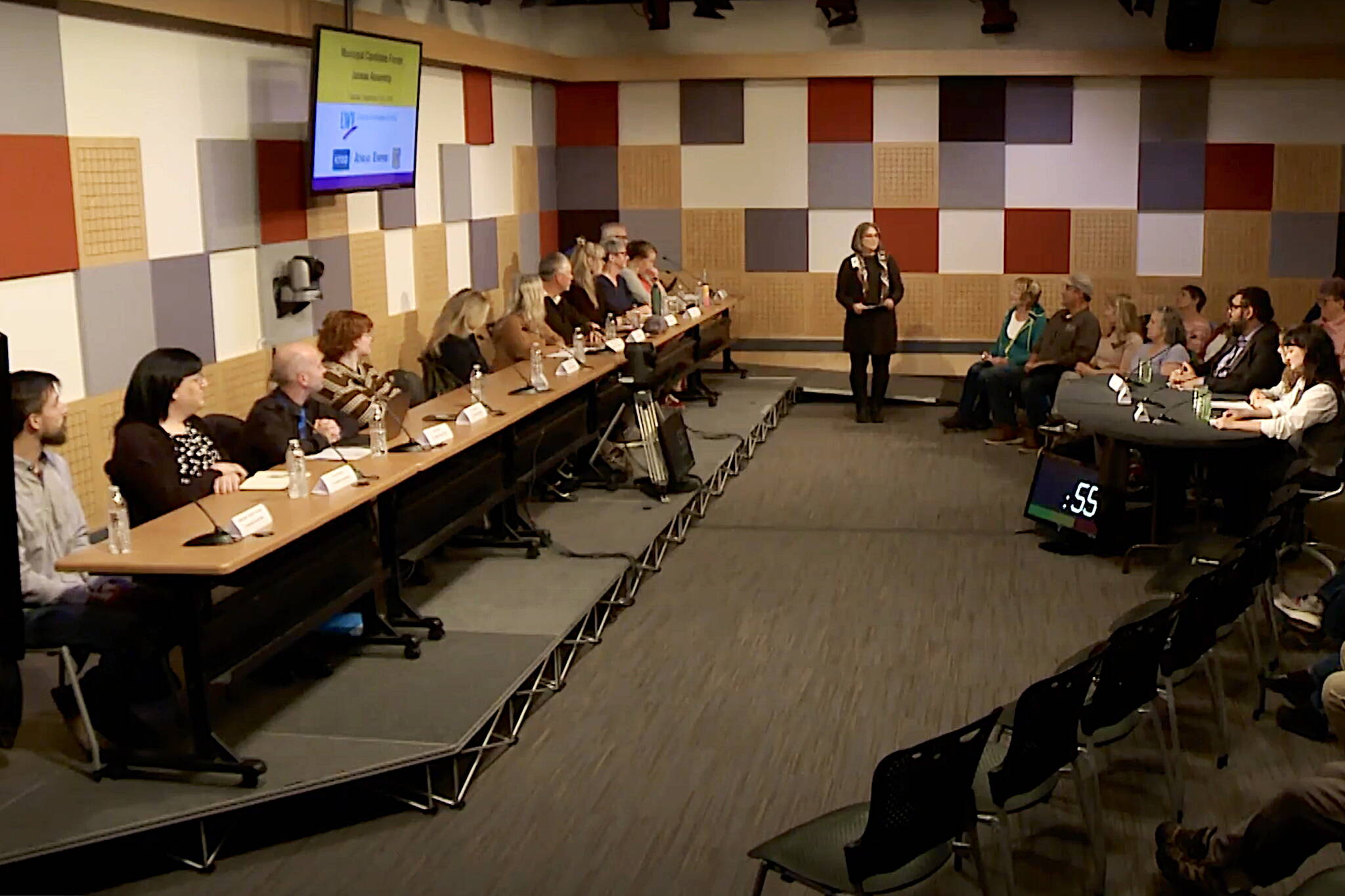
Juneau Assembly candidates largely agreed with trying a limit of five cruise ships a day next summer and that there aren’t easy fixes for solving certain issues such as the lack of a warming shelter for people experiencing homelessness this winter.
But the 14 hopefuls seeking four Assembly seats differed widely about a ballot proposition to fund most of a new City Hall, resolving the housing shortage and the city’s spending priorities.
The candidates faced off during a 90-minute forum Tuesday night hosted by the Juneau League of Women Voters, and moderated by media representatives from KTOO, KINY and the Juneau Empire. Six questions were asked of the candidates, who had 45 seconds to respond (except the first candidate in the rotating order, who had 55 seconds).
There are 10 candidates seeking two Areawide seats, and two candidates each for a single vacancy in the District 1 and District 2 seats.
All of the candidates participated, but some were not present for the entire event. District 2 candidate David Morris showed up an hour after the 6 p.m. start of the forum, stating during the first question he responded to “I just got out of the pool.” Areawide candidate JoAnn Wallace left about five minutes later, stating she had “daycare duty.”
The opening question was about the limit of five cruise ships a day and concerns that have been expressed about the size of increasingly large ships. Candidates generally supported the limit, sometimes using qualifying phrases such as “a good starting point” or trial experiment. But many candidates also agreed trying to limit the actual number of visitors could be problematic for legal and other reasons.
Among the participants not expressing support for the five-ship limit was Areawide candidate Jeff Jones.
“I don’t like to tell my friends and neighbors they can’t earn a living,” he said. “I do believe we get overrun sometimes, (but) not to the extent need to cut tourism.”
Nathaniel (Nano) Brooks, another Areawide candidate, said “I want to see every industry thrive as long as they thrive responsibly” and fellow Areawide hopeful Laura Martinson McDonnell said “if we start pulling revenue out of city coffers that way who’s going to pay for it?”
Housing shortages and rising property taxes have been a foremost local issue in recent years, and the question of where resolving those issues should be in the city’s budget priorities resulted in a wide range of replies.
JoAnn Wallace, a longtime real estate agent seeking an Areawide seat, said recent assessments have gone up far too much · citing a top-end figure of 40% for some residents — and suggested Juneau implement a cap on how much of an increase is allowed each year.
“This town has a lot of revenue streams, so the question is where are we spending our money,” she said.
A few candidates — including Areawide hopefuls Michele Stuart-Morgan and Emily Mesch, and District 1 incumbent Alicia Hughes-Skandijs — suggested building more housing so the tax burden on each homeowner is lower. Several candidates also said the city should prioritize key needs such as emergency services and schools before considering funding other things — with some emphasizing plans for a new City Hall estimated to cost $43.3 million should be among the proposed projects scrapped.
A bond measure to fund $27 million of the cost of a new City Hall has been among the most contentious issues this election, especially since voters narrowly rejected a $35 million bond last year. Candidates were divided on their support for this year’s ballot initiative, but even some who say they support the project said they disagree with the process being used by the Assembly and city leaders — including spending $50,000 of public funds to advocate for the bond’s passage.
“The more important question is not whether I support it, but what the people of Juneau want. I think it’s very possible the community is going to tell us they need more time and need to assess options,” McDonnell said. Nonetheless, she said she plans to vote for the bond because “if I run the numbers I see no way of saving money if we do it a different way.”
Among those expressing the strongest opposition to the bond measure was District 1 challenger Joe Geldhof, repeating comments from earlier in the campaign that the Assembly and the city manager are disrespecting the voters. He also questioned the claimed cost of the building, noting “there’s no firm bids” yet, and said he believes the operations and maintenance costs of a new City Hall will be higher than the current one.
Jones said he doesn’t support the ballot measure because “the company I work for takes care of Bartlett (Regional Hospital) and schools, and those buildings are in shambles as well. We need to prioritize.”
A question about a shortage of child care resulted in a few proposed city-fueled solutions such as expanding the city-operated RALLY child care program, having the city set an example by ensuring employees have child care access as one of their benefits, and providing grants to private and nonprofits providing such care.
Areawide candidate Dorene Lorenz said Juneau had a Boys and Girls Clubs of America program that languished years ago, and noted there was “a bad hire” in the former program, but “generally cities have strong participation.”
“It’s something we should look into reinstating here,” she said.
The issue of homelessness arose after Assembly members were told Monday night the city is still struggling to find a solution for hosting a cold weather emergency shelter beginning in mid-October, since a church that has provided the shelter in recent years voted against doing so this winter. Most candidates addressed the broader issue of people experiencing homelessness, with some noting coming up with a solution within weeks for the warming shelter is a challenge they don’t have ideal answers to.
Brooks, echoing an idea floated by Anchorage Mayor Dave Bronson, suggested a lack of staffing was a reason for the problem and “I would much rather buy a ticket to a warmer place than seeing people die on the street.”
The final question of the night was about Juneau’s goal of reaching 80% renewable energy in the sectors of transportation and space heating by 2045. While there was general support for increased use of renewable energy sources, there were many candidates who also expressed reservations about whether the timeline is realistic.
“I think it’s good to have goals, but I think we have to be really careful with some of the deadlines,” Wallace said.
She and some other candidates noted the first electric bus the city put into service was a failure and the company making it recently declared bankruptcy. In such cases, candidates said, it may be better to wait until advances in technology make implementing such ideas practical.
“This is going to be small steps and this is all going to equal one large step — or many large steps,” Morgan said.
Since the evening was a forum rather than a debate, there were no verbal fireworks between candidates questioning and rebutting each other’s remarks, and nobody had to be forcefully cut off for exceeding their allotted speaking time. But there were interesting moments and trends among some of the candidates.
Mesch had the only notable “gaffe” of the night, pausing on the question about a shortage of child care and declaring “sorry my mind just went blank. I have no idea what I was about to say. The words just came and they just disappeared,” before offering an abbreviated response. But she also had the one humorous “sound bite” of the evening, ending her closing statement with “I think it’s time to Mesch things up.”
Kelly managed to work references to the effect of “what I’m hearing knocking on doors” into most of his answers, claiming in his closing statement he’s knocked on 1,600 so far “to share my priorities.” Nance, in his closing, shared a letter stating he got a “thumbs down” from the police and firefighters union because “apparently I wasn’t positive enough about them.”
Another forum featuring the three candidates seeking two seats on the Juneau Board of Education, plus a discussion about the City Hall ballot measure between departing City Manager Rorie Watt speaking in favor and local resident David Ignell speaking in opposition, is scheduled at 6 p.m. Wednesday.
• Contact Mark Sabbatini at mark.sabbatini@juneauempire.com or (907) 957-2306.
