Assembly holding public hearing on $8K per-property flood district as other agreements, arguments persist
Published 9:30 pm Saturday, December 14, 2024
This story has been corrected to properly attribute statements incorrectly attributed to Alaska Hydroscience Owner Ed Neal.
Some residents objecting to paying nearly $8,000 per household to install riverside barriers by next summer to protect against glacial flooding are near-certain to tell city leaders during a public comment session Monday night a levee at Mendenhall Lake should be built instead during the coming months — even though a project highlighted as a role model took more than a decade to complete.
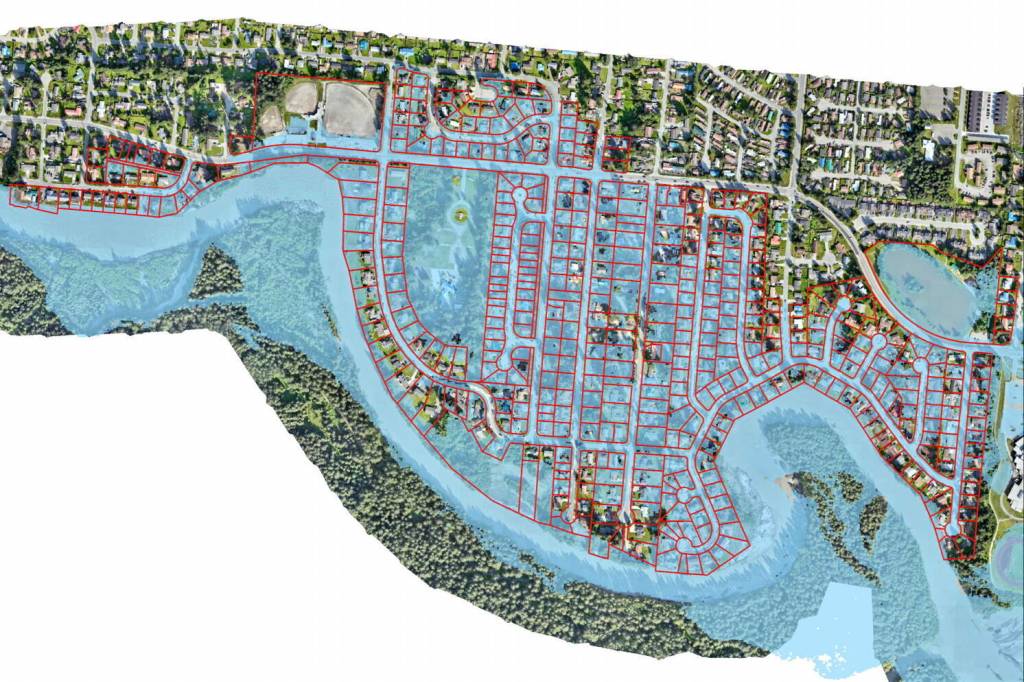
A months-old battle of proposed solutions by various government and citizen groups is scheduled to again be revised when the Juneau Assembly hosts the first of two planned public comment sessions at 7 p.m. Monday about a proposed ordinance establishing a Local Improvement District (LID) for properties in areas at risk of flooding from Suicide Basin.
[See also: Locals protesting $8K payment for temporary flood barriers told rejection may endanger permanent fix]
The problem stems from glacial outburst floods at record levels in early August the past two years that have damaged or destroyed about three dozen homes last year and damaged about 300 this year. Officials have stated flooding at similar levels is likely in future years — and if waters rise further many more homes in the Mendenhall Valley could be vulnerable.
Local and federal officials have stated the only large-scale protection plan feasible by next summer is a semipermanent levee of Hesco barriers being provided by the U.S. Army Corps of Engineers along the bank of the Mendenhall River where most of the at-risk residences are located. The city would be responsible for the cost of installing and maintaining the barriers.
The LID as proposed would require owners of 462 at-risk properties to pay $7,972 to cover half the city’s total cost, along with four riverside properties being required to pay $50,000 for riverbank armoring to safeguard against erosion. Payments would be allowed over a 10-year period.
Not surprisingly, there has been intense opposition from many owners of at-risk properties about paying the fee, as well as from riverside property owners who don’t want the interlinking barriers — which are three feet square and four feet high — on their properties.
A citizens group called Juneau Flood Solution Advocates that formed after the flood this August posted a nine-minute video on YouTube Dec. 3 advocating the alternative solution of a levee around Mendenhall Lake, which has also been suggested to Assembly and other city leaders in recent months. The video quotes Ed Neal, owner of Alaska Hydroscience and a former specialist for the U.S. Geological Survey’s Alaska Science Center, supporting that option.
“The most viable option that would probably protect the valley into the future would be to construct some sort of flood retention basin here that backs up the level of the lake, say an additional 10 to 12 feet, to knock the flow levels down,” he says in the video.
An example of such a project cited by the video is the Chena River Lakes Flood Control Project in North Pole, authorized by Congress after a major flood in 1967. However, construction didn’t begin until 1973 and it took until 1979 for the Army Corps of Engineers to complete the $256 million project.
The video’s narration states “although the functionality would be similar, the scale of a flood control project at Mendenhall Lake would be less than a quarter of the size of the Chena River Lakes Flood Control Project.”
Regardless, the multiyear timeframe of any substantial project taking place at Mendenhall Lake or other U.S. Forest Service property has been emphasized by a range of officials — from city administrators to the Corps of Engineers to Alaska’s congressional delegation — due to the environmental, safety, financial and other issues involved. But members of the citizens group and others favoring the lake levee have argued the actual work to build one can be done quickly if the regulations are waived.
Such waivers, regardless of precedent, may not be out of the question once President-elect Donald Trump takes office and is working with a Republican-led Congress. He has vowed to repeal numerous regulations including those related to the environment and development. Furthermore, on Monday Gov. Mike Dunleavy submitted a request list for Alaska that includes declaring Mendenhall Lake and Mendenhall River belong to the state rather than the federal government, following up on a 2022 lawsuit seeking state seizure of those submerged lands.
However, Deputy City Manager Robert Barr, in an email Sunday to an advocate of a lake levee, stated it’s not just regulatory issues preventing it from being quickly built.
“Based on our conversations with the Army Corps of Engineers and other professionals in the field, it is impossible to build a lake levee prior to next summer,” Barr wrote. “There are many reasons, but perhaps the most significant is that any levee would have to be engineered sufficient to all but guarantee it would not fail, because in our case the consequences of a lake levee failure would be catastrophic.”
Efforts are underway between local government officials and the U.S. Forest Service to seek a solution, according to a press release issued Friday by the City and Borough of Juneau. It states CBJ and the Forest Service have “signed a $1 million participating agreement to search for a long-term solution providing relief to Juneau residents who reside in the flood path of the Mendenhall River.”
The release also notes the Central Council of the Tlingit and Haida Indian Tribes of Alaska, which provided assistance during this year’s flood, is involved in the cooperative agreement.
“The funds will go towards near-term studies to provide baseline data for the General Investigative Study by the U.S. Army Corps of Engineers,” the release states. “The local and federal agencies are eager to get to work on a long-term solution, and this funding will help get some of the work started.”
• Contact Mark Sabbatini at mark.sabbatini@juneauempire.com or (907) 957-2306.