
The U.S. military has a long history in Alaska, ever since the Army took possession of the territory from Imperial Russia in 1867. But in those days, the Army used more to enforce regulations on Alaska Natives and less to protect them and improve their communities.
So what’s changed in 150 years?
“As an ethnic group, Alaska Natives and Native Americans served in the United States military at a higher percentage than any other ethnic group to be found across the United States of America,” said retired Air Force Maj. Gen. Randy “Church” Kee, executive director of Arctic Domain Awareness Center as part of a panel at the Alaska Federation of Natives annual conference last week. “The Alaska Native community and the uniformed services have extremely common values and extremely common interests.”
Church and other leaders on the panel took time to recognize the huge contributions Alaska Natives have made to the United States military, though their service and support. Coming from a rough introduction, Alaska Natives have served in the military with distinction in many of the conflicts of the last century.
“You’ve already heard the statistics about the veterans we have in Alaska,” said Brig. Gen. Torrence Saxe, the adjutant general for the Alaska National Guard. “Normal is 1 percent. Alaska is 10 percent, and it can be way higher in some villages.”
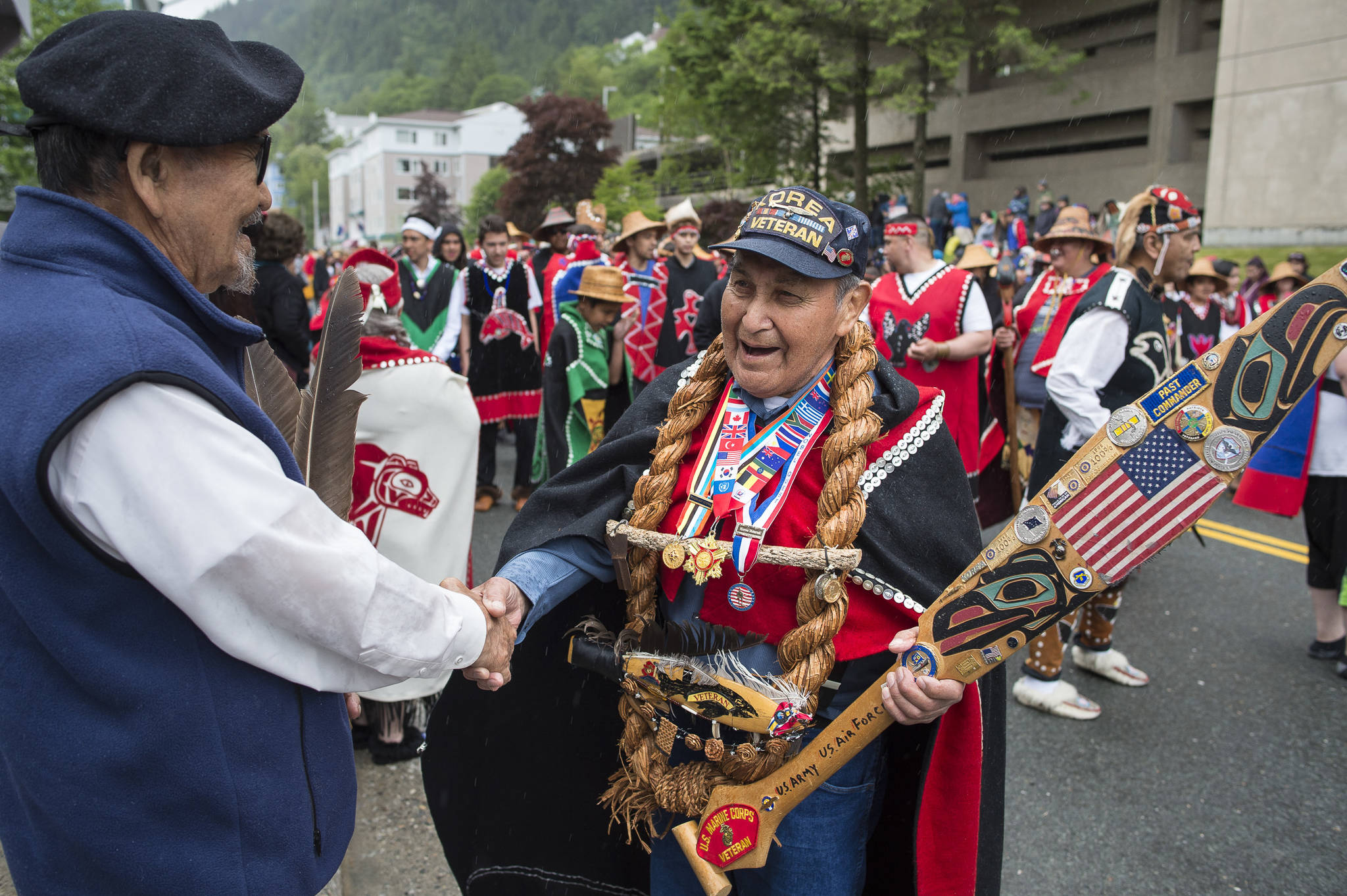
Marine veteran Marvin Kadake, right, of the Keex’ Kwaan Dancers (People of Kake) shakes hands with Ed Kunz during the Grand Entrance for Celebration 2018 along Willoughby Avenue on Wednesday, June 6, 2018. (Michael Penn | Juneau Empire)
Saxe also discussed plans to increase operations in rural Alaska, placing them in close proximity with the Native communities in their homes.
“I think that the Guard is way too focused in Anchorage and Fairbanks,” Saxe said. “I want to put the Guard back in rural Alaska.”
Saxe said that the exercises would be centered around areas with runways in the 5,000-7,000 foot range to support aviation operations from larger military aircraft. He also said that exercises into more rural parts would begin in 2020 with an exercise in Bethel, a reversal on recent policy to concentrate forces and exercises in more urban areas.
[Legendary Loss: Alaska Native frogman, SEAL, mayor passes away in Metlakatla]
“In the last 14 months, your alert forces have intercepted 12 Russian bombers, four Russian fighter aircraft and four reconnaissance aircraft from the Russian air force that have penetrated the Alaska Identification Zone,” said Lt. Gen Tom A. Bussiere, commanding general of 11th Air Force, based out of Joint Base Elemendorf-Richardson.
Bussiere said the Air Force was reinforcing its mission here in Alaska, providing air defense from any hostile threats to North American airspace, including the largest concentration of 5th generation fighters — F-22s and F-35s — in the country. The Air Force is also augmenting Clear Air Force Station and Fort Greely with enhanced radars for anti-aircraft and anti-missile operations for defending against any hostile targets coming over the pole or Alaska.
Other units are more focused on things at ground level. The Army Corps of Engineers has an active presence in Alaska, led by Col. Phillip Borders, the commander of the Alaska District for the ACOE.
“One of the biggest things I love to talk about is that, in partnership in FY19, over 75 percent of small business contracts awarded by the Alaska district were awarded to Alaska Natives,” Borders said. The contracts had an estimated $180 million value, Borders said.
[Coast Guard training with Marines and Navy in Alaska exercise]
The ACOE is also working actively with a number of communities on civil projects, such as flood and erosion control, navigation improvement, coastal erosion control, and the remote and subsistence harbor assistance program, said Borders.
Coast Guard District 17, based in Juneau, is also expanding operations, including a recent joint exercise with the Navy and Marine Corps as they sought to integrate some of the Coast Guard’s hard-won experience operating in the high Arctic.
“It’s about 2,500 Coasties spread around the state, and they’re here for you,” said Rear Adm. Matt Bell, commanding officer of USCG D17. “They work for you, they protect you, they serve you across the expanse of Alaska.”
Bell said that the Coast Guard has carried out more than 500 missions and saved 220 lives in the last year. They’ve also assisted more than 500 people in trouble, and saved almost $25 million across Alaska in vessels and assets saved, Bell said.
“Given this state, given its distance, given its length, there’s no way the Coast Guard does it alone,” Bell said. “Partnerships are key.”
• Contact reporter Michael S. Lockett at 757-621-1197 or mlockett@juneauempire.com.
