
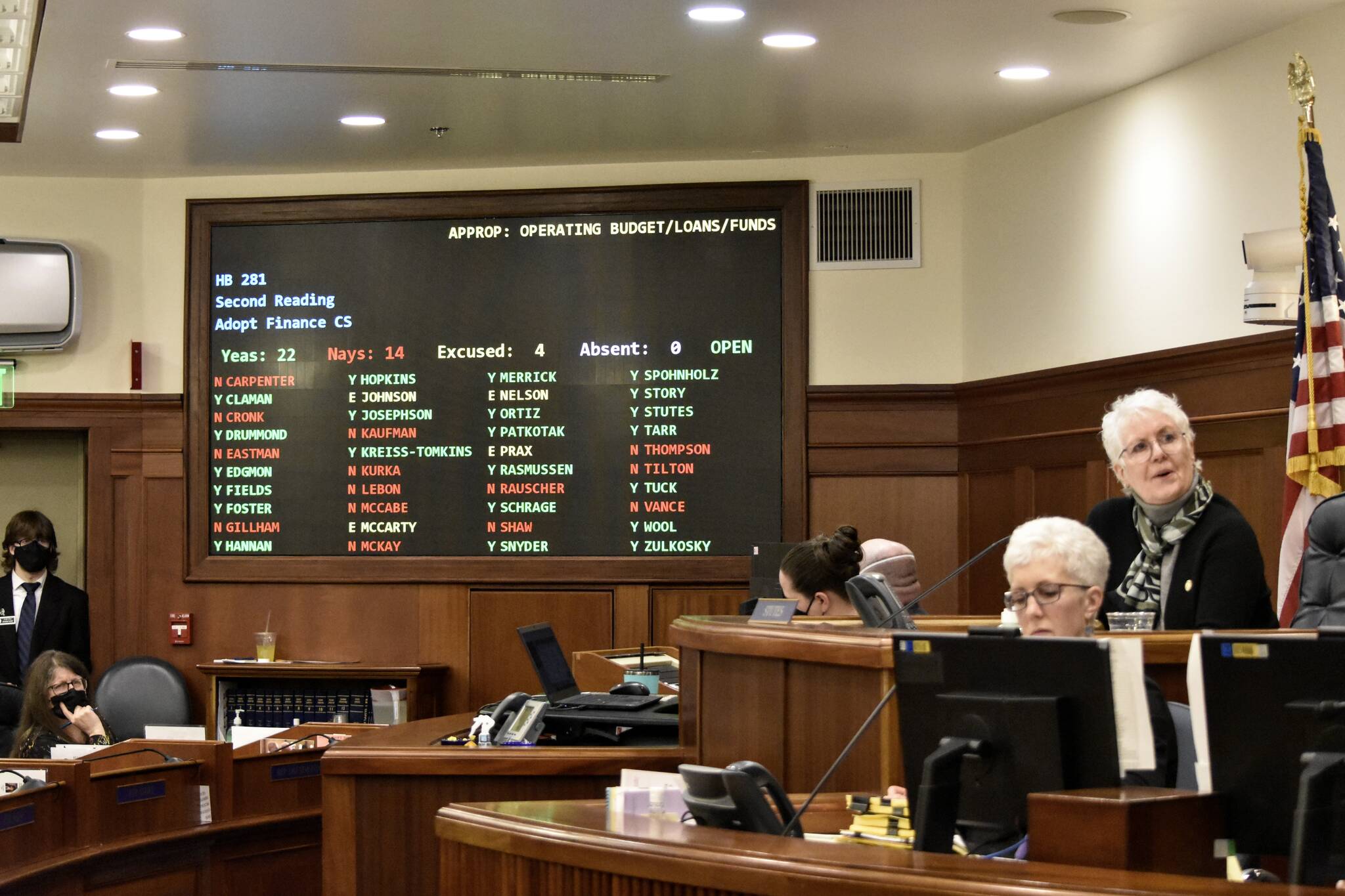
After a week of delays, the Alaska House of Representatives introduced the state’s operating and mental health budget bills, moving the legislation closer to final passage in that body and beginning the amendment process.
House meetings were canceled last week amid an outbreak of COVID-19 among lawmakers and staff and a refusal by some lawmakers to wear face masks while in the House chamber. Masking requirements were lifted at the Alaska State Capitol in February but following dozens of positive cases last week, House Speaker Louise Stutes, R-Kodiak, informed House members masks would temporarily be required on the floor.
But three Republican Reps. Ben Carpenter, Nikiski; Chris Kurka, Wasilla, and David Eastman, Wasilla, refused to wear masks, leading Stutes to cancel last week’s sessions. Stutes told House members Monday that because of the decline in COVID-19 cases at the Capitol masks are now optional.
Last week’s delays came as the House Finance Committee finalized its versions of the state operating and mental health budget bills and was preparing to introduce them to the floor. The state’s budget bills are initially introduced by the governor before undergoing changes in legislative finance committees.
On the floor Monday, several Republican lawmakers including House Minority Leader Cathy Tilton, R-Wasilla, objected to the introduction of the House Finance Committee’s substitute bill. Specifically, Tilton noted the difference in the proposed Permanent Fund dividend in the committee’s bill.
Tilton said she was concerned, “how the dividend is treated in the original budget bill versus how it is treated in the (committee substitute).”
The committee bill has a smaller PFD than the $2,500 proposed by Gov. Mike Dunleavy in his initial budget proposal, but in February the House Majority Coalition announced it was proposing a $1,300 “energy relief check” in addition to the bill’s proposed PFD of $1,200
Following updated revenue projections in March, Dunleavy said the state could afford a PFD of “at least” $3,700.
Rep. Sara Rasmussen, R-Anchorage, who sits on the Finance Committee and is not a member of any caucus in the House, noted to lawmakers that once introduced, bills are subject to an amendment process where changes can be made.
The committee substitute makes several other substantial changes from the governor’s proposals including increasing per-student funding in line with a bill from Rep. Andi Story, D-Juneau, and a proposal from Rasmussen to pay off state oil tax credits.
[Candidate crowd balloons on last day to register for special election]
Stutes told House members amendments to the bill were due at 2 p.m. Monday, noting last week’s delays had given lawmakers several days to submit amendments to the bill. Debate on amendments to the budget bills are set to take place Tuesday, according to Joe Plesha, spokesman for the House Majority.
The constitutional end of the legislative session is May 18, and the state’s budget is the only thing the Legislature is constitutionally required to pass each year. Last year lawmakers went through multiple special sessions before the budget process was finalized.
Infrastructure spending
But even as lawmakers finalize the existing portions of the state budget, Dunleavy Monday introduced bills with proposed matching funds for various federal programs under the bipartisan infrastructure law, the Infrastructure, Investment and Jobs Act.
In a meeting with reporters Monday, Dunleavy administration officials said because U.S. Congress only finalized the federal budget in March, guidance for applying to programs within the IIJA was only recently made available.
Identical bills were introduced in both bodies Monday, and according to a letter from the governor’s office, the bills propose using just under $80 million in state funding to access $868 million in federal funding.
According to the letter, $58.8 million in state funds would be used to access $560 million in non-competitive, formula-based funding for surface transportation programs, the Department of Environmental Conservation’s Water and Wastewater Programs and the Department of Military and Veterans Affairs’ program for state and local cybersecurity grants.
The additional $21.5 million would be used on investments to make the state more attractive for the competitive grants Alaska will be vying against every other state for, officials said. That includes the creation of an infrastructure coordination office to help manage the infrastructure opportunities across multiple relevant agencies.
Several federal funding opportunities are targeted to non-state entities, the governor’s office said, including local governments, tribes, nonprofits, education institutions, utilities and commercial industry. The bill includes $3 million for the Alaska Federation of Natives and the Alaska Municipal League to help non-state organizations with issues related to the infrastructure bill.
• Contact reporter Peter Segall at psegall@juneauempire.com. Follow him on Twitter at @SegallJnuEmpire.
