
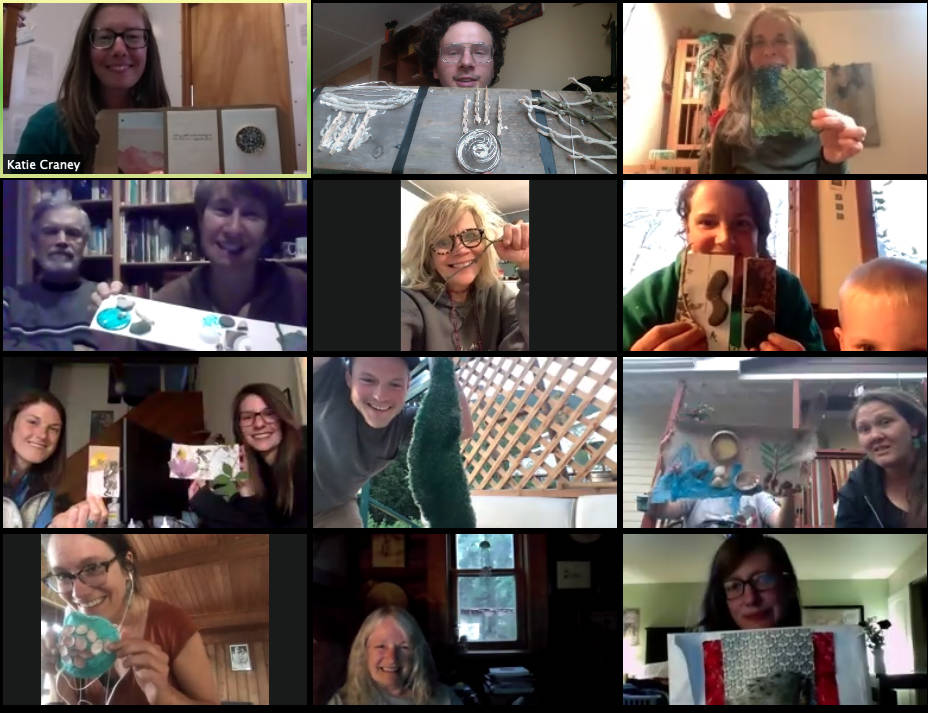
This screenshot of a Zoom event shows a workshop led by artist Katie Craney. It was one in a series of events planned by Southeast Alaska Conservation Council focused on producing climate change-focused art. (Courtesy Photo | Matt Jackson, SEACC)                                Courtesy Photo | Matt Jackson, SEACC                                This screenshot of a Zoom event shows a workshop led by artist Katie Craney. It was one in a series of events planned by Southeast Alaska Conservation Council focused on producing climate change-focused art.

This screenshot of a Zoom event shows a workshop led by artist Katie Craney. It was one in a series of events planned by Southeast Alaska Conservation Council focused on producing climate change-focused art. (Courtesy Photo | Matt Jackson, SEACC) Courtesy Photo | Matt Jackson, SEACC This screenshot of a Zoom event shows a workshop led by artist Katie Craney. It was one in a series of events planned by Southeast Alaska Conservation Council focused on producing climate change-focused art.

Arts and activism are coming to a screen near you

Zines and pop-up shops could be coming later on.

Naawéiyaa Tagaban has practiced traditional spruce root basket weaving for about seven years, but over the last couple of years, the Tlingit-Cherokee-Filipino artist has been attracted to the idea of art for action.

Tagaban, who is a Southeast Alaska Conservation Council board member and Juneau resident, will be the next artist in a series of Zoom events focused on making art about climate change. Tagaban’s presentation will focus on how to make stencils and wheat paste.

“We want people to come away from this event with not only one stencil and one sign, but the skills to make them over and over again,” Tagaban said in a recent video interview. “For me, it’s about skill-building.”

He said stenciled designs can be used to give posters or signs a uniform look or to easily reproduce an image that’s intended to be used for multiple events.

[Juneau activists stand with Canadian protesters]

“It’s important to think about having a unified message,” Tagaban said.

Wheatpaste, Tagaban said, is an adhesive made from flour that can be dissolved by water. It can be used to affix fliers or posters to a surface in a non-destructive way.

“The idea is it’s non-permanent,” Tagaban said. “Here, in Alaska, it’s very non-permanent.”

The Zoom event, slated for 5:30 p.m., Wednesday is the fourth in a series of climate change-focused arts happenings. Past events have featured Sitka artist Ellie Schmidt, Haines artist Katie Craney and Ketchikan artist Matt Hamilton.

Matt Jackson, climate organizer for SEACC, who joined Tagaban for a video interview, said the goal was to spotlight young artists as well as creators who have already cultivated a following.

Initially, the events were planned to be in-person, but that was derailed by COVID-19, Jackson said.

“We had been all set up to do a workshop for First Friday in April,” Jackson said. “Then, the world turned upside down.”

However, Jackson said the idea of blending art and climate change remained a goal, and the Zoom series took shape.

“I think climate change is a really interesting challenge for our time because it’s not just a policy problem we need solutions for. It’s also a social and cultural problem. It has a potential to win hearts in a way that policy solutions don’t.”

Jackson said there are plans to submit images produced through the art workshops to Alaska’s congressional delegation and perhaps for a physical zine or pop-up galleries once in-person gatherings resume. He said it’s hoped there will be future virtual events too, but specifics are still being determined.

“Art can help us cope with our anxieties and envision a new world,” Jackson said.

• Contact Ben Hohenstatt at (907)308-4895 or bhohenstatt@juneauempire.com. Follow him on Twitter at @BenHohenstatt.

Know & Go

What: Hunker Down for Climate Change with Naawéiyaa Tagaban

When: 5:30 p.m., Wednesday, June 10.

Where: Via Zoom.

How: Attendance requires an RSVP. Those can be submitted at SEACC.org/juneauhunkerdown.

More in News

Brenda Schwartz-Yeager gestures to her artwork on display at Annie Kaill’s Gallery Gifts and Framing during the 2025 Gallery Walk on Friday, Dec. 5. (Mari Kanagy / Juneau Empire)
Alaska artist splashes nautical charts with sea life

Gallery Walk draws crowds to downtown studios and shops.

A totem pole, one of 13 on downtown’s Totem Pole Trail in Juneau, Alaska, Nov. 27, 2024. (Christopher S. Miller/The New York Times)
Downtown Juneau experiences its first significant city-level snow fall of the season as pictured on Saturday, Dec. 6, 2025. (Mari Kanagy / Juneau Empire)
Sub-zero temperatures to follow record snowfall in Juneau

The National Weather Service warns of dangerous wind chills as low as -15 degrees early this week.

A truck rumbles down a road at the Greens Creek mine. The mining industry offers some of Juneau’s highest paying jobs, according to Juneau Economic Development’s 2025 Economic Indicator’s Report. (Hecla Greens Creek Mine photo)
Juneau’s economic picture: Strong industries, shrinking population

JEDC’s 2025 Economic Indicators Report is out.

Map showing approximate location of a 7.0-magnitude earthquake on Saturday, Dec. 6, 2025. (Courtesy/Earthquakes Canada)
7.0-magnitude earthquake hits Yukon/Alaska border

Earthquake occurred about 55 miles from Yakutat

A commercial bowpicker is seen headed out of the Cordova harbor for a salmon fishing opener in June 2024 (Photo by Corinne Smith)
Planned fiber-optic cable will add backup for Alaska’s phone and high-speed internet network

The project is expected to bring more reliable connection to some isolated coastal communities.

Gustavus author Kim Heacox talked about the role of storytelling in communicating climate change to a group of about 100 people at <strong>Ḵ</strong>unéix<strong>̱</strong> Hídi Northern Light United Church on Wednesday, Dec. 3, 2025. (Mari Kanagy / Juneau Empire)
Author calls for climate storytelling in Juneau talk

Kim Heacox reflects on what we’ve long known and how we speak of it.

The Juneau road system ends at Cascade Point in Berners Bay, as shown in a May 2006 photo. (Michael Penn / Juneau Empire file)
State starts engineering for power at proposed Cascade Point ferry terminal

DOT says the contract for electrical planning is not a commitment to construct the terminal.

Most Read