
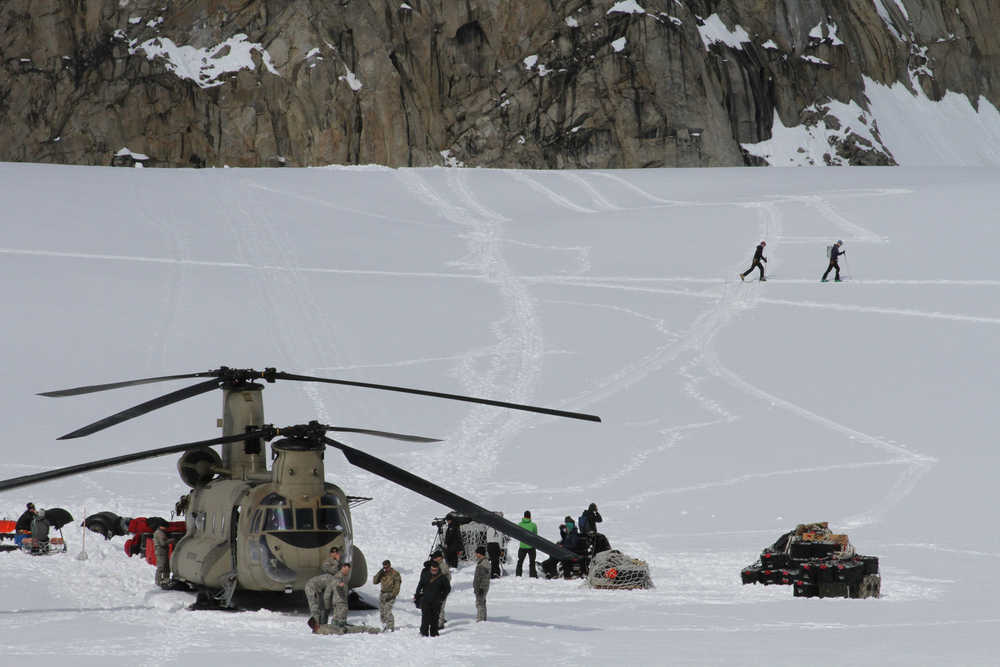
KAHILTNA GLACIER — Three U.S. Army Chinook helicopters the size of city buses ascend higher and higher in the Alaska Range, following the 44-mile long Kahiltna Glacier, which from above resembles a frozen, mile-wide white ribbon of ice cutting through craggy mountains.
At 7,200 feet, they land light as a feather at the base of North America’s tallest mountain, below a few brightly colored tents, temporary shelters for early season climbers dotting the white landscape.
There’s nothing military about this mission. Instead, these Chinooks are delivering potentially lifesaving food and medical equipment for two base camps, one at 7,200 feet and the other at 14,000 feet, to assist those attempting to climb the 20,310-foot Denali.
But it’s not just a delivery job for the Army, ferrying this equipment up the mountain for the National Park Service. It’s training for when the helicopters need to fly in high altitude locations such as Afghanistan, which one of the helicopter pilots said most closely resembles Alaska.
“It’s really valuable training in a really unique location in high-altitude flying, in hoist training and then mountainous area flying,” said Capt. Corey Wheeler, commander of B Company, 1st Battalion, 52nd Aviation Regiment.
The unit, which goes by the more non-militaristic nickname of Sugar Bears, is based at Fort Wainwright, near Fairbanks, Alaska.
“This is one of the opportunities we have here in Alaska that really they don’t get in a lot of the other places in the Lower 48,” said the pilot, Chief Warrant Officer III Kirk Donovan, who was wearing dark sunglasses to fend off the unforgiving sunlight glistening off the glacier.
Among the benefits is taking “the helicopter right to the very limit of what it will and will not do. But on top of that, it gets all the guys familiar with the competence and the confidence it takes to fly up there on a regular basis,” he said.
The Chinooks were temporarily based at the airstrip in nearby Talkeetna, Alaska, the quirky little tourist town where climbers get their last taste of civilization before heading up the mountain.
They flew supplies to the lower base camp on April 24, where soldiers slogged, slipped and sank in 2 feet of snow trying to off load telecommunication equipment, plywood flooring for tents, propane tanks, fuel blivets and boxes of frozen food.
The supplies for the higher base camp were set aside for delivery at a later date, when a park service helicopter could fly the supplies higher up the mountain and when rangers were in place to receive them.
The Army has helped establish the base camps for decades when not deployed, and in those years it helps reduce the carbon footprint of getting supplies on the mountain, said Dan Corn, one of Denali rangers.
“It helps out a tremendous amount because we get everything in here with one load,” Corn said. It would take a small aircraft 10 or 11 trips to match the 12 1/2-ton carrying capacity of a Chinook.
That wasn’t the most impressive part of the helicopters for Geoffrey Johnson, a Boston man who was spending a two-week climbing and skiing trip with a friend.
“The rotor wash was quite powerful and it blew the center pole of our cook tent through the snow base that we had erected for it,” he said of one Chinook’s landing about 100 yards downglacier from their tent.
Johnson and his friend never intended to climb Denali, instead setting their sights on the smaller 10,450-foot Mount Frances — which was right outside the flap of their tent. Those attempting to climb Denali arrive in late April, and the main climbing season goes through early July.
As of Tuesday, there were 759 climbers on Denali, attempting to become the first to reach the summit after the Obama administration changed the name of Mount McKinley late last summer to its traditional Alaska Native name.
