
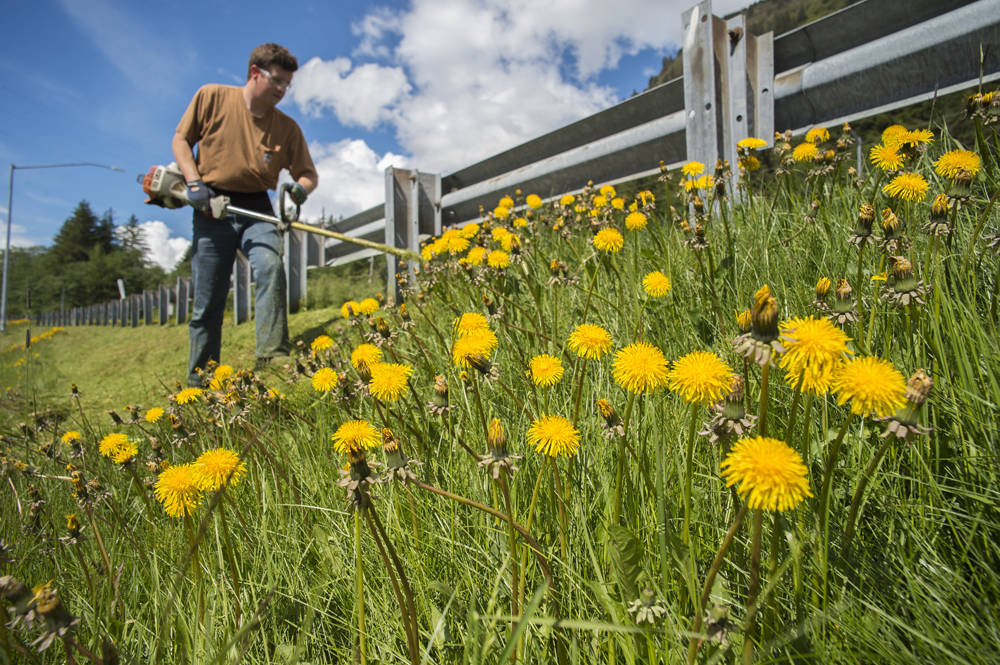
Their cheery, bright yellow flower heads adorn the roadsides in late spring, before the compulsive mowing machines decapitate them. Foraging deer, bears, and human herbivores make use of their good nutrition. Bees and other insects visit the showy flower heads for nectar and pollen.
Dandelions seem to be everywhere in spring — roadsides, trailsides, some gardens, and even out on the rocky sea stacks. That widespread distribution led someone to ask if they are taking over the whole country. The simple answer is No. Dandelions are very good at colonizing open ground. They belong to a suite of weedy plants that specialize in colonizing disturbed sites — an ecological way of life known as “ruderal.” Their numerous airborne plumed seeds waft about, sometimes for long distances, and a lucky few will land on disturbed ground such as roadsides, trailsides and gardens (to the dismay of gardeners who have just weeded out the ‘last’ dandelion from their vegetable beds). So although a glance at our roadsides might make it seem like dandelions are taking over, unless all native habitats are disturbed by removing the original vegetation and rumpling the soil, dandelions are not going to take over everyplace.
The dandelions we see along the roads and trails probably belong to the species Taraxacum officinale, which originated in Eurasia and has become naturalized here. It has been on this continent for several hundred years, either brought over (intentionally or not) by immigrants from Europe or somehow by seeds blown over the ocean. In that time span, this dandelion has managed to spread all over North America in disturbed habitats.
When seeds are produced, the flower stem elongates, to raise the seed head above much of the surrounding vegetation. Each seed bears a long-stalked, puffy ‘parachute’ that catches any available breeze that might carry it to a new spot for colonization. Both the structure of the seed and parachute and the stem elongation are dispersal adaptations that aid the species’s ruderal strategy. But those adaptations are just part of the story.
Taraxacum officinale is generally known to be obligately asexual, producing seeds without pollination. That would mean that all offspring would be just like their mother — essentially forming a clone identical to her. The ability to reproduce asexually is another feature that helps to make the ruderal way of life successful — one plant can start a whole new population.
However, endless asexuality tends to reduce genetic diversity, which would eventually lead to considerable uniformity among all the individuals in a population. And that, in turn, as we know from what happens to genetically uniform crops when stricken by certain afflictions, can lead to catastrophic failure for the whole population. That somehow has not happened for dandelions, for various reasons. Mutations may occur, so that some offspring are a bit different from their mothers, and new asexual clones get started. Researchers have found that there is a further complication: the asexual dandelions are generally triploid (with three sets of chromosomes instead of the usual two sets) and during the process of seed formation there may be some recombination of genes between chromosomes, thus adding to the genetic diversity of the population. There is even a hint that pollination may (rarely) occur, such that some resulting seeds have been produced by sexual means, introducing still more genetic diversity to the population. In any case, as a result of mutation and occasional recombination, any population of dandelions is likely to be comprised of many clones.
All of that, however, leaves open a major evolutionary question about dandelion flowers. The function of flowers is sexual reproduction — attracting pollinators that convey pollen from one plant to another. But if the introduced dandelions reproduce without sex (at least almost always), why do they make such attractive floral displays? The bright yellow inflorescence is comprised of many small flowers, which offer nectar and pollen to insect visitors; production of flowers, pollen, and nectar is costly of energy. So why do it if reproduction is not sexual? It might be that dandelions engage in surreptitious sex more often than is thought to happen. Or perhaps the beautiful yellow inflorescence is a legacy of the past, reflecting the sexual reproductive habits of the ancestors of the present, clonal species.
In Southeast Alaska, besides the Eurasian dandelion, there are also two native species of dandelion that typically live in alpine and subalpine habitats. One of these is known to be obligately sexual, requiring pollen transfer between flowers. Bees and other flower-visiting insects might not discriminate between the native and the invasive species and may visit both in quick succession. Hand-pollination experiments have shown that pollen transferred from the invader to the sexually reproducing native species can result in some seed production, so genes from the invader may be assimilated by the native species. Such hybridization tends to obscure the distinction between the species. There is also a possibility that viable pollen from T. officinale could interfere with seed production in the native dandelion species (as has been reported for a similar situation in Japan).
The genetics of dandelions can be complex, and the taxonomy of the genus is quite confusing, with differences of opinion about which variants to call separate species. For now, suffice it to say that T. officinale is a highly successful ruderal, one that brightens our landscape with color.
• Mary F. Willson is a retired professor of ecology. “On The Trails” is a weekly column and appears every Friday. Her essays can be found online at onthetrailsjuneau.wordpress.com.
