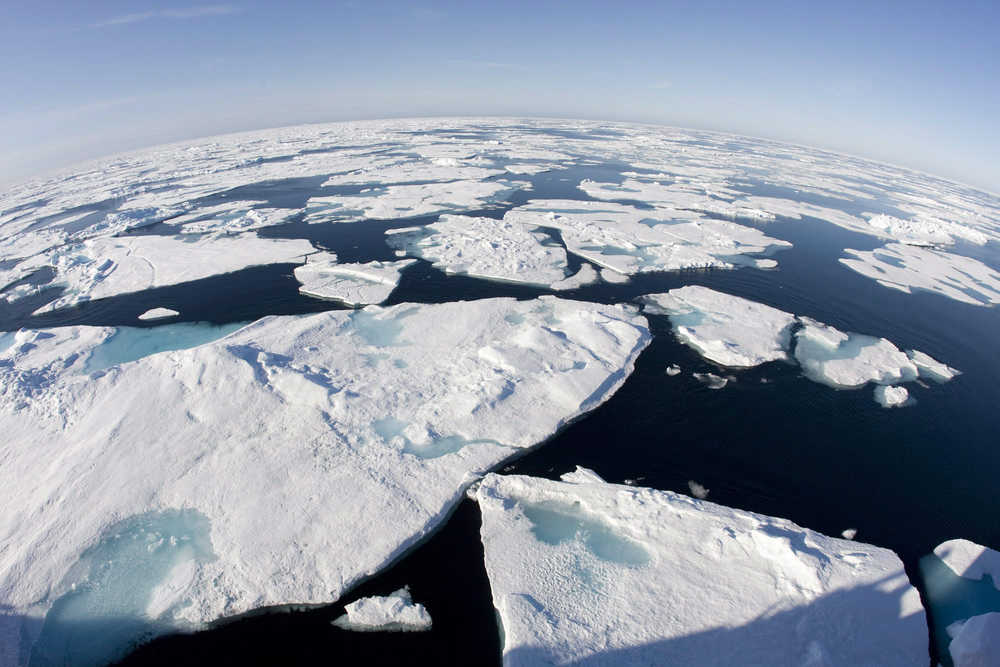
This July 10, 2008 photo made with a fisheye lens shows ice floes in Baffin Bay above the Arctic Circle, seen from the Canadian Coast Guard icebreaker Louis S. St-Laurent. I

This July 10, 2008 photo made with a fisheye lens shows ice floes in Baffin Bay above the Arctic Circle, seen from the Canadian Coast Guard icebreaker Louis S. St-Laurent. I

Arctic posts record warmth over land

NEW YORK — The warming Arctic has set another record.

The average air temperature over Arctic land reached 2.3 degrees F above average for the year ending in September. That’s the highest since observations began in 1900.

The new mark was noted in the annual Arctic Report Card, released Tuesday by the National Oceanic and Atmospheric Administration. The Arctic centers on the North Pole and reaches into North America and Eurasia.

“Warming is happening more than twice as fast in the Arctic than anywhere else in the world. We know this is due to climate change,” NOAA chief scientist Rick Spinrad told reporters in San Francisco at a meeting of the American Geophysical Union.

Another record emerged for sea ice, which appears when Arctic Ocean water freezes. When it reached its peak coverage in February, it was the lowest maximum extent since records began in 1979. The minimum ice coverage, reached in September, was the fourth lowest on record.

The retreat of sea ice is considered a threat to animals like walruses, which use it for mating, giving birth and getting out of the water.

Walruses can use land instead to leave the water, but they are crowding onto beaches where a stampede can be devastating for calves, two editors of the report card told AP.

Walruses have been hauling themselves out on land in northwest Alaska, a recent phenomenon, Martin Jeffries of the federal Office of Naval Research and Jackie Richter-Menge of the U.S. Army Corps of Engineers wrote in a joint email.

Snow cover in June in both the North American and Eurasian parts of the Arctic was at the second lowest level since records began in 1967. Reduced snow cover lets more sunlight through to the land, which absorbs the energy and gets warmer. Since 1979, the extent of June snow cover has been dropping by 18 percent per decade, the study said.

___

Online:

Report card: http://www.arctic.noaa.gov/reportcard

More in News

The northern lights are seen from the North Douglas launch ramp late Monday, Jan. 19. A magnetic storm caused unusually bright northern lights Monday evening and into Tuesday morning. (Chloe Anderson/Juneau Empire)
Rare geomagnetic storm causes powerful aurora display in Juneau

The northern lights were on full display Monday evening.

teaser
Juneau activists ask Murkowski to take action against ICE

A small group of protesters attended a rally and discussion on Wednesday.

A female brown bear and her cub are pictured near Pack Creek on Admiralty Island on July 19, 2024. (Chloe Anderson for the Juneau Empire)
Pack Creek permits for bear viewing area available now

Visitors are welcome from April 1 to Sept. 30.

Cars pass down Egan Drive near the Fred Meyer intersection Thursday morning. (Clarise Larson / Juneau Empire file photo)
Safety changes planned for Fred Meyer intersection

DOTPF meeting set for Feb. 18 changes to Egan Drive and Yandukin intersection.

Herbert River and Herbert Glacier are pictured on Nov. 16, 2025. (Mari Kanagy / Juneau Empire)
Forest Service drops Herbert Glacier cabin plans, proposes trail reroute and scenic overlook instead

The Tongass National Forest has proposed shelving long-discussed plans to build a… Continue reading

A tsunami is not expected after a 4.4-magnitude earthquake northwest of Anchorage Wednesday, Feb. 4, 2026. (U.S. Geological Survey)
No tsunami expected after 4.4-magnitude earthquake in Alaska

U.S. Geological Survey says 179 people reported feeling the earthquake.

ORCA Adaptive Snowsports Program staff member Izzy Barnwell shows a man how to use the bi-ski. (SAIL courtesy photo)
Adaptive snow sports demo slides to Eaglecrest

Southeast Alaska Independent Living will be hosting Learn to Adapt Day on Feb. 21.

Cars drive aboard the Alaska Marine Highway System ferry Hubbard on June 25, 2023, in Haines. (Photo by James Brooks)
Alaska’s ferry system could run out of funding this summer due to ‘federal chaos problem’

A shift in state funding could help, but a big gap likely remains unless a key federal grant is issued.

Photo by James Brooks/Alaska Beacon
U.S. Sen. Dan Sullivan stands with acting Coast Guard Commandant Adm. Kevin Lunday during the after the commissioning ceremony for the Coast Guard icebreaker Storis on Sunday, Aug. 10, 2025, in Juneau, Alaska.
Coast Guard’s new Juneau base may not be complete until 2029, commandant says

Top Coast Guard officer says he is considering whether to base four new icebreakers in Alaska.

Most Read