
The Trump administration considered a proposal to mobilize as many as 100,000 National Guard troops to round up unauthorized immigrants, including millions living nowhere near the Mexico border, according to a draft memo obtained by The Associated Press.
Staffers in the U.S. Department of Homeland Security said they had been told by colleagues in two DHS departments that the proposal was still being considered as recently as Feb. 10. A DHS official described the document as a very early draft that was not seriously considered and never brought to Homeland Security Secretary John Kelly for approval.
The 11-page document calls for the unprecedented militarization of immigration enforcement as far north as Portland, Oregon, and as far east as New Orleans, Louisiana. The document can be accessed at http://apne.ws/2l1Dj0k
Four states that border on Mexico were included in the proposal — California, Arizona, New Mexico and Texas — but it also encompasses seven states contiguous to those four — Oregon, Nevada, Utah, Colorado, Oklahoma, Arkansas and Louisiana.
White House spokesman Sean Spicer said Friday the document was “not a White House document.”
“There is no effort to do what is potentially suggested,” he said. Spicer called the AP report “100 percent not true,” adding that there was “no effort at all to utilize the National Guard to round up unauthorized immigrants.”
The AP had sought comment from the White House beginning Thursday and DHS earlier Friday and had not received a response from either.
Governors in the 11 states would have had a choice whether to have their guard troops participate, according to the memo, which bears the name of Kelly, a retired four-star Marine general.
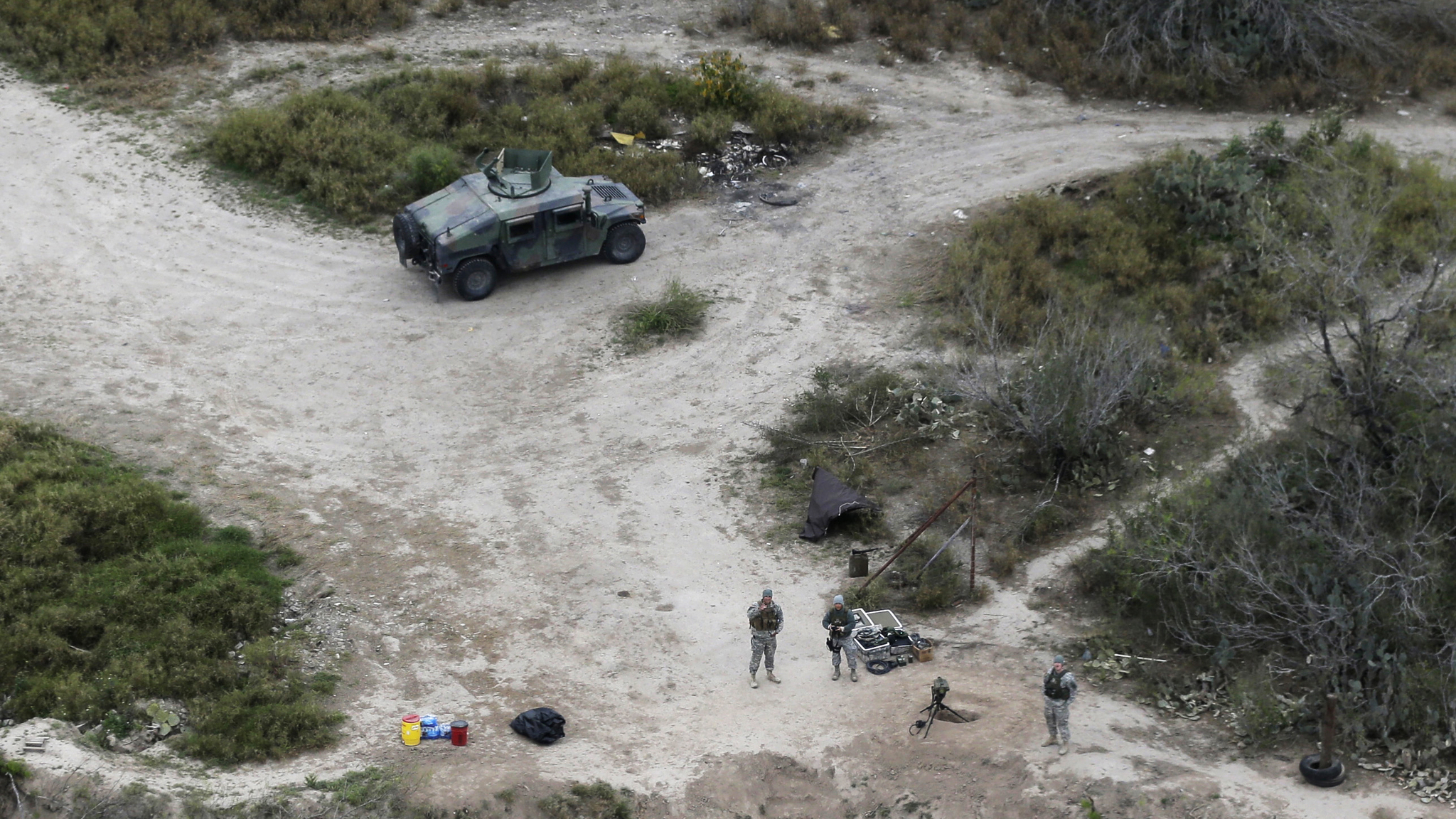
While National Guard personnel have been used to assist with immigration-related missions on the U.S.-Mexico border before, they have never been used as broadly or as far north.
The memo was addressed to the then-acting heads of U.S. Immigration and Customs Enforcement and U.S. Customs and Border Protection. It would have served as guidance to implement the wide-ranging executive order on immigration and border security that President Donald Trump signed Jan. 25. Such memos are routinely issued to supplement executive orders.
Also dated Jan. 25, the draft memo says participating troops would be authorized “to perform the functions of an immigration officer in relation to the investigation, apprehension and detention of aliens in the United States.” It describes how the troops would be activated under a revived state-federal partnership program, and states that personnel would be authorized to conduct searches and identify and arrest any unauthorized immigrants.
If implemented, the impact could have been significant. Nearly one-half of the 11.1 million people residing in the U.S. without authorization live in the 11 states, according to Pew Research Center estimates based on 2014 Census data.
Use of National Guard troops would greatly increase the number of immigrants targeted in one of Trump’s executive orders last month, which expanded the definition of who could be considered a criminal and therefore a potential target for deportation. That order also allows immigration agents to prioritize removing anyone who has “committed acts that constitute a chargeable criminal offense.”
Under current rules, even if the proposal had been implemented, there would not be immediate mass deportations. Those with existing deportation orders could be sent back to their countries of origin without additional court proceedings. But deportation orders generally would be needed for most other unauthorized immigrants.
The troops would not be nationalized, remaining under state control.
Spokespeople for the governors of 10 of the states either declined to comment or said it was premature to discuss whether they would participate.
Arkansas Gov. Asa Hutchinson said his state had not had any contact about the proposal, but added, “I would have concerns about the utilization of National Guard resources for immigration enforcement. I believe it would be too much of a strain on our National Guard personnel.”
Oregon Gov. Kate Brown said she was “glad to hear” that DHS said they never seriously considered the draft memo,” according to her press secretary, Chris Pair. He said Brown will fight to keep Oregon “a welcoming and inclusive place for all Oregonians, regardless of heritage, religion, or immigration status.”
The proposal would have extended the federal-local partnership program that President Barack Obama’s administration began scaling back in 2012 to address complaints that it promoted racial profiling.
The 287(g) program, which Trump included in his immigration executive order, gives local police, sheriff’s deputies and state troopers the authority to assist in the detection of immigrants who are in the U.S. illegally as a regular part of their law enforcement duties on the streets and in jails.
The draft memo also mentions other items included in Trump’s executive order, including the hiring of an additional 5,000 border agents, which needs financing from Congress, and his campaign promise to build a wall between the U.S. and Mexico.
The signed order contained no mention of the possible use of state National Guard troops.
According to the draft memo, the militarization effort was to be proactive, specifically empowering Guard troops to solely carry out immigration enforcement, not as an add-on the way local law enforcement is used in the program.
Allowing Guard troops to operate inside non-border states also would go far beyond past deployments.
In addition to responding to natural or man-made disasters or for military protection of the population or critical infrastructure, state Guard forces have been used to assist with immigration-related tasks on the U.S.-Mexico border, including the construction of fences.
In the mid-2000s, President George W. Bush twice deployed Guard troops on the border to focus on non-law enforcement duties to help augment the Border Patrol as it bolstered its ranks. And in 2010, then-Arizona Gov. Jan Brewer announced a border security plan that included Guard reconnaissance, aerial patrolling and military exercises.
In July 2014, then-Texas Gov. Rick Perry ordered 1,000 National Guard troops to the border when the surge of migrant children fleeing violence in Central America overwhelmed U.S. officials responsible for their care. The Guard troops’ stated role on the border at the time was to provide extra sets of eyes but not make arrests.
Bush initiated the federal 287(g) program — named for a section of a 1996 immigration law — to allow specially trained local law enforcement officials to participate in immigration enforcement on the streets and check whether people held in local jails were in the country illegally. ICE trained and certified roughly 1,600 officers to carry out those checks from 2006 to 2015.
The memo describes the program as a “highly successful force multiplier” that identified more than 402,000 “removable aliens.”
But federal watchdogs were critical of how DHS ran the program, saying it was poorly supervised and provided insufficient training to officers, including on civil rights law. Obama phased out all the arrest power agreements in 2013 to instead focus on deporting recent border crossers and immigrants in the country illegally who posed a safety or national security threat.
Trump’s immigration strategy emerges as detentions at the nation’s southern border are down significantly from levels seen in the late 1990s and early 2000s. Last year, the arrest tally was the fifth-lowest since 1972. Deportations of people living in the U.S. illegally also increased under the Obama administration, though Republicans criticized Obama for setting prosecution guidelines that spared some groups from the threat of deportation, including those brought to the U.S. illegally as children.
Last week, ICE officers arrested more than 680 people around the country in what Kelly said were routine, targeted operations; advocates called the actions stepped-up enforcement under Trump.
Read draft memo here: http://apne.ws/2l1Dj0k
