
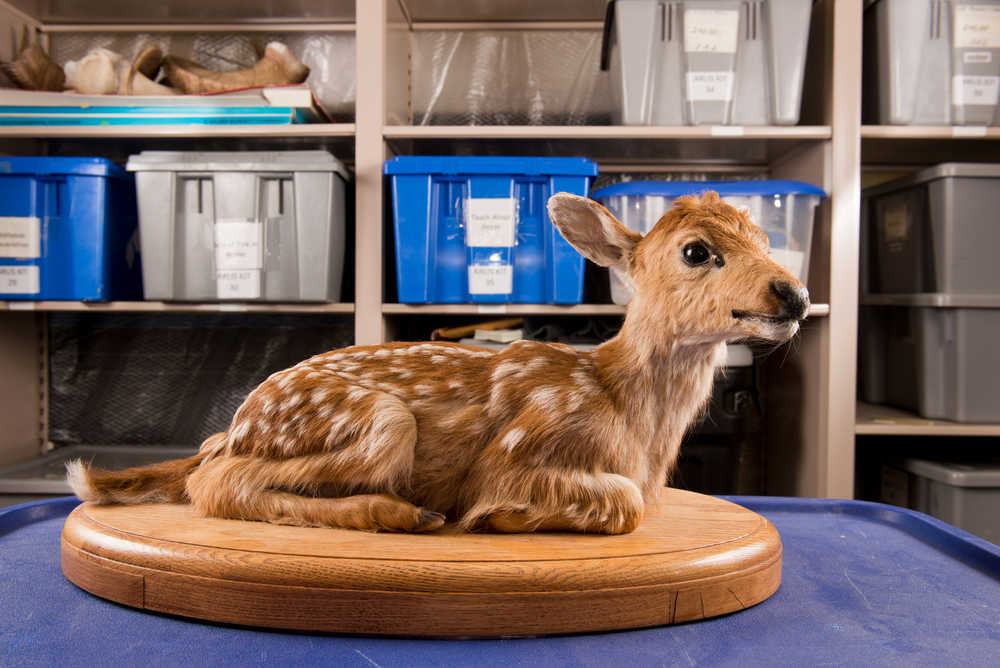
ANCHORAGE — Need to borrow a polar bear fur? Or a walrus skull complete with tusks? Or how about a beluga whale vertebrae or piece of baleen?
All you need is a library card and a trip to the Alaska Resources Library and Information Services on the University of Alaska Anchorage campus.
The library — better known as ARLIS — is home to the furs, mounts and skulls collection. It’s where hundreds of animal specimens from wolverine furs to stuffed puffins are available for checkout by the general public.
The collection is housed in a staff-only section of the library, but search the catalog for realia — the library classification for real, 3D objects — and any object can be yours. For two weeks at a time, as long as you have an ARLIS, UAA or Anchorage library card.
According to Celia Rozen, ARLIS collection development coordinator and Alaska Department of Fish and Game librarian, the most popular items include bear and wolf furs, both of which are often used in Boy Scout promotion ceremonies. The snowy owl mounts are also popular, often needed for Harry Potter events.
“There’s no limit as to what people can do with it,” Rozen said.
Rozen said the collection was first developed in the late 1990s. Most of it came from Fish and Game, though some items have been donated through the U.S. Fish and Wildlife Service and other government entities. Recently the North Pacific Fisheries Observer Training Center donated over a dozen fish mounts and numerous stuffed shore birds.
Rozen said that before ARLIS, Fish and Game would sometimes lend out the preserved animals themselves, but had no formal system to do so. When ARLIS formed in 1997 and merged eight different natural and culture resource collections, it became easier to circulate the specimens.
Kristen Romanoff, an education specialist with Fish and Game, said it’s not uncommon for institutions to lend education kits, but those are often geared toward educators, not the general public. She said it’s rare to hear of libraries that lend out actual items.
“I don’t know that (museums or libraries) are set up where you have library card and the same way you check out a book you check out a bird,” she said.
About one item a day gets checked out, Rozen said. While educators mostly use the library, others, including Boy Scout troops, parents, day-camps, scientists and artists regularly borrow from the collection, Rozen said.
Some of the animals are even famous. Rozen said set designers for “The Frozen Ground” borrowed extensively from the collection for the film. Many of the animal mounts and furs in serial killer Robert Hansen’s fictionalized basement came from the library.
Rozen praised the efforts of the film crew. They even repaired a broken walrus tusk.
The mounts come with a little more responsibility for the user than your average book. Rozen said anyone who checks out the pieces has to sign a statement of responsibility. Mounts must stay in Plexiglas cases the library provides, the tags can’t be removed, and people are held financially liable for any damage.
She said for the most part, people return the specimens in near perfect condition. There have been exceptions, like when a polar bear hide came back with a slice up the middle. Rozen said it’s unclear what happened, but the day camp which borrowed the item paid hundreds of dollars in fees. She declined to name the camp.
South Anchorage High School science teacher Chris Backstrum was returning a ram horn to the library Thursday afternoon, dropping the item off at the circulation desk. He said he’s used items from the collection in his classroom for the last 15 years after hearing about the collection from a fellow teacher.
At beginning of each school year he heads to the collection and gets about 10 specimens for a three-day lab that allows students to get up close to the things they’ll be studying each year. He said having the resources available for his ninth grade biology and marine biology classes is tremendous.
“It gets them excited about being in biology class,” he said. “It starts the year off on a good foot.”
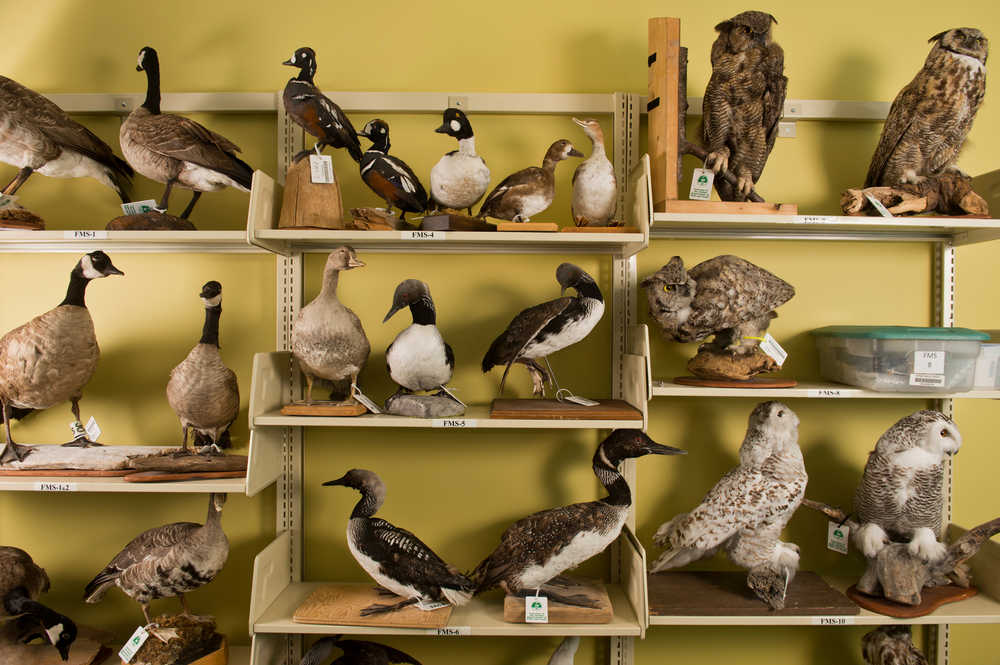
This photo taken Sept. 24 shows mounted geese, owls and waterfowl, part of the furs, mounts and skulls collection, stored inside University of Alaska Anchorage Consortium Library in Anchorage. The collection is housed in a staff-only section of the library, but search the catalog for realia, the library classification for real, 3D objects, and any object can be yours. For two weeks at a time, as long as you have an ARLIS, UAA or Anchorage library card.
