
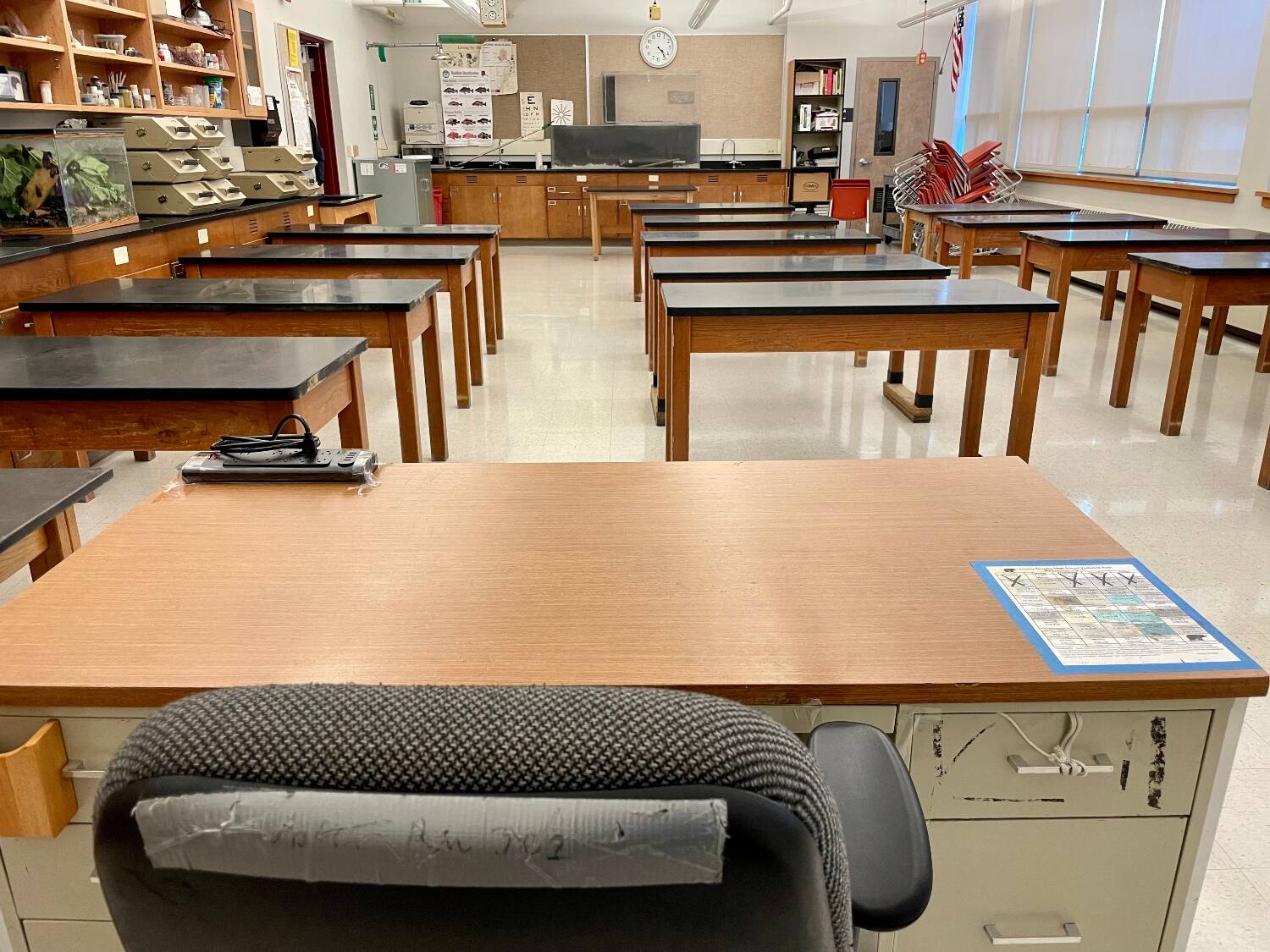
An empty classroom at Juneau-Douglas High School: Yadaa.at Kalé on July 20, 2022. (Photo by Lisa Phu/Alaska Beacon)

An empty classroom at Juneau-Douglas High School: Yadaa.at Kalé on July 20, 2022. (Photo by Lisa Phu/Alaska Beacon)

Alaska’s schools have among the highest rates of chronic absenteeism

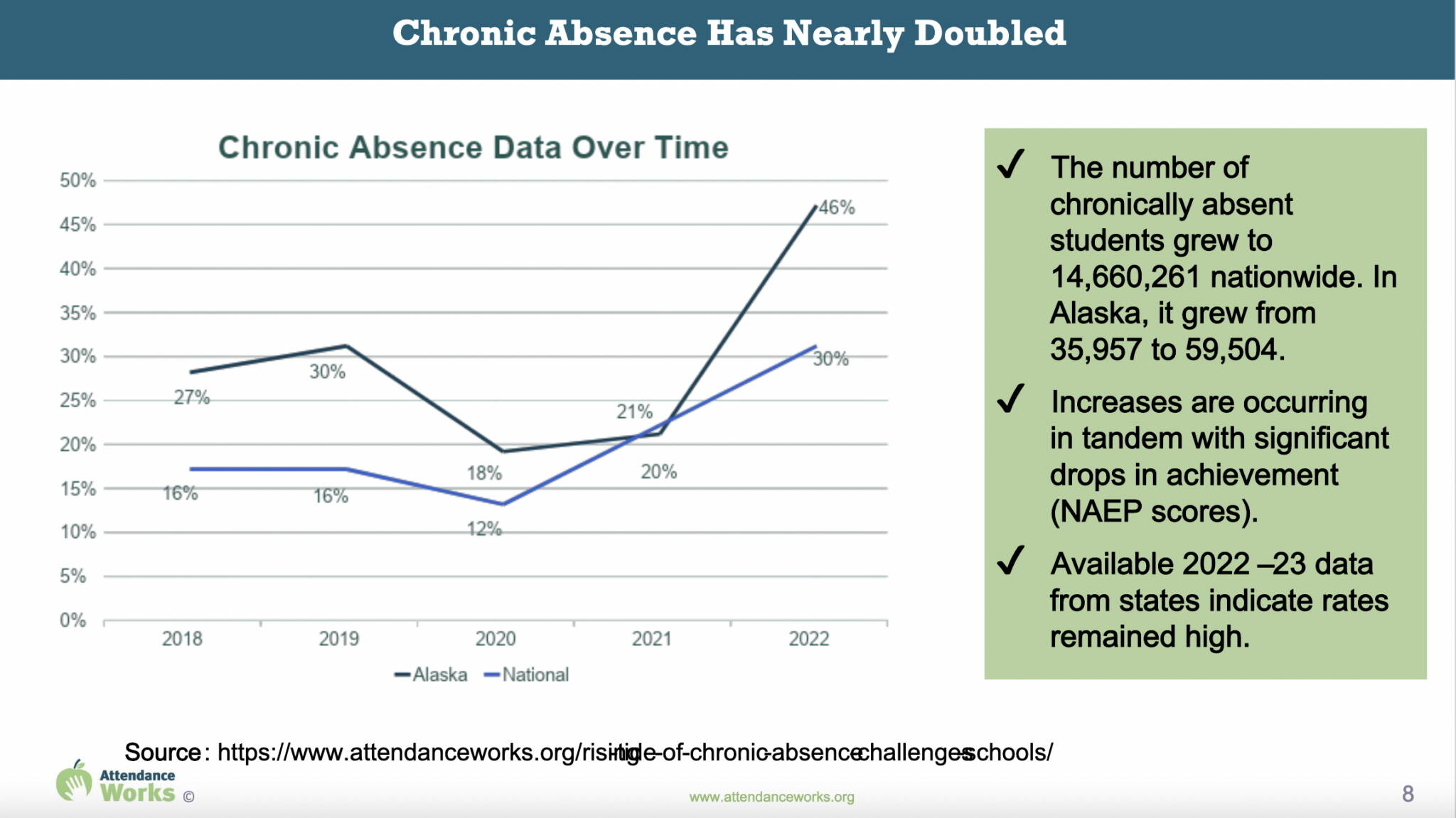
In 2022, only one state, Arizona, had more chronically absent students than Alaska, where more than 45% of students missed enough school to be academically at-risk, according to a national nonprofit.

That means nearly half of Alaska students missed at least 10% of the school year in the most recent available data. In a presentation to the Senate Education Committee on Wednesday, Hedy Chang, executive director of the nonprofit Attendance Matters, said chronic absenteeism rates have doubled nationwide since the pandemic and Alaska is no exception.

“Part of why you want to notice chronic absence and make sure that kids have good attendance is because it ultimately gets to those outcomes that we really care about,” she said.

The organization defines chronic absenteeism as missing 10% or more of school days for any reason.

Data collected by Attendance Matters showed that the increases in chronic absence in the state are occurring at the same time as the state’s scores on national standardized tests are dropping. “I think something like 25% of that decline is explained by attendance, the increases in absences actually,” Chang said.

Data also showed the second graders who were chronically absent were less likely to be able to read at grade level than their peers who were not chronically absent. Chang said that the consequences could persist and manifest as poor performance in middle school and a higher likelihood of dropping out of high school.

Before the pandemic, nearly half of the state’s schools experienced “extreme chronic absence,” where 30% or more students are chronically absent. In the 2021-2022 school year, 86% of Alaska schools experienced extreme chronic absenteeism.

Chang said when students show up everyday to school, it builds routine, reduces stress, creates a sense of security, and increases engagement.

“What happens in school is not just instruction, but all those relationships and the opportunities to learn and develop with peers, as well as with adults, when you go to school,” she said. “It gives you greater access to resources, whether that’s mental health, meals — meals is something that we really saw during the pandemic, tutoring, mentoring, technology or also those extracurriculars — sports, music — that really help develop a whole person. And then attendance really matters for learning.”

Chang pointed to underlying causes of absenteeism, such as trauma, housing or food insecurity, lack of challenging or culturally responsive education, or lack of meaningful relationships with adults at school — especially given staff shortages, her presentation noted.

Sen. Löki Tobin, D-Anchorage, said she would like to see guidance from the Department of Education and Early Development on policy approaches so that the Legislature can support schools and districts and address what she called a “clearly highly impactful issue.”

Tobin noted that the presentation showed that culturally relevant education is among the solutions to chronic absenteeism. She said she is looking at tribal compacting and ways of decolonizing education in the state as potential ways to address the different ways of learning and knowing in Alaska’s communities.

“Sometimes our students are absent because they’re hunting or they’re fishing, or they’re spending time with their grandparent, or they may be skin sewing with an elder. And sometimes the way that we catalog learning within a Western construct, may not necessarily fit our state,” she said.

Tobin said that she was caught off guard by how much absenteeism can affect reading outcomes, a metric that legislators aimed to improve when they passed the Alaska Reads Act in 2022.

“The Alaska Reads Act was so important to me when it comes to creating that statewide understanding that every child has a right to learn to read. That right also means that you have to get to school,” she said. “We can’t just set policy and forget it.”
• Claire Stremple is a reporter based in Juneau who got her start in public radio at KHNS in Haines, and then on the health and environment beat at KTOO in Juneau. This article originally appeared online at alaskabeacon.com. Alaska Beacon, an affiliate of States Newsroom, is an independent, nonpartisan news organization focused on connecting Alaskans to their state government. This article was produced as a project for the USC Annenberg.
Attendance Works data visualization.

Attendance Works data visualization.

More in News

CBJ sign reads “Woodstove burn ban in effect.” (City and Borough of Juneau photo)
Update: CBJ cancels air quality emergency in Mendenhall Valley Sunday morning

The poor air quality was caused by an air inversion, trapping pollutants at lower elevations.

A dusting of snow covers the Ptarmigan chairlift at Eaglecrest Ski Area in December 2024. (Eaglecrest Ski Area photo)
Update: Waterline break forces closure at Eaglecrest Friday, Saturday

The break is the latest hurdle in a challenging opening for Juneau’s city-run ski area this season.

Patrick Sullivan stands by an acid seep on July 15,2023. Sullivan is part of a team of scientists who tested water quality in Kobuk Valley National Park’s Salmon River and its tributaries, where permafrost thaw has caused acid rock drainage. The process is releasing metals that have turned the waters a rusty color. A chapter in the 2025 Arctic Report Card described “rusting rivers” phenomenon. (Photo by Roman Dial/Alaska Pacific University)
Ecosystem shifts, glacial flooding and ‘rusting rivers’ among Alaska impacts in Arctic report

NOAA’s 2025 report comes despite Trump administration cuts to climate science research and projects

The U.S. Capitol in Washington, D.C., on Oct. 1, 2025. (Photo by Jennifer Shutt/States Newsroom)
Moderate US House Republicans join Dems to force vote on extension of health care subsidies

WASHINGTON — Republican leaders in the U.S. House will face a floor… Continue reading

The National Weather Service Juneau issues a high wind warning forDowntown Juneau, Southern Douglas Island and Thane due to increased confidence for Taku Winds this afternoon. (National Weather Service screenshot)
Taku winds and dangerous chills forecast for Juneau

Gusts up to 60 mph and wind chills near minus 15 expected through the weekend.

Chloe Anderson for the Juneau Empire
Fallen trees are pictured by the Mendenhall river on Aug. 15, 2025. Water levels rose by a record-breaking 16.65 feet on the morning of Aug. 13 during a glacial outburst flood.
Lake tap chosen as long-term fix for glacial outburst floods

The U.S. Army Corps of Engineers and Juneau leaders agreed on the plan.

Gift card displays, such as this one in a CVS in Harlem, N.Y., have been a source of concerns for lawmakers hoping to combat gift card fraud. “Card draining,” or stealing numbers from poorly packaged cards, is one of the costliest and most common consumer scams, and states are trying to combat it with consumer alerts, arrests and warning signs on store displays. (Photo by Robbie Sequeira/Stateline)
Alaskans targeted by scammers posing as government officials, FBI warns

The FBI reports Alaskans lost over $26.2 million to internet-based scams in 2024, with $1.3 million of those losses due to government impersonation scams

A buck enters the view of an Alaska Department of Fish and Game trail camera on Douglas island in November 2020. (Alaska Department of Fish and Game courtesy photo)
Douglas deer: The island’s hunt faces calls for new rules

Board of Game is seeking public comment on regulation changes that would affect Juneau.

A cat says hello at Juneau Animal Rescue in February 2025. (Jasz Garrett / Juneau Empire file photo)
New animal shelter site approved by Juneau Assembly

Juneau Animal Rescue secures eight-acre lease, but fundraising remains.

Most Read