
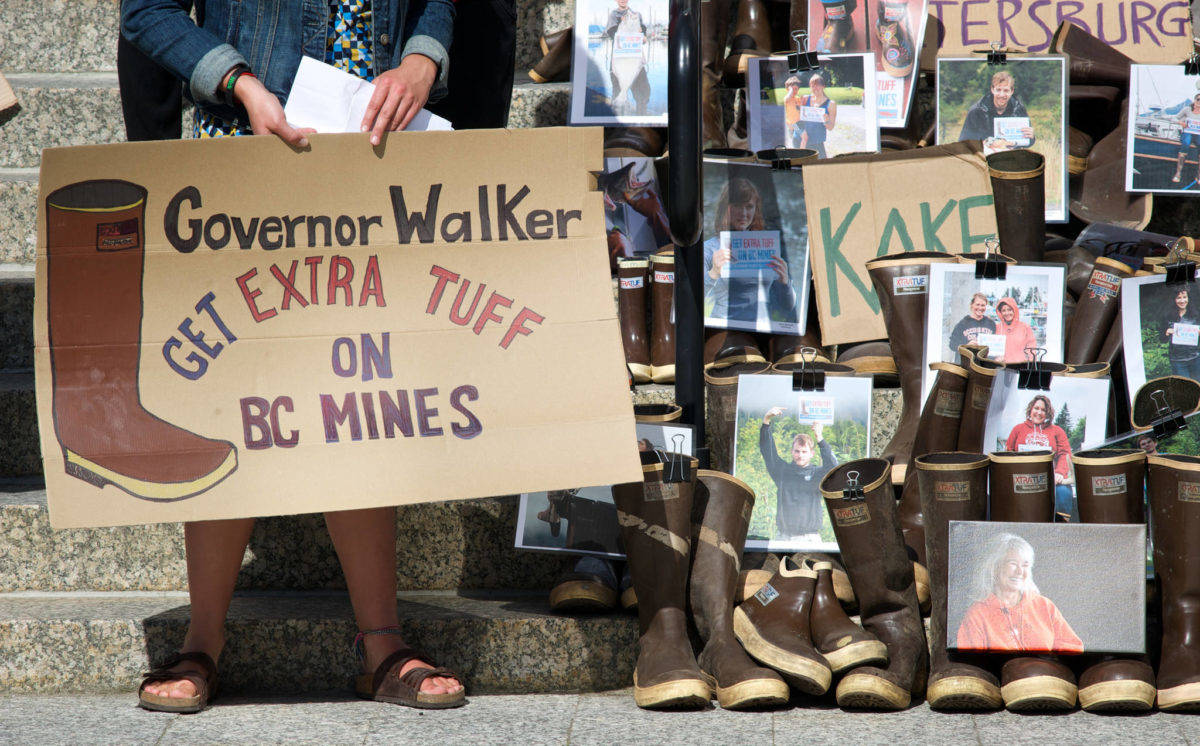
Alaska’s congressional delegation penned another letter, made public in a Tuesday press release, urging the State Department to protect Alaska’s watersheds from Canadian transboundary mine pollution.
The letter, dated Oct. 2 and signed by Sens. Lisa Murkowski and Dan Sullivan, Rep. Don Young, Gov. Bill Walker and Lt. Gov. Byron Mallott, asks the department to “deliver a strong message” to Canada at bilateral meetings in Ottowa this month.
That message includes an ask for water quality monitoring by both nations, binding legal protections for Alaska’s watersheds and financial assurances for possible pollution.
“American resources, communities, and industries must not be harmed by developments upstream in British Columbia,” the group wrote.
October’s letter is the latest in a series of correspondences from Alaska’s executive branch and its congressional delegation dating back to the Obama administration.
The group fears that British Columbia’s mining practices have left Alaska’s waters vulnerable. Alaska requires 100 percent funding for a mine’s environmental liabilities before a mine is allowed to begin operations. Canada does not. As of Dec. 31 2016, when the last figures were publicly available, B.C. mines were under bonded by more than $1.5 billion — money that wouldn’t be available should polluted runoff from tailings facilities drain into Alaska’s waters.
The Red Chris Mine, for example, is underfunded by more than $4 million and may soon face bankruptcy. The copper and gold mine lies upriver from Wrangell and Petersburg on the Stikine River watershed, which supports an annual run of about 40,000 Chinook salmon.
[Transboundary mine faces $200-million cash crunch]
“These Canadian mining projects are located near transboundary rivers that flow from British Columbia into four U.S. states, including Alaska, and, if managed poorly, pose a threat to Southeast Alaska’s flourishing commercial fishing and tourism industries,” the delegation wrote.
The delegation hopes to secure financial assurances from Canada that should their mines harm downstream water quality, there would at least be some money to do something about it.
Alaska would also need to prove that water quality was harmed in the first place. That can only be accomplished by water quality monitoring, something the delegation is still pushing for but has made strides toward funding.
Murkowski has included $1.5 million in funds for stream gauges in an Interior Department appropriations package currently being negotiated in a congressional conference committee.
Conservation group Salmon Beyond Borders Campaign Director Jill Weitz said she was happy with the delegation’s latest effort.
“The development of large-scale open-pit B.C. mines in watersheds that flow into Alaska is moving forward at a mind-blowing pace, while the cleanup of mines like the bankrupt Tulsequah Chief, which has been polluting the Taku River watershed for more than 60 years, is at a seemingly constant stand-still. With the uncertainties regarding Imperial Metals’ financial standing, we need enforceable protections now, before the Red Chris mine goes bankrupt and begins polluting the Stikine River on a far greater scale,” Weitz said in a statement.
Pen pals
The congressional delegation has written letters to at least three previous State Department heads but their requests haven’t yet been fully satisfied.
In May of 2016, the delegation wrote to then-Secretary of State John Kerry, asking him to pursue intervention via the International Joint Commission, a venue tasked with settling transboundary watershed disputes. It’s unclear whether that letter was answered.
The delegation reiterated those concerns in a Sept. 8, 2016 letter, saying that the administration wasn’t doing enough to protect Southeast.
“These mines pose huge economic risk to Alaska in the form of acid mine drainage and toxic heavy metals that threaten Alaska Native communities … as well as the regional $2 billion-dollar-a-year fishing and tourism industries. … To this point, we believe there has been a failure by your Department to support potential solutions embraced by Alaskans,” the delegation wrote.
That letter garnered a response, but no guarantees that the delegations requests would be met.
The delegation tried again in November of last year, this time writing to Secretary of State Rex Tillerson. Tillerson responded, through a representative, that the State Department would need Canadian cooperation to pursue IJC intervention.
Tillerson left his post in March, and latest letter is addressed to current secretary Mike Pompeo, who is yet to respond.
• Contact reporter Kevin Gullufsen at 523-2228 and kgullufsen@juneauempire.com. Follow him on Twitter at @KevinGullufsen.
