
By Yereth Rosen
Alaska Beacon
When natural disasters strike in the Lower 48, people affected are compensated for income lost from wage-earning jobs that have been interrupted, as well as lost assets with assigned financial value.
For residents of the Yukon-Kuskokwim region who were displaced by Typhoon Halong, such losses are not so easily quantified.
In the region’s affected villages, which are among the most rural communities in North America, most residents are Yup’ik and adherence to Indigenous traditions is strong. Those traditions are tied to the harvesting of wild foods and materials for personal and family needs. And much of the labor performed to carry out those harvests falls outside of the usual American cash economy.
Losses inflicted by the disaster in Kipnuk, Kwigillingok and other storm-damaged villages include the stockpiles of wild fish, game meat, berries and greens that have been built over months of unpaid work.
While there is not a dollar number for the food that was lost, its value is high, said Kelsey Ciugun Wallace, president of the Alaska Native Heritage Center in Anchorage.
“Our foods are just so important to who we are as Native people,” said Wallace, who is Yup’ik and from Bethel, the Yukon-Kuskokwim Delta’s hub community. Traditional foods provide not just nutrition, but also emotional and spiritual support and “connect us to the land and water,” she said.
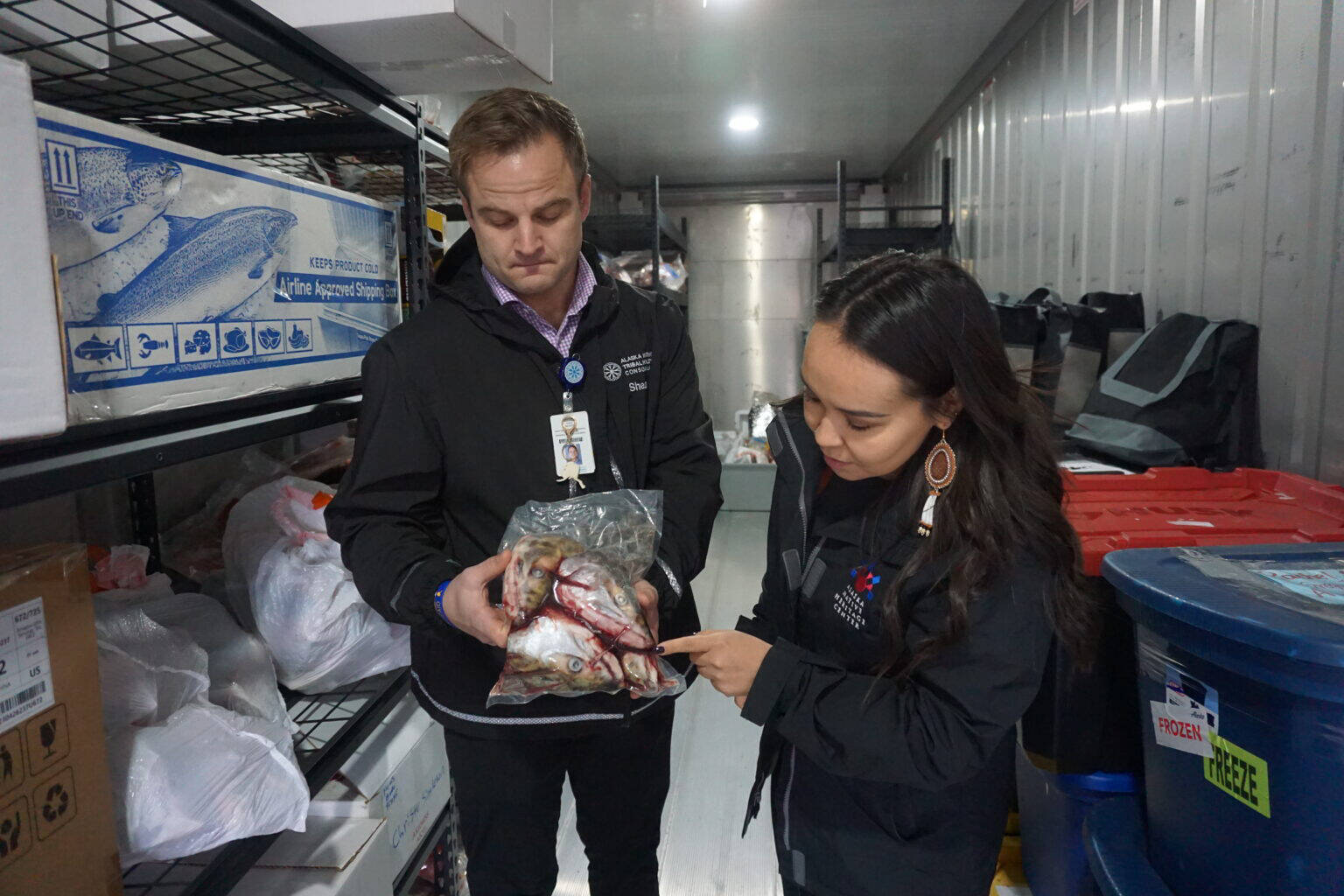
In response to the loss of subsistence food and access to food-gathering sites, the Alaska Native Heritage Center and the Alaska Native Tribal Health Consortium are funneling traditional foods to displaced families.
They are coordinating a program that is taking in donations from around the state. Through it, frozen foods, like sockeye salmon from the Copper River Basin, muktuk from the North Slope and berries from Southcentral Alaska’s mountain slopes, have been collected in a huge freezer trailer parked at the heritage center.
The volunteer response has been overwhelming, and it extends beyond donations to cooking, preparing and serving, Wallace said.
“All the aunties in Anchorage are wanting to cook,” she said.
For ANTHC, the emergency food collection and distribution adds to a year-round traditional foods program, said Shea Siegert, the consortium’s senior manager of external affairs.
Siegert said he does not know how long the emergency program will run. “As long as there’s a need, we will continue to fill it,” he said.
Some of the donated food is being used by the nonprofit World Central Kitchen, which has been providing hot meals to evacuees and emergency workers at the William A. Egan Civic & Convention Center in downtown Anchorage and the Alaska Airlines Center on the University of Alaska Anchorage campus. Both sites have been operating as assistance hubs for the evacuees in the Anchorage area, and the two sites were also used as temporary shelters, though most of the clients were set to be transitioned to longer-lasting and more private living quarters by last week, according to state officials.
Government agencies providing economic assistance are also attempting to accommodate the cultural needs of the people displaced by the typhoon.
One is the U.S. Small Business Administration, which typically provides low-interest loans to help victims of declared natural disasters recover from economic losses.
Kelly Loeffler, the SBA’s administrator, said the agency recognizes that damages in the Yukon-Kuskokwim region are different from disaster damages in the Lower 48.
Loeffler, at a Wednesday news conference held in Anchorage with Gov. Mike Dunleavy, said the SBA has “modified some of the rules in order to speed relief to those survivors.”
Loans will be available to replace lost or damaged subsistence-related items, Loeffler said at the news conference, which was held outside the Alaska Airlines Center. That includes things like all-terrain vehicles, hunting knives and boats.
“We’re going to continue to respond to unique needs of the terrain, people and this culture and make sure that the funding meets the moment,” she said.
However, damages to subsistence camps are not eligible for such aid, according to an SBA statement issued on Monday.
The quandary of how to compensate for subsistence losses also affected the response to a similar disaster three years ago. When remnants of Typhoon Merbok struck the same region and wreaked havoc farther north into the Bering Strait region, rural and mostly Indigenous Alaskans had to work through aid systems to get compensation for lost subsistence gear and equipment.
Federal agencies attempted to tailor aid programs to the needs of rural Alaska residents, and some of the relief effort focused on rebuilding and repairing traditional fishing and hunting camps. Additionally, the U.S. Geological Survey stepped up its mapping of the region and its identification of coastal hazards in Merbok’s wake.
But there were bumps, such as improper language translations provided by a contractor the Federal Emergency Management Agency hired.
The urgency for tailoring disaster response to the particular needs of Western Alaska is expected to continue into the future. Scientists project that climate change, by warming the ocean, thawing permafrost and thus causing the land to sink, raising sea levels and diminishing sea ice will trigger yet more regional disasters like Halong and Merbok.
Yereth Rosen came to Alaska in 1987 to work for the Anchorage Times. She has been reporting on Alaska news ever since, covering stories ranging from oil spills to sled-dog races. She has reported for Reuters, for the Alaska Dispatch News, for Arctic Today and for other organizations. She covers environmental issues, energy, climate change, natural resources, economic and business news, health, science and Arctic concerns — subjects with a lot of overlap. In her free time, she likes to ski and watch her son’s hockey games.
Alaska Beacon is part of States Newsroom, the nation’s largest state-focused nonprofit news organization.
