
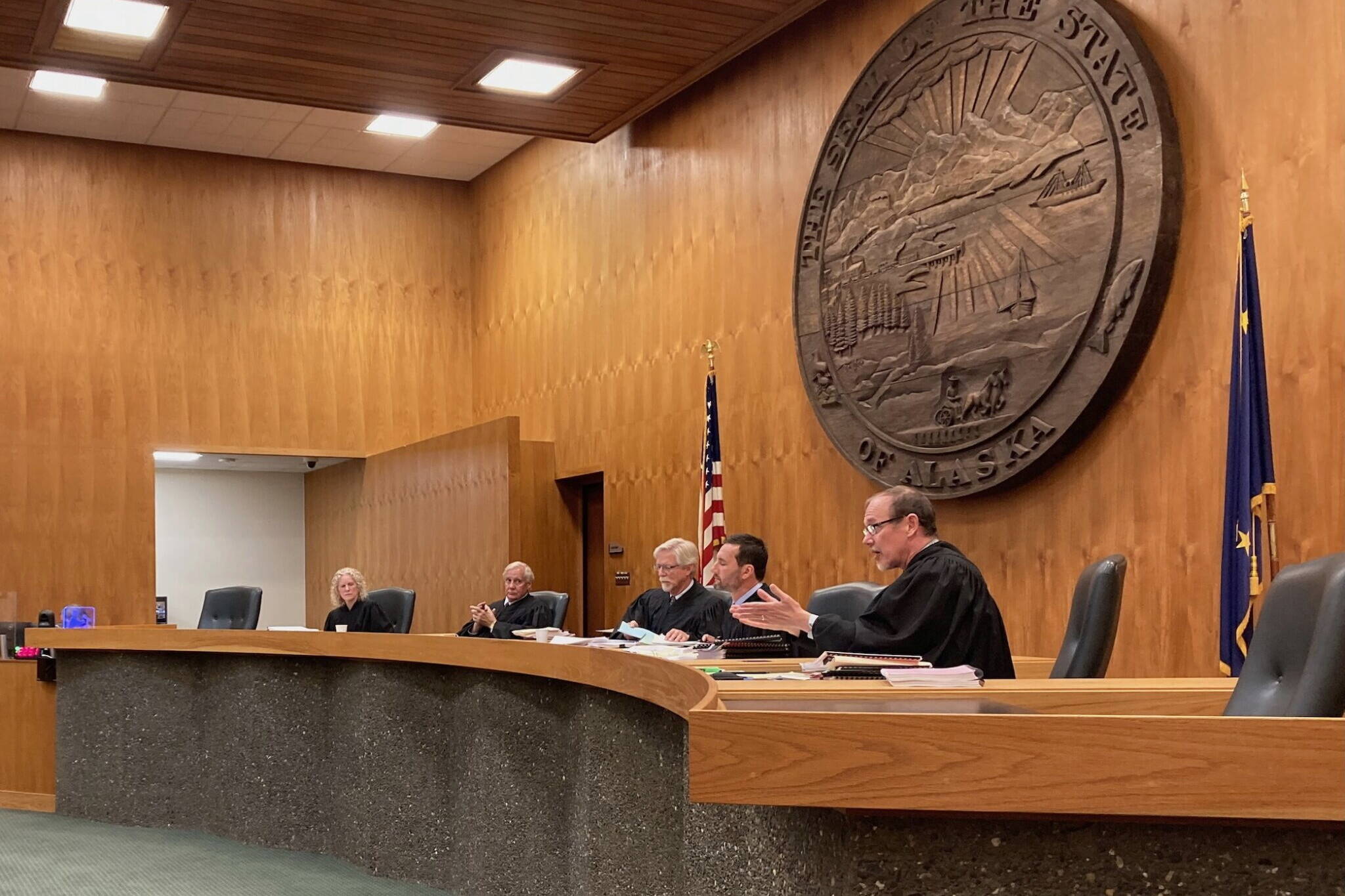
In a first-of-its-kind ruling, the Alaska Supreme Court said Friday that the COVID-19 pandemic does not qualify as “physical loss” or “damage” under common commercial insurance policies.
The decision likely means that insurance companies will not have to pay most claims related to business losses caused by COVID-19.
The ruling came in response to an unusual “certified question” request from Alaska’s U.S. District Court. All 49 other state supreme courts have considered similar questions about COVID-19 liability, but until Friday, Alaska’s had not.
“Even with our insured-friendly approach to interpreting insurance contracts, we conclude that neither the presence of the COVID-19 virus at an insured property nor operating restrictions imposed on an insured property by COVID-19 pandemic-related governmental orders is ‘direct physical loss of or damage to’ property. ‘Direct physical loss of or damage to’ property requires a tangible or material alteration of property,” wrote Justice Susan Carney on behalf of the court.
The court’s decision, rendered unanimously, has major financial implications: If the court had decided differently, the ruling could have allowed businesses to collect millions of dollars from their insurance policies to cover the costs of COVID-mandated closures and health restrictions.
In an amicus brief, the American Property Casualty Insurance Association said insurance premiums would rise as a result if insurers were required to pay out more.
The Supreme Court was asked to rule after Baxter Senior Living filed suit two years ago against its insurance company, Zurich American.
Baxter operates a senior home in Anchorage and spent money to enact anti-COVID procedures that also limited its operations. Local anti-COVID rules also restricted its operations. The company filed a claim in 2020 with Zurich American, but the company denied the claim.
At the time, Zurich American said Baxter’s policy covered “direct physical loss of or damage to” property, and it argued that “(n)either the mere presence of the COVID-19 virus … or any generalized threat from its presence constitutes the ‘direct physical loss of or damage to’” Baxter’s property under the policy.
Baxter challenged the denial in state court, and the insurer moved the case to federal court, which then asked the Alaska Supreme Court to decide whether the presence of COVID-19 constitutes “direct physical loss” or “damage” to property, and whether governmental orders pertaining to COVID-19 also constitute that loss or damage.
“Our answer to both questions is ‘no,’” Carney wrote in Friday’s published order.
Explaining at length, the order says that meeting the policy’s standard language requires “a physical alteration of property,” and COVID-19’s presence on a surface doesn’t alter its property.
“An analogy between the COVID-19 virus and water illustrates this point,” Carney wrote in Friday’s order. “COVID-19 is to property what water is to a plastic sheet: water does nothing to a plastic sheet but at most, it stays on it or attaches to it. But water transforms, alters, or changes the state of dry paper into a wet “mush” or makes it much easier to tear.”
“We conclude that ‘direct physical damage’ requires physical alteration of property. But because COVID-19 does not physically alter property and merely attaches to it, the presence of COVID-19 on property does not constitute ‘direct physical damage.’”
Friday’s order marked the first time since 2021 that the court had been asked to consider a certified question from the state’s federal court.
With the question resolved, the case returns to federal court for further proceedings.
• James Brooks is a longtime Alaska reporter, having previously worked at the Anchorage Daily News, Juneau Empire, Kodiak Mirror and Fairbanks Daily News-Miner. This article originally appeared online at alaskabeacon.com. Alaska Beacon, an affiliate of States Newsroom, is an independent, nonpartisan news organization focused on connecting Alaskans to their state government.
