
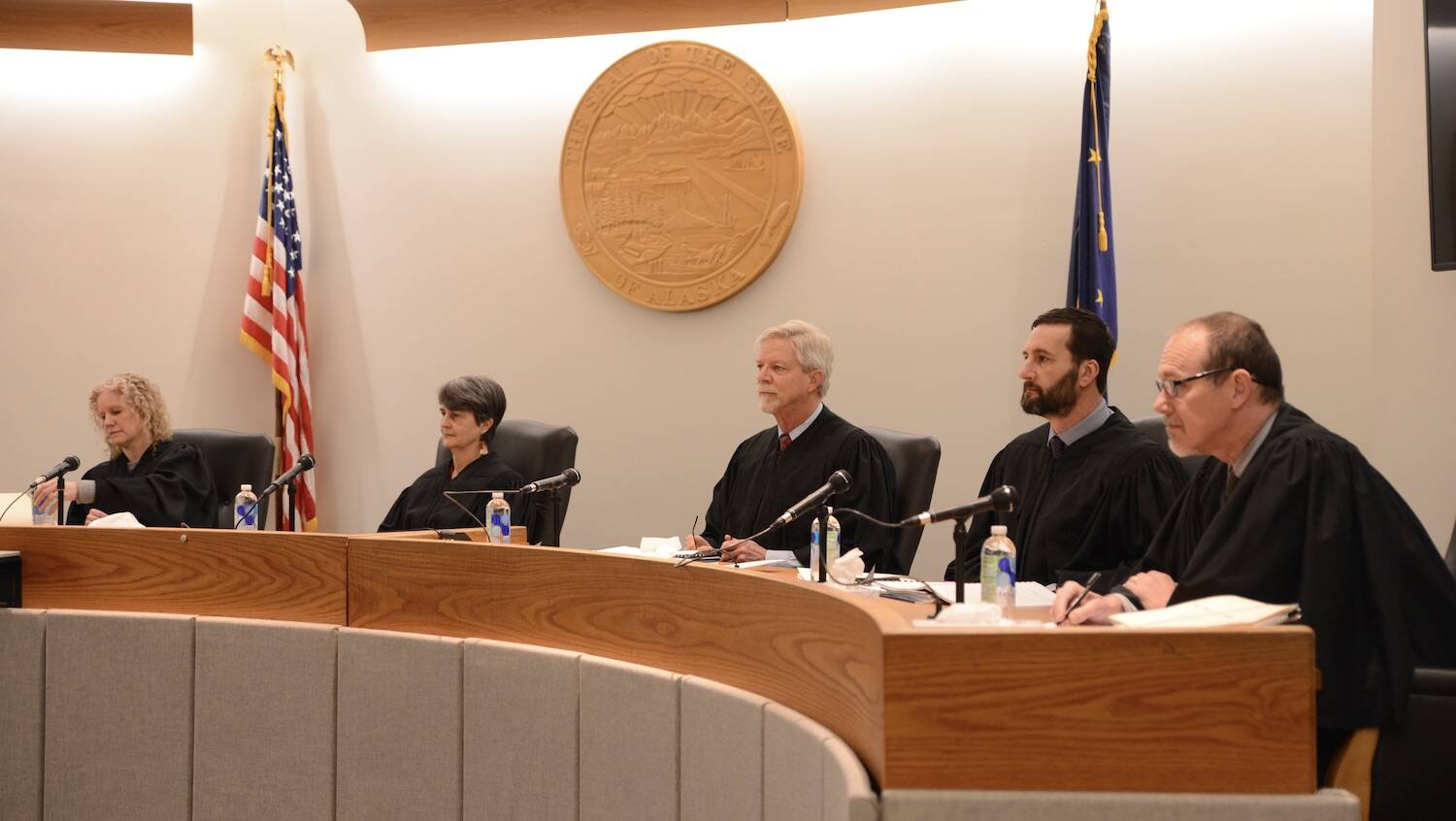
An Alaskan is someone physically present in the state who intends to remain permanently and make a home here, the Alaska Supreme Court concluded in a split opinion published Friday.
Residency can begin even if someone leaves the state before moving all of their belongings here, the justices said.
Friday’s opinion has implications for a variety of state services, including the Permanent Fund dividend, that are available only to state residents.
The opinion was the result of a 2022 lawsuit that challenged the eligibility of Rep. Jennie Armstrong, D-Anchorage, to run for (and serve in) the Alaska Legislature.
A three-judge panel of the Supreme Court ruled in favor of Armstrong’s eligibility in January 2023 with a short order, and Friday’s opinion, issued by the full court, explained justices’ reasoning.
“I feel immensely grateful for the courts’ continued affirmation of my residency and their acknowledgment of the abundance of evidence showing such,” Armstrong said on Friday.
One of the key moments during Superior Court discussions was a discussion by Armstrong and her husband about how they met, fell in love and made the decision to live together in Alaska.
“I’m grateful that our love story can live on in the public record,” she said.
Under the Alaska Constitution, a candidate for legislative office must have “been a resident of Alaska for at least three years.”
The justices said candidacy implicates several laws: The person must be an eligible voter, which has its own requirements; they must be a resident of their state House district for at least one year; and they must have been a resident of Alaska for at least three years.
Liz Vazquez, Armstrong’s Republican opponent in the 2022 legislative election for their shared Anchorage district, brought the lawsuit and cited social media posts from Armstrong that appeared to indicate that she moved to Alaska in June 2019. Armstrong registered as a candidate on June 1, 2022, and if she had moved to Alaska after June 1, 2019, she would have been ineligible to run in 2022.
In Anchorage Superior Court, Armstrong offered evidence that she “formed the intent to remain in Alaska indefinitely and to make her home here on May 20, 2019,” and Superior Court Judge Herman Walker ruled in her favor.
Vazquez appealed to the Supreme Court, which concluded that Walker ruled correctly but cited the wrong law when he ruled in favor of Armstrong.
The start date of someone’s Alaska residency, the justices concluded, is determined by when someone intends to remain here and make a home here, even if they briefly are absent from the state.
The law, the justices concluded, says that someone must “demonstrate intent by maintaining a principal place of abode within Alaska for at least 30 days and by acting consistently with the intent to remain, even during absences.”
In Armstrong’s case, that meant leaving Alaska to gather her things and move them to the state. Because she left some personal items at the home of her future husband before leaving, “she established a principal place of abode,” the court wrote.
Alaska’s five high-court justices typically issue consensus opinions, but they did not in this case, splitting on the definition of state residency.
Justice Susan Carney dissented from the other four members of the court, saying that their opinion “open(s) the door for almost any tourist that falls in love with Alaska or an Alaskan to immediately become a state resident.”
She speculated that under the majority opinion, someone who visits Alaska as a tourist might be able to rent a room, leave some belongings there, then leave the state for an indefinite period before returning.
“Would a month be too long? Several months? A year?” Carney wrote.
The majority justices said that speculation ignores other possible evidence in favor of or against the idea that someone was “maintaining a principal place of abode within Alaska.”
In Armstrong’s case, the majority justices wrote, “the superior court heard and considered detailed evidence regarding each of these points, and after weighing that evidence, determined that Armstrong demonstrated the requisite intent.”
• James Brooks is a longtime Alaska reporter, having previously worked at the Anchorage Daily News, Juneau Empire, Kodiak Mirror and Fairbanks Daily News-Miner. This article originally appeared online at alaskabeacon.com. Alaska Beacon, an affiliate of States Newsroom, is an independent, nonpartisan news organization focused on connecting Alaskans to their state government.
