
The Alaska Department of Education and Early Development is proposing new rules that could reduce the amount of money that local governments are able to contribute to their neighborhood school districts.
The new rules, contained within emergency regulations published Monday, would redefine a municipality’s “local contribution” — the amount of money a school district can receive from a city or borough — to include “services provided at no charge to a district by the city or borough.”
That would mean that any time a school activity takes place at a city-owned pool or library, the city would effectively have to charge the school district rent, subtracting rental fees from the amount of money it normally gives to the school district for instruction.
Monday’s announcement comes toward the end of the fiscal year for school districts, many of which are already cutting programs and closing schools because of flat state funding.
A formula increase approved this spring by the state Legislature over Gov. Mike Dunleavy’s opposition would provide only a small year-over-year funding increase, and the governor could end up vetoing that increase anyway. The state budget isn’t due back from the governor until later this month.
The Department of Education did not respond to requests for comment about the proposal on Tuesday.
If approved by the state school board — something that could take place as soon as Wednesday — the regulations could become quickly effective. Although Dunleavy has announced a freeze on new regulations, the education department already sought and obtained a waiver exempting this new rule from the freeze.
The state education department has been discussing proposals similar to Monday’s rule change for almost a year.
The new rule is being driven in part by the state’s choice to use $81 million in federal “impact aid” for schools as a replacement for state funding.
Impact aid is distributed to states to compensate for federal land that is non taxable and doesn’t contribute to local property taxes, which typically benefit local schools.
Alaska is the only state in the country to use that federal money as a replacement for state money, rather than an additive. As a result, the state must pass what’s called a “disparity test” — it looks at how much is spent per student at each of the state’s school districts, then removes the bottom 5% and top 5%. The difference between the remaining schools can be no more than 25%.
This year, the federal government warned that the state had failed the disparity test and failed a similar “equity test,” putting the $81 million in impact aid at risk.
The state could have sought to fix the problem by increasing education funding, but it now appears to be reducing funding instead.
Other states send the impact aid to local schools directly, noted Nils Andreassen, director of the Alaska Municipal League, which represents cities and boroughs.
“To further reduce local contributions while taking $81 million from local school districts is pretty incredible to me,” he said.
Making things more difficult for local school districts, he said, is the fact that the change would be retroactive to fiscal year 2025, which ends June 30.
“I think the local governments and school districts would have to go back and re-evaluate all their local contributions,” he said. “It could be problematic, moreso for some than others. … It’s going to be anybody who’s close to the cap. It’s Juneau, it’s probably Anchorage, but also anybody who provides other types of support for districts. I’m thinking Sitka, who just took over the pool. It’s those kinds of things they’re going to be looking for.”
Frank Hauser, superintendent of the Juneau School District, said he’s still trying to understand the pending change, but his first impression is that it could cost the district as much as $2.1 million.
“Why is this (regulation) going through when there’s been a freeze on everything else?” he said.
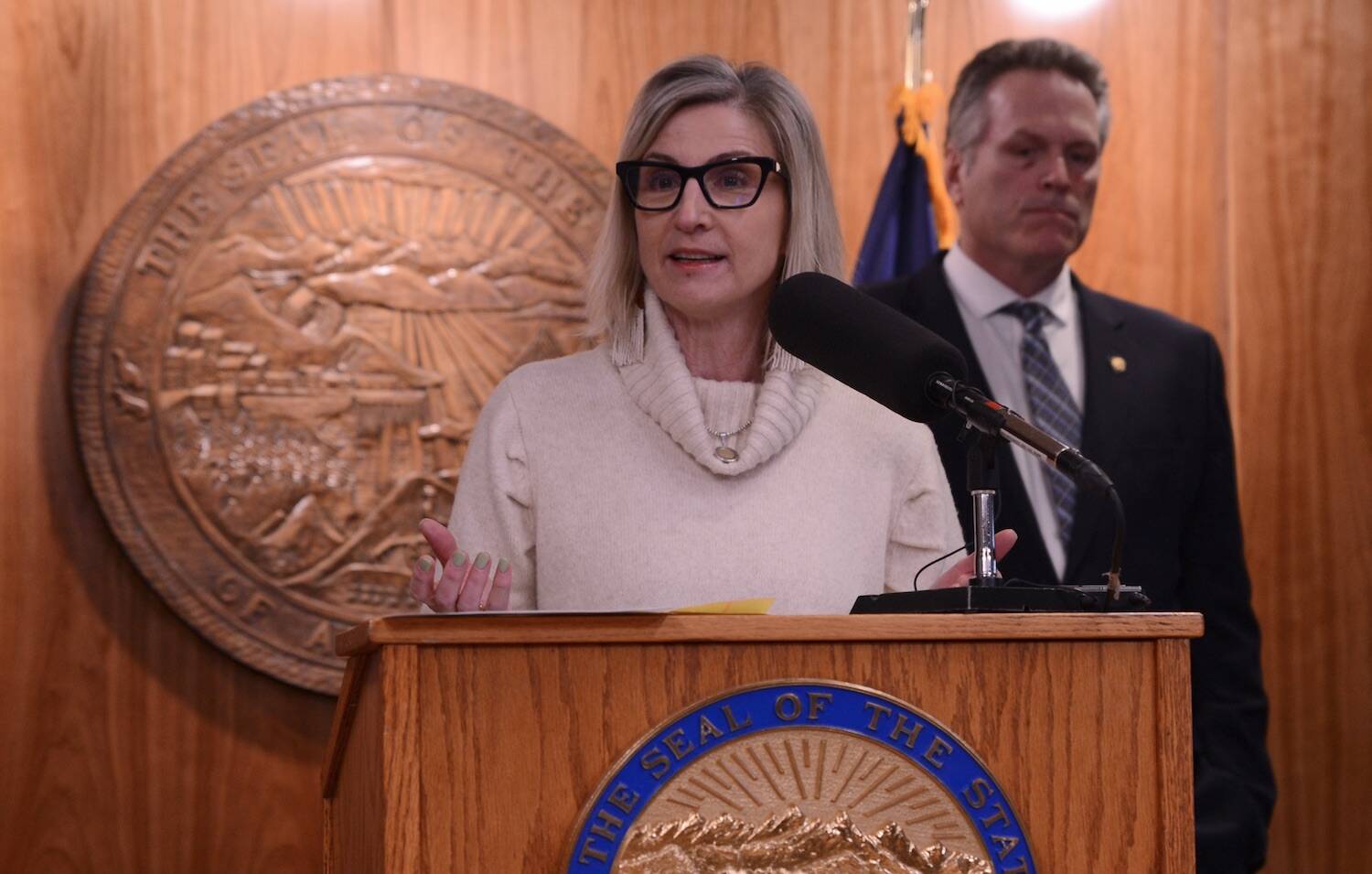
DEED commissioner Deena Bishop told the state school board on Tuesday that “the local contribution issue started with a headline that said a district is funding outside the cap.”
That alerted the department to a possible problem with impact aid, she said.
“That really is the basis for this. It is an equalizing factor in our formula,” Bishop said, adding that the regulation change will be “shoring up” the limits on local contributions.
“The reason we were proposing these changes … is to help put some siderails to ensure that future tests don’t fail,” said Lori Weed, school finance manager for the Department of Education.
Assistant attorney general Susan Greenlee Sonneborn said the emergency regulations are needed now because school districts are approaching the end of their fiscal year and want the new limits to take effect before the fiscal year ends.
“We believe that by getting this regulation in place within this fiscal year, we’ll limit our exposure to the chances of failing the disparity test for 2027, based on fiscal year 2025 data,” she said.
The state school board is scheduled to take public comment on the regulation change and other items on its agenda starting at 8:25 a.m. Wednesday, and it is scheduled to vote on the proposal before 11 a.m.
• James Brooks is a longtime Alaska reporter, having previously worked at the Anchorage Daily News, Juneau Empire, Kodiak Mirror and Fairbanks Daily News-Miner. This article originally appeared online at alaskabeacon.com. Alaska Beacon, an affiliate of States Newsroom, is an independent, nonpartisan news organization focused on connecting Alaskans to their state government.
