
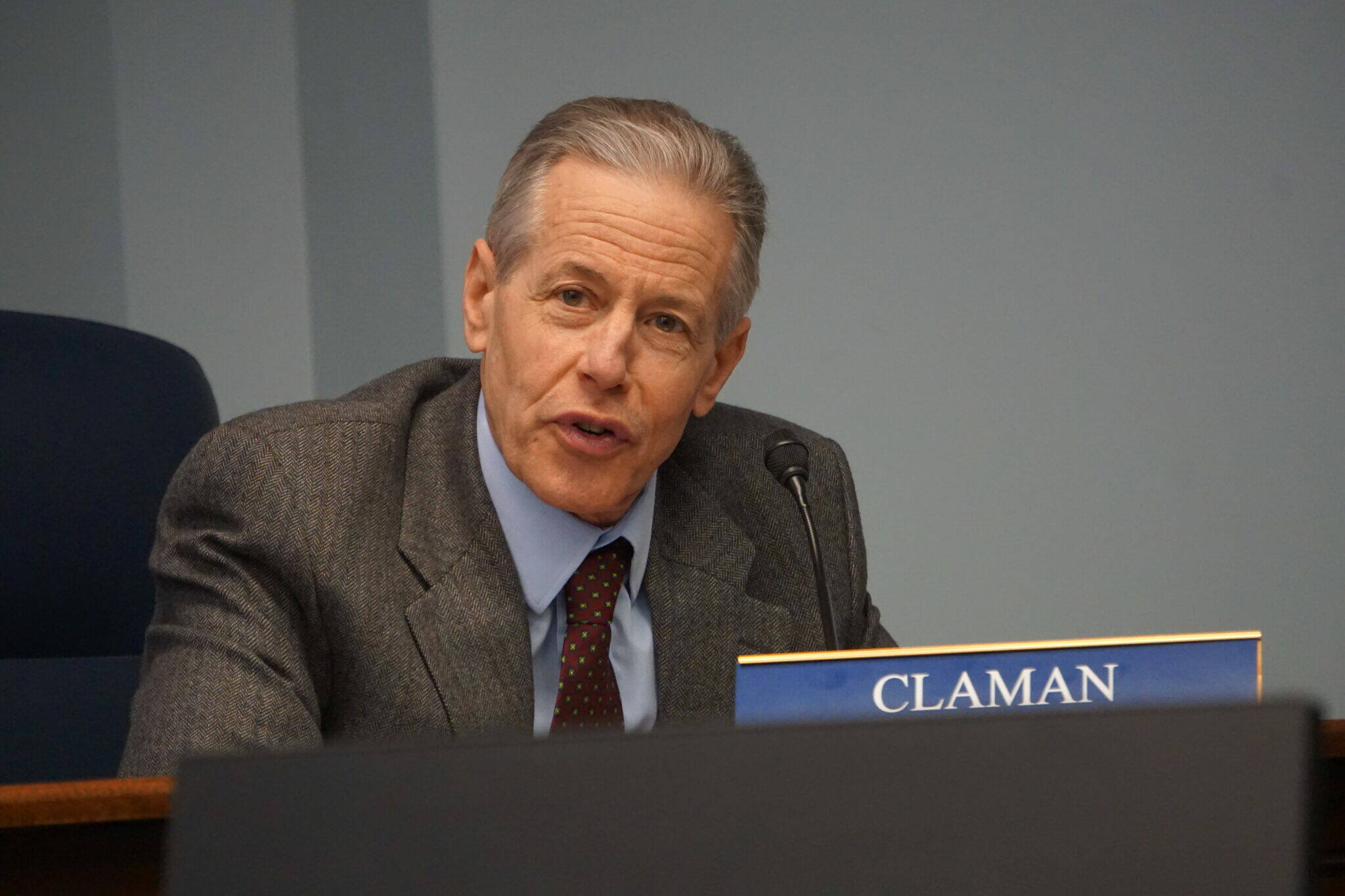
Sen. Matt Claman, D-Anchorage, speaks at a Tuesday news conference held by the Senate majority caucus. Claman has proposed a constitutional amendment to lower the threshold needed to override a veto by a governor of a spending bill. (Yereth Rosen/Alaska Beacon)

Sen. Matt Claman, D-Anchorage, speaks at a Tuesday news conference held by the Senate majority caucus. Claman has proposed a constitutional amendment to lower the threshold needed to override a veto by a governor of a spending bill. (Yereth Rosen/Alaska Beacon)

Alaska senators consider constitutional amendment easing some veto override votes

The Alaska Senate is moving closer to approving a state constitutional amendment that would lower the number of votes needed to override a governor’s veto of a spending bill. The House would also have to approve an amendment before it could go to a public vote on final approval.

On Tuesday, the Senate State Affairs Committee passed Senate Joint Resolution 15, which would require two-thirds of the Legislature, or 40 votes, to override a spending veto, the same as the current threshold for vetoes of non-spending bills. The current spending-bill threshold is three-quarters of the Legislature, or 45 votes.

If that amendment had been in place on Monday, it wouldn’t have changed the Alaska Legislature’s failure to override Gov. Mike Dunleavy’s decision to veto a multipart education bill, but Sen. Scott Kawasaki, D-Fairbanks and chair of the State Affairs Committee, said the amendment “sort of got legs because of what happened with the governor’s veto.”

Sen. Matt Claman, D-Anchorage, proposed the amendment in February, and it was scheduled for Tuesday’s hearing last week.

“We’re the only state in the country that has a three-quarter override threshold for fiscal matters. And I think two-thirds is more than enough,” Claman said on Wednesday.

He said it’s a good policy to examine whether the government is working well.

The Alaska Legislature hasn’t overridden a governor’s veto since 2009, in part because of the fiscal threshold, which is the highest in the nation according to the National Conference of State Legislatures.

In January, lawmakers unsuccessfully attempted to overturn Dunleavy’s 2023 budgetary vetoes. That vote was 33-26 and would have also failed under the proposed threshold.

Enacting a constitutional amendment requires 14 votes in the Senate, 27 in the House, and approval by a majority of voters during a general election. Constitutional amendments are not subject to a veto.

If the same number of House members who opposed the education-bill veto override vote also were to oppose the proposed amendment, they would be able to block it.

SJR 15 has been referred to the Senate Finance Committee, which has not yet scheduled it for a hearing.

• James Brooks is a longtime Alaska reporter, having previously worked at the Anchorage Daily News, Juneau Empire, Kodiak Mirror and Fairbanks Daily News-Miner. This article originally appeared online at alaskabeacon.com. Alaska Beacon, an affiliate of States Newsroom, is an independent, nonpartisan news organization focused on connecting Alaskans to their state government.

More in News

Brenda Schwartz-Yeager gestures to her artwork on display at Annie Kaill’s Gallery Gifts and Framing during the 2025 Gallery Walk on Friday, Dec. 5. (Mari Kanagy / Juneau Empire)
Alaska artist splashes nautical charts with sea life

Gallery Walk draws crowds to downtown studios and shops.

A totem pole, one of 13 on downtown’s Totem Pole Trail in Juneau, Alaska, Nov. 27, 2024. (Christopher S. Miller/The New York Times)
Downtown Juneau experiences its first significant city-level snow fall of the season as pictured on Saturday, Dec. 6, 2025. (Mari Kanagy / Juneau Empire)
Sub-zero temperatures to follow record snowfall in Juneau

The National Weather Service warns of dangerous wind chills as low as -15 degrees early this week.

A truck rumbles down a road at the Greens Creek mine. The mining industry offers some of Juneau’s highest paying jobs, according to Juneau Economic Development’s 2025 Economic Indicator’s Report. (Hecla Greens Creek Mine photo)
Juneau’s economic picture: Strong industries, shrinking population

JEDC’s 2025 Economic Indicators Report is out.

Map showing approximate location of a 7.0-magnitude earthquake on Saturday, Dec. 6, 2025. (Courtesy/Earthquakes Canada)
7.0-magnitude earthquake hits Yukon/Alaska border

Earthquake occurred about 55 miles from Yakutat

A commercial bowpicker is seen headed out of the Cordova harbor for a salmon fishing opener in June 2024 (Photo by Corinne Smith)
Planned fiber-optic cable will add backup for Alaska’s phone and high-speed internet network

The project is expected to bring more reliable connection to some isolated coastal communities.

Gustavus author Kim Heacox talked about the role of storytelling in communicating climate change to a group of about 100 people at <strong>Ḵ</strong>unéix<strong>̱</strong> Hídi Northern Light United Church on Wednesday, Dec. 3, 2025. (Mari Kanagy / Juneau Empire)
Author calls for climate storytelling in Juneau talk

Kim Heacox reflects on what we’ve long known and how we speak of it.

The Juneau road system ends at Cascade Point in Berners Bay, as shown in a May 2006 photo. (Michael Penn / Juneau Empire file)
State starts engineering for power at proposed Cascade Point ferry terminal

DOT says the contract for electrical planning is not a commitment to construct the terminal.

Most Read