Alaska Senate approves pared-down budget draft while warning of ‘coming storm’ in state finances
Published 9:30 pm Tuesday, May 6, 2025
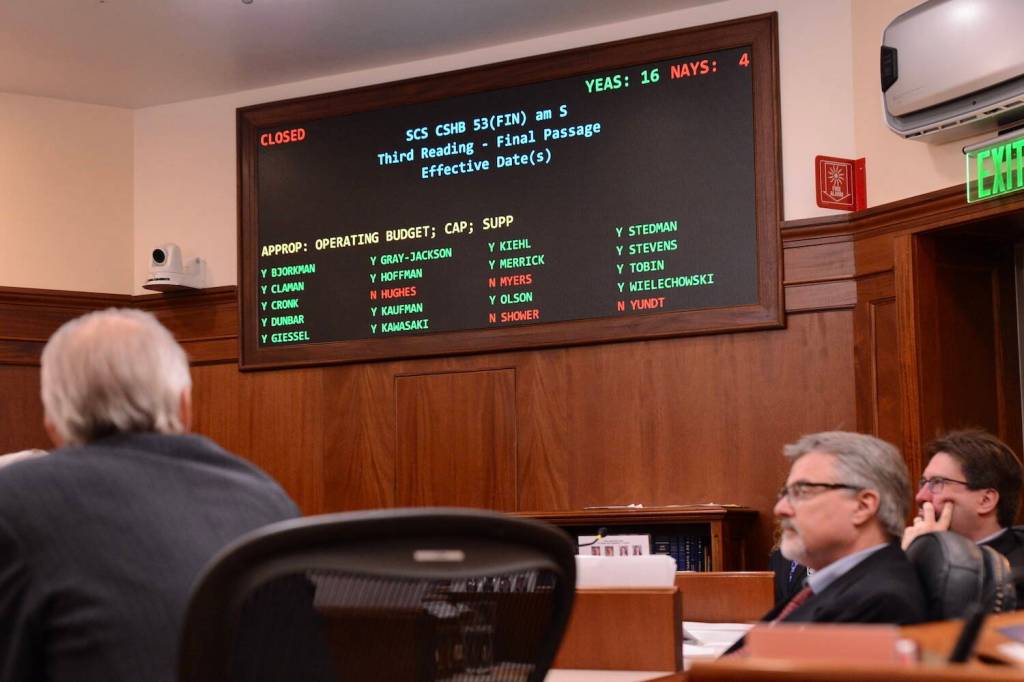
Members of the Alaska Senate issued warnings Wednesday as they approved a draft operating budget for the upcoming fiscal year.
Senators’ draft, which includes an estimated $1,000 Permanent Fund dividend for eligible Alaskans and a small year-over-year increase for K-12 education, also cuts services.
The proposal would cut proposed funding increases for early education programs, reduce funding for state prisons, eliminate the state’s office of citizenship assistance, mostly defund the state militia, reduce road maintenance, and deny salary increases except as required by union contracts.
Legislators are trying to address a significant deficit caused by low oil prices, and Wednesday’s 16-4 vote by the Senate keeps the Capitol on schedule for the May 21 end of the regular session.
The Senate’s draft of the budget measure, House Bill 53, is scheduled to return to the House as soon as Friday. If lawmakers there vote down the Senate draft, that action would set up the creation of a conference committee designed to combine the Senate’s draft budget with one passed by the House in April.
The resulting compromise likely would be among the last items completed before lawmakers end their session for the year. The budget bill would then go to Gov. Mike Dunleavy, who has the power to veto individual line items.
Members of the bipartisan group that leads the Senate said they wanted to balance the budget without using the state’s savings accounts, because a worsening state fiscal picture will almost certainly require tapping them next year.
“The Senate Finance chairs believe that the state is facing some very strong headwinds in future budgets,” said Sen. Lyman Hoffman, D-Bethel and the lead author of the Senate’s draft budget.
Right now, the Senate’s $5.8 billion budget proposal has a small surplus when combined with all other spending bills and the state’s spring revenue forecast.
But that surplus is almost certainly an illusion, Hoffman said. The federal government is cutting the amount of money it sends to states, oil prices are below what was forecast in March, labor contracts will increase in costs, and this year’s budget uses one-time funding sources that won’t be available next year.
“With all of these budget headwinds, it’s clear to me that the decisions next year will be more difficult than the decisions made today,” Hoffman said.
Where the House proposed spending from savings to boost the amount of the Permanent Fund dividend and increase some spending on services, the Senate prioritized the state’s savings accounts.
“Now is the time to preserve our rainy-day fund for that coming storm,” Hoffman said.
All 14 members of the Senate’s bipartisan majority caucus voted in favor of the budget proposal, as did two Republicans who are members of the Senate’s all-Republican minority caucus and sit on the finance committee.
“This is a conservative budget, no matter how you look at it. It’s very lean,” said Sen. Mike Cronk, R-Tok and one of those lawmakers.
“Is this perfect? No. It’s going to be a lot worse next year, and I think that people in Alaska need to understand that,” he said.
Sen. Robert Yundt, R-Wasilla, is also a member of the Senate minority and criticized Dunleavy, whose initial budget proposal in December included a $3,900 Permanent Fund dividend and a $1.5 billion deficit.
“I’ve heard and felt frustration from members of all four caucuses,” he said. “It is baffling to me that you can walk in here and say, ‘Here, 60 people — here’s a budget that’s a billion and a half dollars upside-down.’ It shouldn’t be legal.”
The House’s draft budget, which followed the governor’s proposal, had plenty of problems, said Senate Minority Leader Mike Shower, R-Wasilla.
The Senate’s finance committee “were handed a bag of lemons and told to make lemonade, and frankly, when you look at what they were able to do … I think they really did,” he said.
But Shower, Yundt and two other members of the Senate minority noted that even with the Senate’s cuts, the budget is unsustainable and that they couldn’t support it.
Sen. Jesse Kiehl, D-Juneau, said that Alaskans need to be aware that over the past 10 years, the growth in state spending on services has been below the rate of inflation.
As a result, services have gotten worse because dollars don’t stretch as far as they used to. Construction contracts for road projects aren’t getting out on time, he said.
“The notion that we’re vastly overspending on the services Alaskans want and expect, don’t you believe it for a second,” he said.
Kiehl joined Sen. Bill Wielechowski, D-Anchorage, in saying that if Alaskans want a larger Permanent Fund dividend and better services, they need to ask their legislators to vote for revenue bills.
Wielechowski noted that in the coming fiscal year, Alaska will spend more on tax deductions and tax credits for oil companies than it will on the dividend.
“We need to reevaluate how we are doing things in this state,” Wielechowski said. “We are not following our constitutional obligation to get the maximum value for our resources. If you want a full PFD, you want to have a 50-50 PFD, you have to fix oil taxes. You absolutely have to do that.”
• James Brooks is a longtime Alaska reporter, having previously worked at the Anchorage Daily News, Juneau Empire, Kodiak Mirror and Fairbanks Daily News-Miner. This article originally appeared online at alaskabeacon.com. Alaska Beacon, an affiliate of States Newsroom, is an independent, nonpartisan news organization focused on connecting Alaskans to their state government.