
Courtesy Image / Liza McElroy
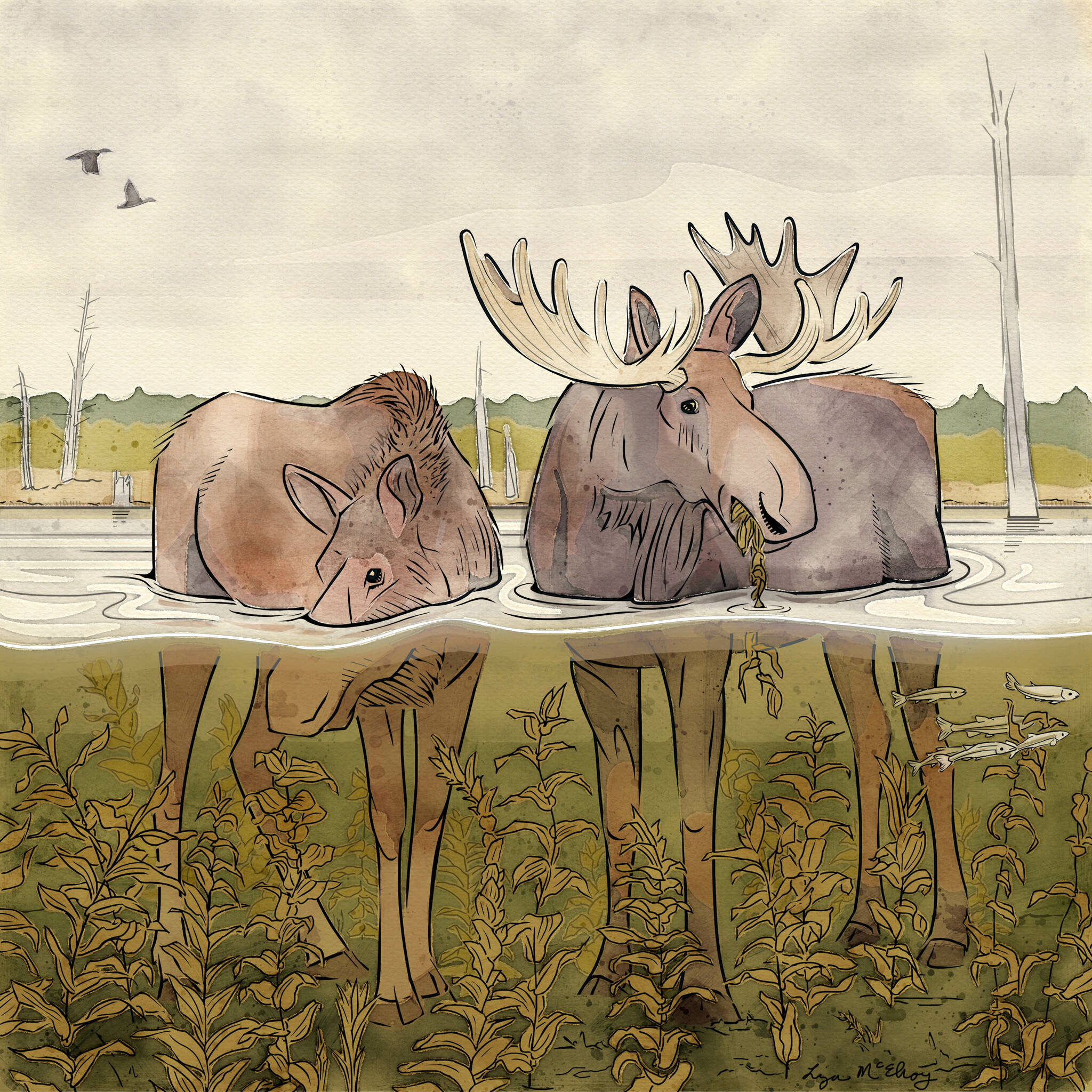
Artist Liza McElroy of Seward, Alaska, recently sketched two moose in their summertime aquatic environment to illustrate this story.

Courtesy Image / Liza McElroy Artist Liza McElroy of Seward, Alaska, recently sketched two moose in their summertime aquatic environment to illustrate this story.

Alaska Science Forum: Why is a moose’s nose so big?

The more you nose.

A scientist from Ohio once pondered why moose have such big noses.

Why might a scientist from Ohio care? It can tell a person about evolution, says Lawrence Witmer. Witmer is a biologist and professor of anatomy at Ohio University. As part of a study of unusual noses on dinosaurs and modern animals, Witmer and his colleagues examined the enigmatic nose of the moose.

Because moose disappeared from Ohio long ago, Witmer looked farther north for help. He found it in Newfoundland, Canada’s easternmost province. There, workers for the Department of Natural Resources shipped him four frozen heads of road-killed moose.

With mooseheads intact in his Athens, Ohio, lab, Witmer dissected the noses for a closer look, finding enough compelling information to write a paper that was published in the Journal of Zoology.

Before Witmer’s study, scientists had speculated on why the moose might have evolved such a long nose while other members of the deer family had relatively short noses.

One argument was that a long nose could help a moose shed heat from its huge body after running long distances to avoid predators. Witmer and his coworkers found this adaptation unlikely because few blood vessels exist near the outside surface of a moose’s nose, and moose are more apt to stand and fight predators than to try and outrun them.

Another reason a moose might have a big nose is to better sniff out predators or potential mates. Witmer found that idea had merit, and his attention soon turned to a moose’s nostrils.

Just like a person’s ears, a moose’s large nostrils point opposite directions. The wide spacing of moose nostrils might permit a moose to better locate smells, as our ears help us locate the direction of a sound and its distance. Witmer couldn’t rule out that moose use their unique nostrils for directional smelling, but all the complicated tissues that make up a moose’s nostrils suggested moose used them for something more — a set of valves that close automatically underwater.

“Animals like horses, dogs, and cats can’t close their nostrils,” Witmer said. “Closing your nostrils is a common aquatic adaptation, but you don’t see it in other members of the deer family.”

When a moose dips its head under water, the difference between the water pressure and the air pressure causes the nostrils to close, Witmer said. This adaptation, perhaps the main reason a moose’s nose is so long, allows a moose to feed underwater without water flooding into its nose, an unpleasant sensation even for two-legged, short-nosed mammals like us.

• Since the late 1970s, the University of Alaska Fairbanks’ Geophysical Institute has provided this column free in cooperation with the UAF research community. Ned Rozell is a science writer for the Geophysical Institute. A version of this story ran in 2004.

More in News

The northern lights are seen from the North Douglas launch ramp late Monday, Jan. 19. A magnetic storm caused unusually bright northern lights Monday evening and into Tuesday morning. (Chloe Anderson/Juneau Empire)
Rare geomagnetic storm causes powerful aurora display in Juneau

The northern lights were on full display Monday evening.

teaser
Juneau activists ask Murkowski to take action against ICE

A small group of protesters attended a rally and discussion on Wednesday.

A female brown bear and her cub are pictured near Pack Creek on Admiralty Island on July 19, 2024. (Chloe Anderson for the Juneau Empire)
Pack Creek permits for bear viewing area available now

Visitors are welcome from April 1 to Sept. 30.

Cars pass down Egan Drive near the Fred Meyer intersection Thursday morning. (Clarise Larson / Juneau Empire file photo)
Safety changes planned for Fred Meyer intersection

DOTPF meeting set for Feb. 18 changes to Egan Drive and Yandukin intersection.

Herbert River and Herbert Glacier are pictured on Nov. 16, 2025. (Mari Kanagy / Juneau Empire)
Forest Service drops Herbert Glacier cabin plans, proposes trail reroute and scenic overlook instead

The Tongass National Forest has proposed shelving long-discussed plans to build a… Continue reading

A tsunami is not expected after a 4.4-magnitude earthquake northwest of Anchorage Wednesday, Feb. 4, 2026. (U.S. Geological Survey)
No tsunami expected after 4.4-magnitude earthquake in Alaska

U.S. Geological Survey says 179 people reported feeling the earthquake.

ORCA Adaptive Snowsports Program staff member Izzy Barnwell shows a man how to use the bi-ski. (SAIL courtesy photo)
Adaptive snow sports demo slides to Eaglecrest

Southeast Alaska Independent Living will be hosting Learn to Adapt Day on Feb. 21.

Cars drive aboard the Alaska Marine Highway System ferry Hubbard on June 25, 2023, in Haines. (Photo by James Brooks)
Alaska’s ferry system could run out of funding this summer due to ‘federal chaos problem’

A shift in state funding could help, but a big gap likely remains unless a key federal grant is issued.

Photo by James Brooks/Alaska Beacon
U.S. Sen. Dan Sullivan stands with acting Coast Guard Commandant Adm. Kevin Lunday during the after the commissioning ceremony for the Coast Guard icebreaker Storis on Sunday, Aug. 10, 2025, in Juneau, Alaska.
Coast Guard’s new Juneau base may not be complete until 2029, commandant says

Top Coast Guard officer says he is considering whether to base four new icebreakers in Alaska.

Most Read