
By Ned Rozell
Within their bulbous bodies, Steller sea lions of the western Aleutian Islands seem to carry more mercury than sea lions closer to mainland Alaska.
By looking at tiny bits of fish and squid, a graduate student is trying to find out where that mercury is coming from.
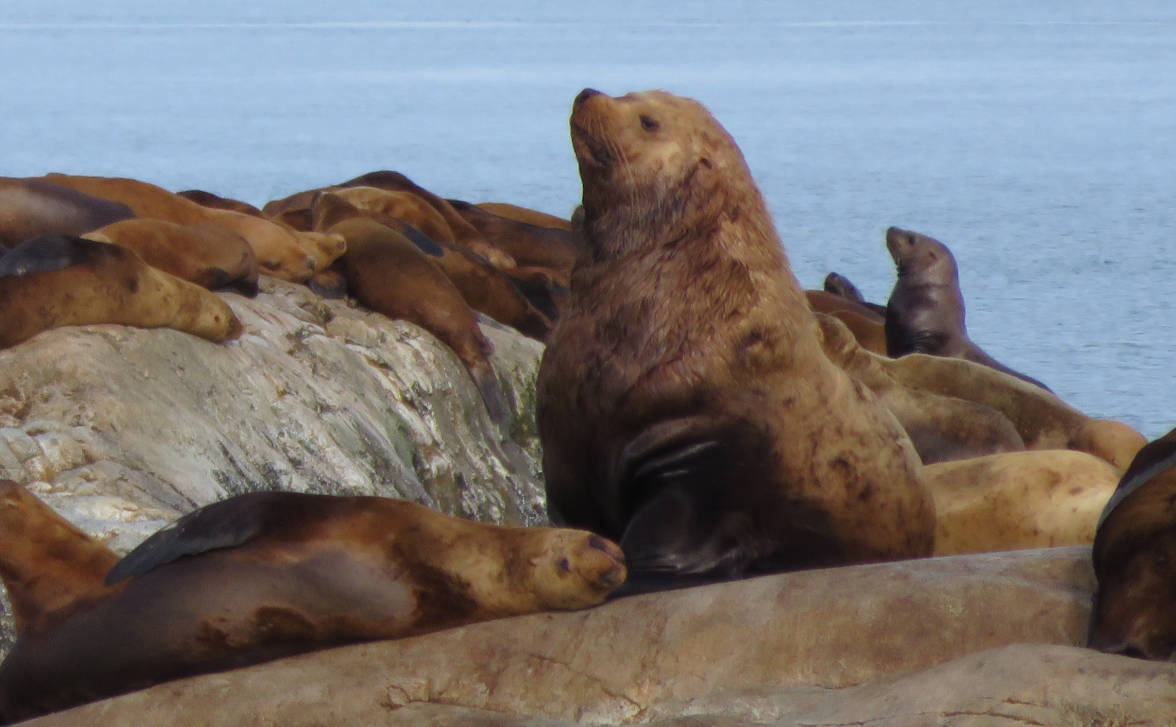
Steller sea lions drape their chocolate bodies over rocks lining the Alaska coast. From those rocks, they plop into deep ocean water, and suddenly become graceful, among the most powerful swimmers in the sea.
Full-grown male Steller sea lions are heavier than the largest bull moose and can live 20 years. Females weigh half as much, despite being just a few feet shorter than the 11-foot males.
Numbers of Steller sea lions in the western Aleutian Islands of Alaska crashed in the 1970s and 1980s. Government officials listed them as endangered in 1997. Sea lion groups in other areas of Alaska are not endangered, but there is something going on with sea lions in the western end of the Aleutian arc, near Attu, Shemya and Buldir islands.
[Pride of Bristol Bay: Catching the Iliamma Lake Monster]
Michelle Trifari, in her work for a master’s degree, will try to tease out the answers in labs at the University of Alaska Fairbanks. Using samples of fish and squid netted during commercial fishing trawls from 2013 to 2015, Trifari will “work down their food chain to try to figure out where the mercury might be entering,” Trifari said.
Mercury — an element released when we burn gas and oil, as well as when volcanoes erupt and permafrost thaws — in high concentrations is bad for living things like Steller sea lions and people.
Scientists found 10% of the sea lion pups they worked on at western Aleutian rookeries had mercury in their hair exceeding toxic levels. They also found mercury levels in Pacific cod and arrowtooth flounder were much higher in the western Aleutians than the same fish sampled in the eastern Aleutians, around Adak and Amchitka.
Sea lions, which can hold their breath and dive for more than 15 minutes, eat any fish they can catch, and also squid and octopus. Trifari will take a look at specks of muscle from walleye pollock, Atka mackerel, flounder, Pacific cod, rockfish and sculpin that are waiting in a UAF freezer.
This winter, Trifari will perform these tests at the Alaska Stable Isotope Facility and the Marine and Ecotoxicology Trophic Assessment Laboratory at UAF. She hopes to find a few answers: Who eats who in the cold waters of the Bering Sea and Northern Pacific Ocean, and is one of these fish or squid passing a heftier dose of mercury on to Stellar sea lions?
• Since the late 1970s, the University of Alaska Fairbanks’ Geophysical Institute has provided this column free in cooperation with the UAF research community. Ned Rozell is a science writer for the Geophysical Institute.
