
By Ned Rozell
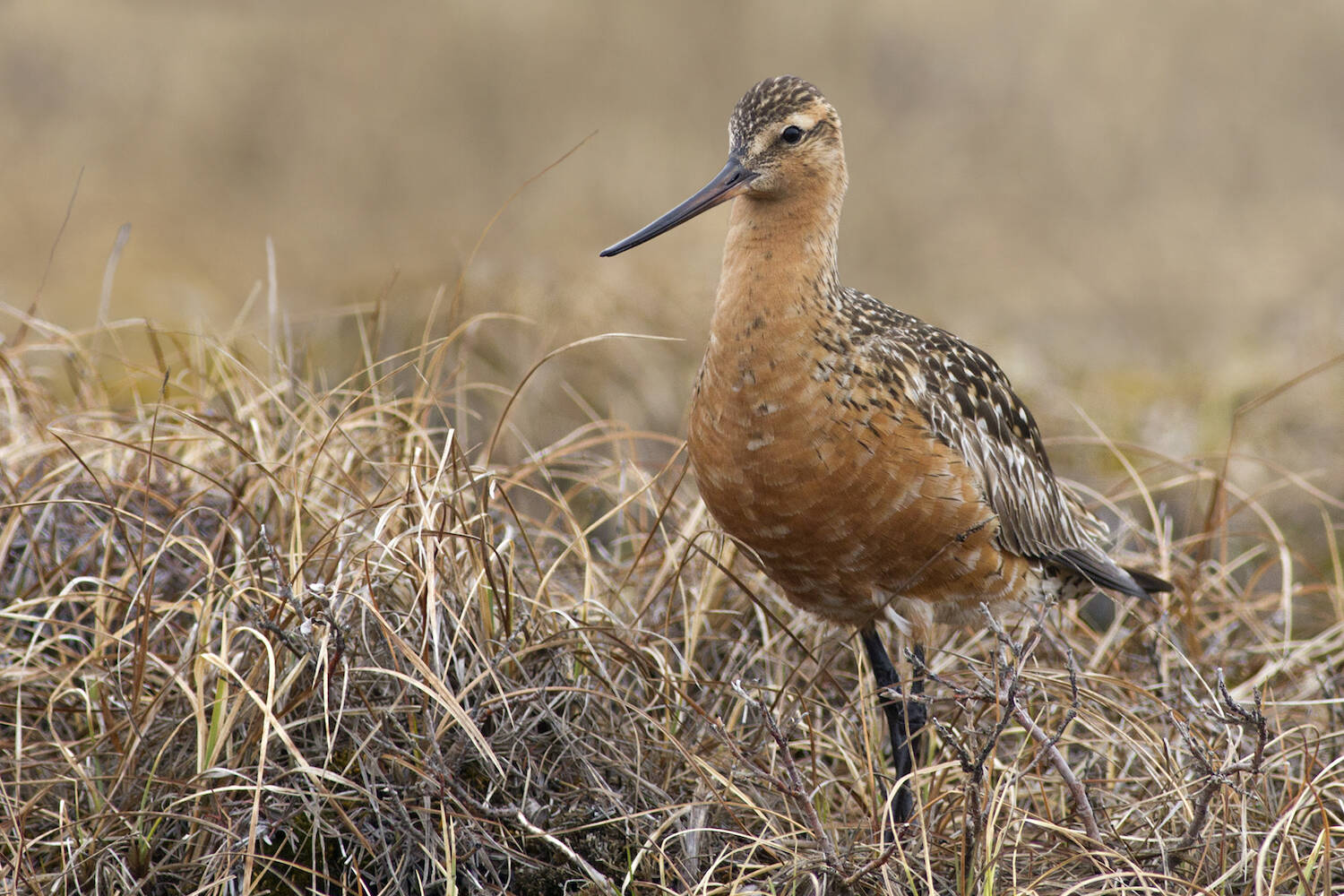
Pencil-beaked shorebirds with the ability to stay airborne for a week — flying all the way from Alaska to New Zealand — rely on a few crescents of mudflat to fuel that incredible journey.
Scientists recently found that almost the entire population of bar-tailed godwits that breed in Alaska fatten up on clams and worms on ephemeral sand bars just west of the mouth of the Kuskokwim River. In autumn, 80% of the birds rest and feed on islands within 15 miles of one another.
Each fall, packed onto islands near Cape Avinof, godwits gorge until they double their body weight. In August and September, the fist-size birds leap into the air on the front end of storm systems, which help blow them out of Alaska.
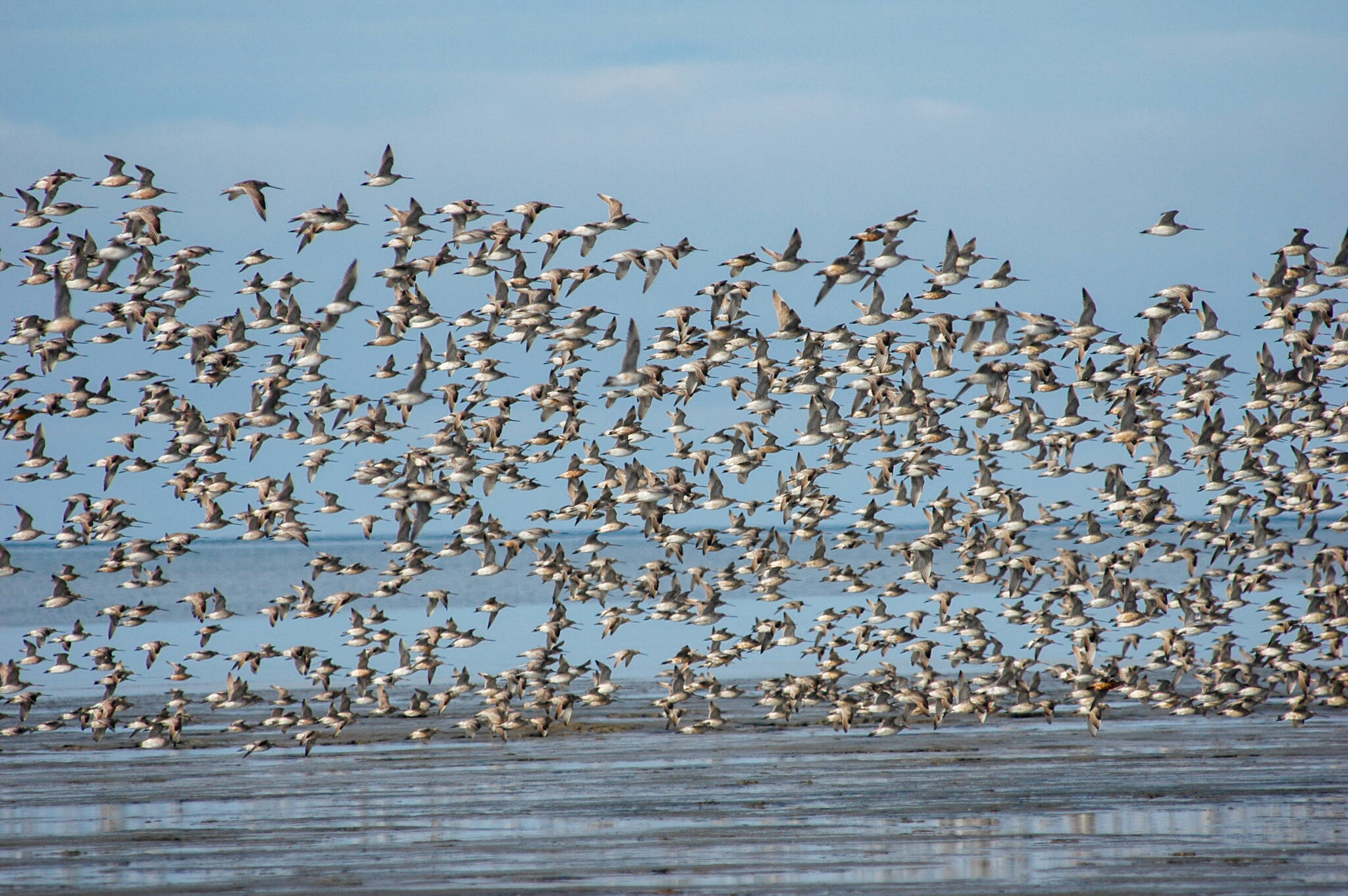
A flock of bar-tailed godwits above a sand shoal near Cape Avinof near the mouth of the Kuskokwim River. Photo by Dan Ruthrauff, (Courtesy Photo / USGS Alaska Science Center)
Once in the sky, some of the birds don’t stop flying for a week or more, losing half their body weight and perhaps even snoozing on the wing during a non-stop flight to New Zealand and Australia. The trip is more than 7,000 miles long, equal to a flight from San Francisco to New York, and then back to San Francisco.
Alaska and New Zealand scientists have monitored the godwits for years using small satellite transmitters. In 2007, Bob Gill and others at the USGS Alaska Science Center in Anchorage noticed that one bird that took off from Alaska did not stop moving until it reached North Cape, New Zealand.
In springtime, the godwits’ route back to Alaska is just as impressive. Birds take off from New Zealand and Australia and often fly straight for 6,000 miles to the Yellow Sea offshore of China and Korea. The birds remain there for a few weeks before blasting off for Alaska, another nonstop of about 4,500 miles.
But things have changed along that route. During the last 50 years, people have converted more than half of the biologically rich tidal flats of the Yellow Sea into something else. These new landcovers include deepwater ports, factories and shrimp farms.
With this big chunk of habitat gone, godwits need to search elsewhere to find the thumbnail-size clams and aquatic worms that make up most of their diet during migration.
Numbers of godwits have decreased, inspiring scientists to find new ways to count them in Alaska to continue studies Bob Gill and others have done for decades.
In 2018 and 2019, biologists including Daniel Ruthrauff of the USGS Alaska Science Center flew in single-engine aircraft 120 feet over the Yukon-Kuskokwim River deltas and along the north side of the Alaska Peninsula. They searched for bar-tailed godwits that were about to leave Alaska. The scientists used a digital camera with a 400-millimeter lens to shoot high-resolution digital photos of every godwit flock they saw.
In what they consider their most accurate survey, the researchers noticed five flocks with more than 80,000 godwits total located along a 15-mile string of sand shoals near the mouth of the Kuskokwim River. The total number of birds they found was about 100,000.
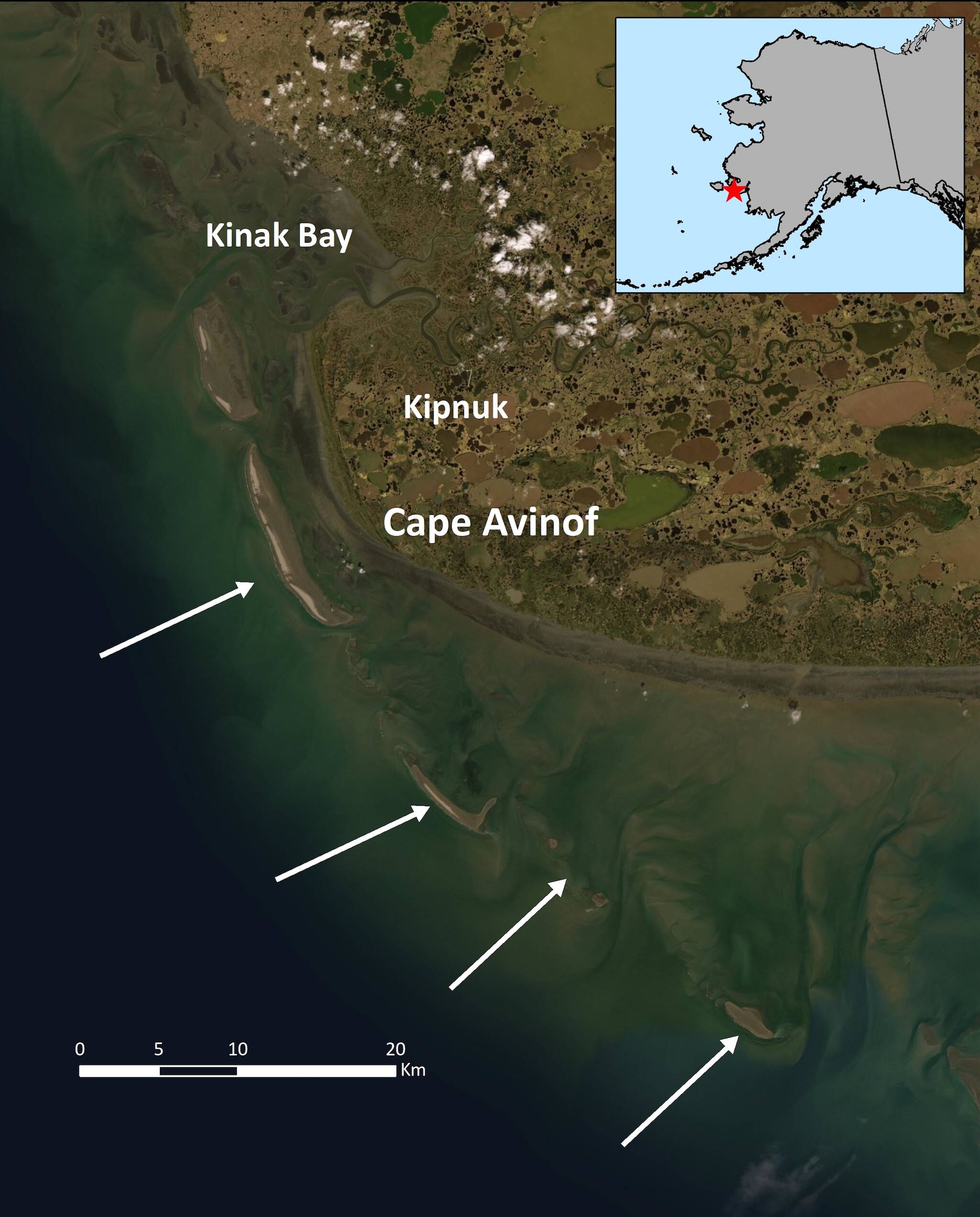
. Sand islands off the Kuskokwim River where much of the world’s population of bar-tailed godwits fuels up in fall. (Courtesy Image /Dan Ruthrauff, USGS Alaska Science Center)
“It’s rare to have so many individuals of just one species occur in one teeny spot like this,” Ruthrauff said.
The sand shoals are great places for birds to roost because they are up to six miles offshore.
“And they’re so low and featureless that it’s hard for falcons to sneak up on godwits,” Ruthrauff said.
That hotspot of mudflats that hosts almost the world’s entire population of this remarkable creature in fall (in summer birds raise chicks on Alaska’s abundant insect population, tending tundra nests as far away as the North Slope) is vulnerable because it is so small.
“Some of the shoals are officially part of the Alaska Maritime National Wildlife Refuge,” Ruthrauff said, “But the unnamed shoals where we detected most of the godwits in 2019 have no official protection or designation. An untimely (oil) spill at the mouth of the Kuskokwim could literally wipe out the entire breeding population.
“It’s a very important spot.”
• Since the late 1970s, the University of Alaska Fairbanks’ Geophysical Institute has provided this column free in cooperation with the UAF research community. This year is the institute’s 75th anniversary. Ned Rozell ned.rozell@alaska.edu is a science writer for the Geophysical Institute.
