
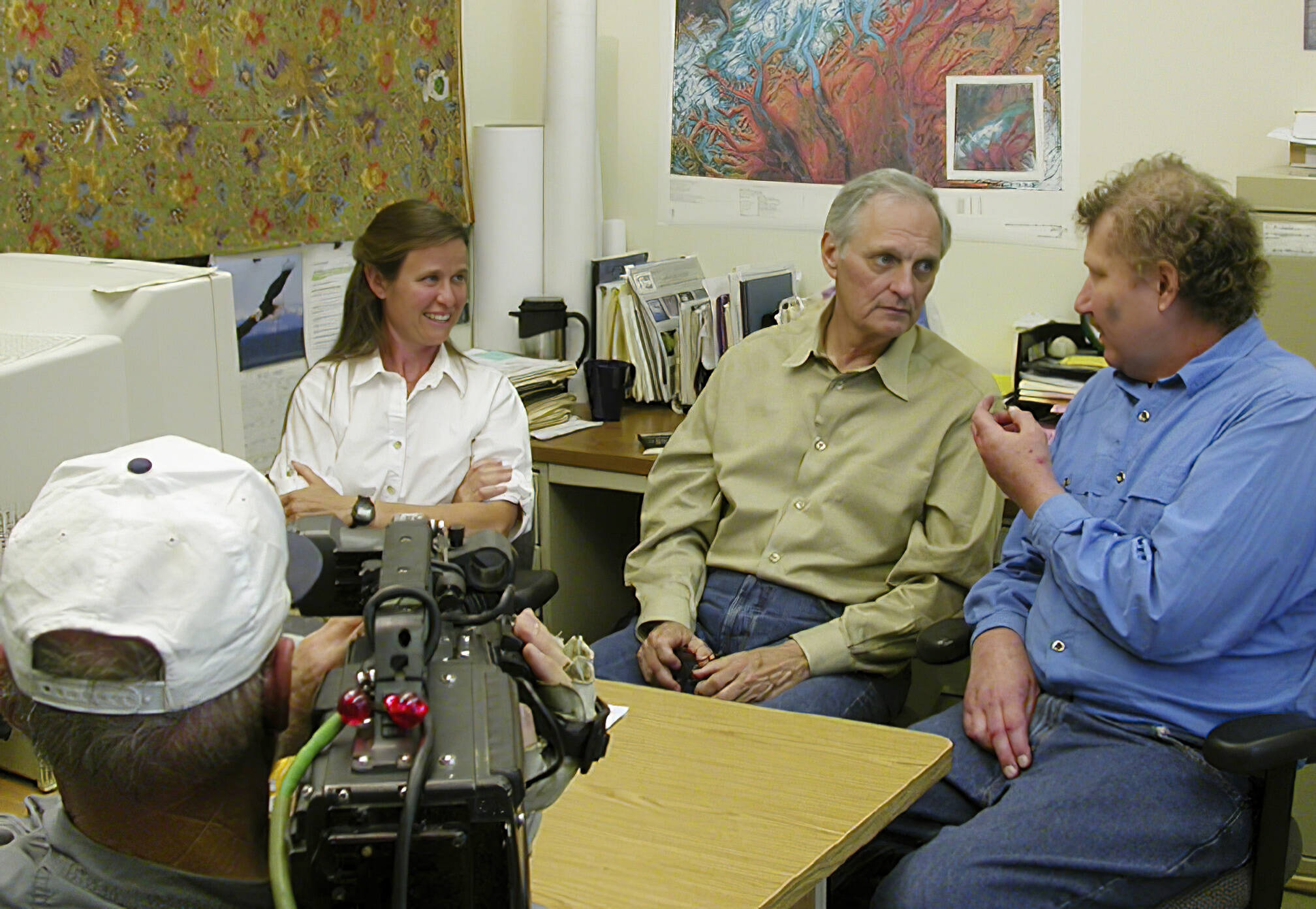
Alan Alda, the actor and host of PBS television’s “Scientific American Frontiers,” recently traveled to Alaska on a mission to interview scientists about the changing North.
Alda and the show’s crew gathered footage and scientist’s opinions for “Hot Times in Alaska,” a program scheduled to air on PBS in 2004. Along the way, they asked good questions, heard frank and scary answers, and carried the message of Alaska scientists to a broader audience.
One of Alda’s first stops was the International Arctic Research Center at the University of Alaska Fairbanks. There, Alda visited Gunter Weller, a northern meteorologist and the director of the Center for Global Change and Arctic System Research.
Weller often talks to reporters, and the staff of “Scientific American Frontiers” impressed him. John Angier, the show’s executive producer, traveled to Alaska one month before Alda or the camera crew in order to line up relevant interviews. Weller said he told Alda the following:
“Climate change in the Arctic and Alaska is substantial; we can see signals it has arrived, and we are seeing its impacts on the environment, peoples’ lives, and the Alaska economy,” Weller said. “Unless the political system takes this seriously, it’s going to be too late to do anything about it.”
Weller said Alda wondered how we could pin the blame on humans for the 4-to-5-degree Fahrenheit increase in Alaska air temperatures in the past 40 years, especially since temperatures have jumped all over the place in recorded history, even before the Industrial Revolution.
“Natural variability has a lot to do with climate,” Weller said. “The scientific opinion now is that anthropogenic (manmade) influences are significant, though you can’t put hard numbers on it … Every academy of science in every developed nation on Earth has said we need to take this seriously.”
While on the west ridge of the UAF campus, Alda also visited the glaciology lab at the Geophysical Institute. There, he met Keith Echelmeyer, the leader of a team that determined Alaska’s melting glaciers have added an enormous amount of fresh water to the world’s oceans in the last 60 years.
By Valentine, a glaciologist whom Alda interviewed with Echelmeyer, told Alda that the amount of meltwater from Alaska’s glaciers since the 1950s is enough to cover the state with 7 feet of water, or put Texas 15 feet under. Alaska’s former glacial ice has added to the level of global seas by more than one-quarter of an inch since the 1950s. That’s a lot of water from one small patch of the globe.
Alda also visited John Walsh, the UA President’s Professor of Global Climate Change. Walsh specializes in supercomputer models that are science’s best attempt at predicting what will happen in the future. Those who work with models try to compute present and future climate using variables, such as temperature, cloud cover, and historic precipitation.
“In a nutshell, the models predict warming over the Arctic Ocean of 5 to 7 degrees C (about 8-12 degrees F) in the next 100 years,” Walsh said. “Precipitation goes up, especially over Alaska in that time, and by 2100, arctic sea ice nearly disappears in summer.”
Walsh said he appreciated Alda’s questions, even the tough ones, such as “What should we do about this warming?”
“We could respond individually, but the bigger issue is the national scale,” Walsh said. “The job for scientists is to convince policymakers that there is a need for action because changes are already occurring here.”
• Since the late 1970s, the University of Alaska Fairbanks’ Geophysical Institute has provided this column free in cooperation with the UAF research community. Ned Rozell ned.rozell@alaska.edu is a science writer for the Geophysical Institute. A version of this column appeared in 2004.
