
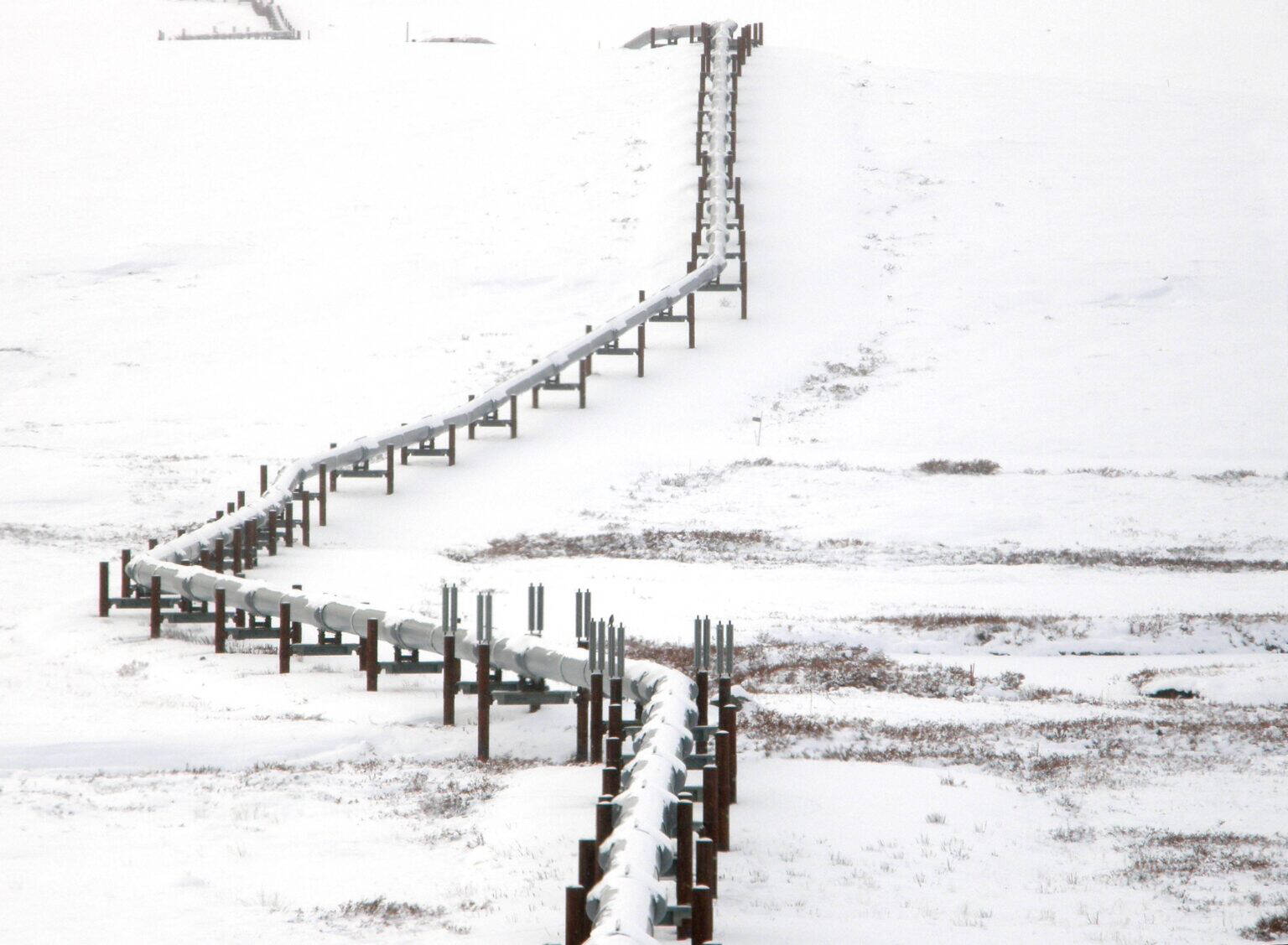
The trans-Alaska pipeline, seen on Oct. 8, 2008, threads over snow-covered terrain in the Brook Range foothills. A gryfalcon is perched on one of the pipeline’s thermosphyons in the lower center of the photo. (Photo by Craig McCaa/U.S. Bureau of Land Management)

The trans-Alaska pipeline, seen on Oct. 8, 2008, threads over snow-covered terrain in the Brook Range foothills. A gryfalcon is perched on one of the pipeline’s thermosphyons in the lower center of the photo. (Photo by Craig McCaa/U.S. Bureau of Land Management)

Alaska revenue forecast predicts more oil, but its importance to the state budget is declining

The Permanent Fund, not oil, is Alaska’s No. 1 source of general-purpose money and has been for years

  • By James Brooks Alaska Beacon
  • Monday, December 15, 2025 9:52am
  • News

Though the state of Alaska is anticipating more oil production in the fiscal year that starts July 1, money from oil continues to make up a dwindling share of general-purpose state revenue, according to a forecast published Wednesday by the Alaska Department of Revenue.

The projection, one of two per year published by the department, was released in conjunction with Gov. Mike Dunleavy’s draft budget for fiscal year 2027.

Altogether, the state expects to earn $6.2 billion in general-purpose dollars between July 1, 2026 and June 30, 2027, the next fiscal year. Officially known as “unrestricted general fund revenue,” it’s the section of the budget where lawmakers and governors focus most of their attention.

Federal money and money designated for specific programs can sometimes be shifted around to different priorities, but not easily. General-fund dollars can (and are) assigned to different priorities each year.

The forecast for next year’s unrestricted general fund revenue is higher by almost $260 million than the current year’s expectation, but most of that increase isn’t coming from oil.

Since 2018, an annual transfer from the Alaska Permanent Fund to the state treasury has been the No. 1 source of general-purpose dollars for services and the Permanent Fund dividend.

That’s more true than ever, according to the state forecast.

In the next fiscal year, just 23% of the state’s general-purpose revenue is expected to come from petroleum revenue — royalties, property taxes and production taxes.

The Permanent Fund transfer would account for almost 66% of the general-purpose money.

That difference comes despite an expectation that oil production will rise significantly between this fiscal year and next — from an average of 457,000 barrels of oil per day to 517,800 per day on average.

According to the Alaska Department of Natural Resources, that’s due to the startup of production in the Pikka oil field and other new production on the North Slope.

Despite that new production, oil revenue is expected to rise only slightly — from $1.43 billion to $1.44 billion.

That’s because the state is expecting North Slope oil prices to average just $62 per barrel during the next fiscal year, down from $65.48 in the current fiscal year.

At the same time, the Permanent Fund transfer is rising by almost $200 million, causing oil to become a still-smaller share of state revenue.

Even though revenue is expected to rise between the current fiscal year and the next one, the projected deficit in Dunleavy’s proposed spending plan stands at more than $1.8 billion.

If oil revenue alone were needed to fill that deficit, average North Slope prices would have to be near $100 per barrel, or the state would have to produce more than 1.2 million barrels of oil per day during the next fiscal year, an amount that is geologically, economically and mechanically unfeasible. The state hasn’t posted an annual average of over 1 million barrels of North Slope oil per day since the turn of the century.

James Brooks is a longtime Alaska reporter, having previously worked at the Anchorage Daily News, Juneau Empire, Kodiak Mirror and Fairbanks Daily News-Miner. A graduate of Virginia Tech, he is married and has a daughter, owns a house in Juneau and has a small sled dog named Barley.

Alaska Beacon is part of States Newsroom, the nation’s largest state-focused nonprofit news organization.

More in News

Patrick Sullivan stands by an acid seep on July 15,2023. Sullivan is part of a team of scientists who tested water quality in Kobuk Valley National Park’s Salmon River and its tributaries, where permafrost thaw has caused acid rock drainage. The process is releasing metals that have turned the waters a rusty color. A chapter in the 2025 Arctic Report Card described “rusting rivers” phenomenon. (Photo by Roman Dial/Alaska Pacific University)
Ecosystem shifts, glacial flooding and ‘rusting rivers’ among Alaska impacts in Arctic report

NOAA’s 2025 report comes despite Trump administration cuts to climate science research and projects

The U.S. Capitol in Washington, D.C., on Oct. 1, 2025. (Photo by Jennifer Shutt/States Newsroom)
Moderate US House Republicans join Dems to force vote on extension of health care subsidies

WASHINGTON — Republican leaders in the U.S. House will face a floor… Continue reading

The National Weather Service Juneau issues a high wind warning forDowntown Juneau, Southern Douglas Island and Thane due to increased confidence for Taku Winds this afternoon. (National Weather Service screenshot)
Taku winds and dangerous chills forecast for Juneau

Gusts up to 60 mph and wind chills near minus 15 expected through the weekend.

Chloe Anderson for the Juneau Empire
Fallen trees are pictured by the Mendenhall river on Aug. 15, 2025. Water levels rose by a record-breaking 16.65 feet on the morning of Aug. 13 during a glacial outburst flood.
Lake tap chosen as long-term fix for glacial outburst floods

The U.S. Army Corps of Engineers and Juneau leaders agreed on the plan.

Gift card displays, such as this one in a CVS in Harlem, N.Y., have been a source of concerns for lawmakers hoping to combat gift card fraud. “Card draining,” or stealing numbers from poorly packaged cards, is one of the costliest and most common consumer scams, and states are trying to combat it with consumer alerts, arrests and warning signs on store displays. (Photo by Robbie Sequeira/Stateline)
Alaskans targeted by scammers posing as government officials, FBI warns

The FBI reports Alaskans lost over $26.2 million to internet-based scams in 2024, with $1.3 million of those losses due to government impersonation scams

A buck enters the view of an Alaska Department of Fish and Game trail camera on Douglas island in November 2020. (Alaska Department of Fish and Game courtesy photo)
Douglas deer: The island’s hunt faces calls for new rules

Board of Game is seeking public comment on regulation changes that would affect Juneau.

A cat says hello at Juneau Animal Rescue in February 2025. (Jasz Garrett / Juneau Empire file photo)
New animal shelter site approved by Juneau Assembly

Juneau Animal Rescue secures eight-acre lease, but fundraising remains.

The trans-Alaska pipeline, seen on Oct. 8, 2008, threads over snow-covered terrain in the Brook Range foothills. A gryfalcon is perched on one of the pipeline’s thermosphyons in the lower center of the photo. (Photo by Craig McCaa/U.S. Bureau of Land Management)
Alaska revenue forecast predicts more oil, but its importance to the state budget is declining

The Permanent Fund, not oil, is Alaska’s No. 1 source of general-purpose money and has been for years

A mound of a snow obscures a “student drop off” sign near Sít’ Eetí Shaanàx-Glacier Valley School. (Ben Hohenstatt / Juneau Empire file photo)
Juneau schools closed, city facilities delayed Monday due to weather

NWS released a weather warning in effect through the evening.

Most Read