
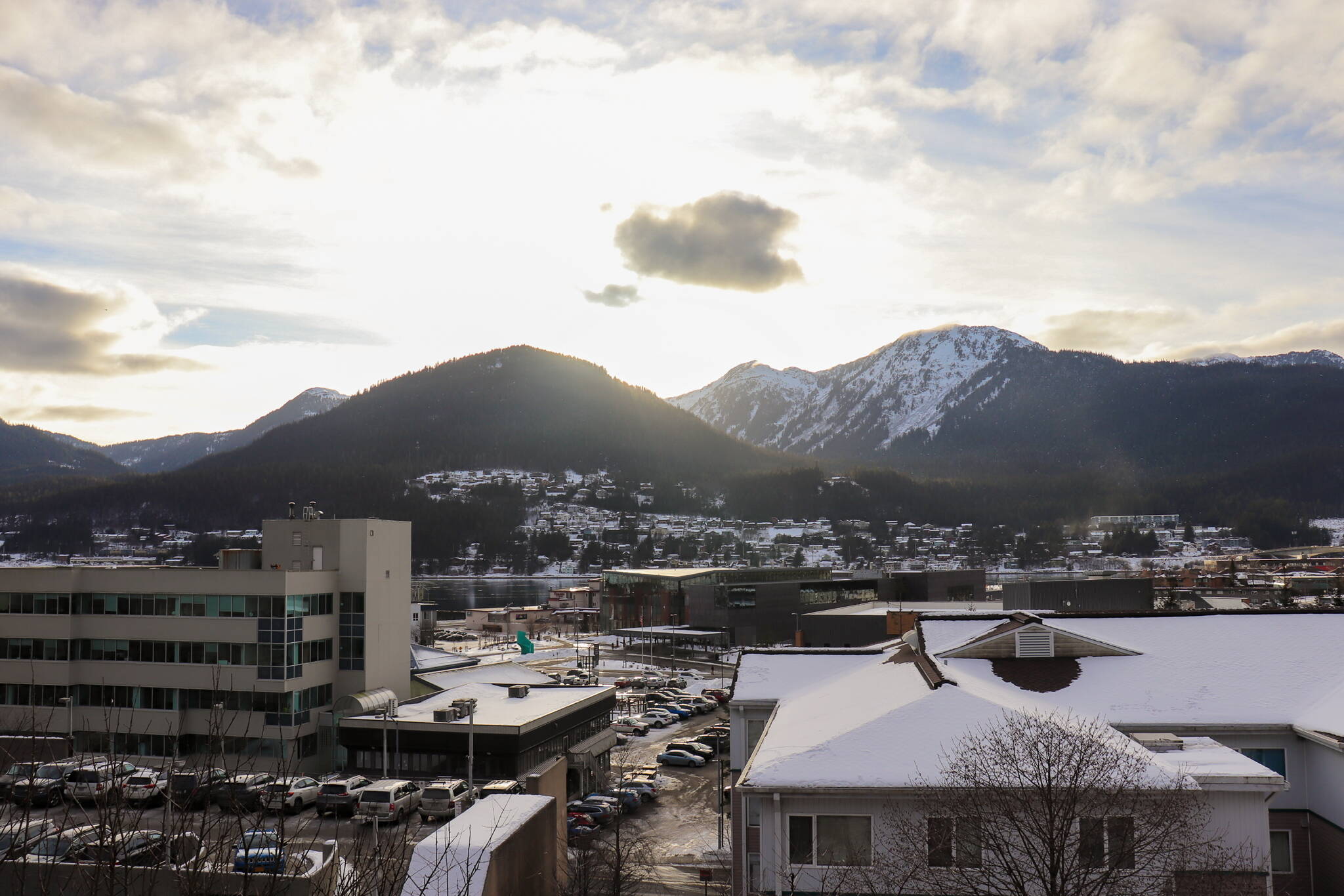
Alaska ranks 49th out of 50 in the annual Best States survey published Tuesday by U.S. News & World Report, a drop of four spots from last year as scores for fiscal stability and opportunity dropped markedly.
The Last Frontier hasn’t scored particularly well since the magazine’s surveys began in 2017, finishing somewhere between 43rd and 49th in the rankings. Two categories with consistently low scores are the economy (ranking between 45th and 50th, including three last-place finishes), and crime and corrections (between 44th and 50th).
The magazine didn’t provide an explanation for Alaska’s overall and category rankings beyond listing the statistics used to compile the assessments. An article accompanying the rankings noted Utah held onto its top ranking for the third straight year while Louisiana ranked last for the third straight year.
“A common factor shared by many of the top-ranked states is a strong performance in the education category — the highest-weighted category of the 2025 rankings based on new survey results showing what areas Americans believe their states should prioritize, and which issues present the most pressing concerns,” the article notes.
The top five states were Utah, New Hampshire, Idaho, Minnesota and Nebraska. The bottom five were Louisiana, Alaska, Mississippi, New Mexico and West Virginia.
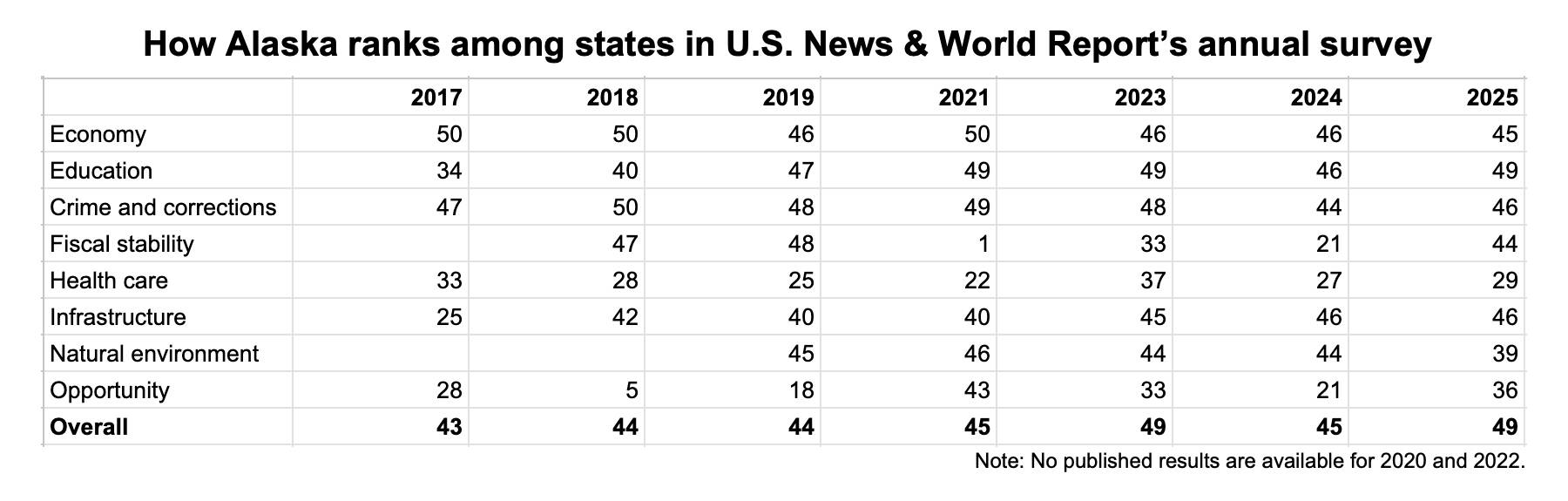
A chart shows Alaska’s rankings in U.S. News & World Report’s annual survey between 2017 and 2025.
The rankings didn’t provoke much reaction among Alaska State Senate leaders who were asked about it during a weekly press availability Tuesday.
“We are still here, we choose to be here and we could leave at any time, I suppose,” Senate President Gary Stevens (R-Kodiak) said.
Sen. Bert Stedman (R-Sitka) defended his hometown region by declaring “I could tell you one of the best places to live and that’s Southeast Alaska.”
“And I’d like to know if there’s any place else on the planet that’s even like it,” he said. “So I would say it’s one the best places to live — far above the Louisiana swamp, by the way.”
Spokespersons for Gov. Mike Dunleavy, who began the first of his two terms in 2018, did not respond to requests for comment Tuesday afternoon about the magazine’s survey.
The category rankings for Alaska in the surveys over the years reflect some hard realities, intriguing questions about criteria for scores and a few bizarre statistical deviations.
Alaska’s education rankings each year since 2017 (excluding 2020 and 2022, when no results are available) are 34th, 40th, 47th, 49th, 49th, 46th and 49th. More specifically for 2025, grades PreK-12 are ranked 49th and higher education 22nd. The magazine notes the high school graduation rate is 77.9% compared to the national average of 85.8% and average NAEP math score of 264 compared to the national average of 273. Average college debt at graduation in Alaska is $10,959 compared to the national average of $13,720.
The year-by-year rankings to an extent mirror test scores that have shown declines — and a near-bottom current ranking by the state — since 2017, with education advocates citing relatively flat funding during those years as the primary reason for the drop.
Education funding has emerged as the most-discussed issue by the Alaska Legislature this year, with lawmakers passing a bill with a $700 increase to the $5,960 per-student formula. Many officials say they are expecting the bill to be vetoed by Dunleavy — who has stated Alaska’s education policies rather than funding is to blame for poor results — although there appear to be enough votes for an override.
A potential eye-opener in the rankings for some people is natural environment, with rankings since 2019 for Alaska of 45th, 46th, 44th, 44th and 39th. But that appears to be mostly linked to the state’s drinking water quality — a major concern in remote areas where fresh water and plumbing are lacking — with the current year’s report noting the 24.60 drinking water violation points per 1,000 customers compared to the national average of 3.26.
Among the true statistical oddities offering fodder for skeptics of the magazine’s methodologies is fiscal stability rankings for Alaska of 47th in 2018, 48th in 2019, first in 2021 and dropping back down to 33rd in 2023. The criteria used for scores are the state’s government credit rating, passing balanced budgets and overall liquidity (with the state scoring well above average on the latter due presumably to the $80 billion Alaska Permanent Fund).
However, a sharp drop in fiscal stability from 21st in 2024 to 44th this year does reflect a crisis mentality setting in among state lawmakers at the Capitol who are facing a budget crisis for the coming year due to low oil prices and other uncertainties. The Senate is scheduled to begin floor debate on a budget with a Permanent Fund dividend of $1,000, which would be the lowest adjusted for inflation since the annual payments began in 1982.
• Contact Mark Sabbatini at mark.sabbatini@juneauempire.com or (907) 957-2306.
