
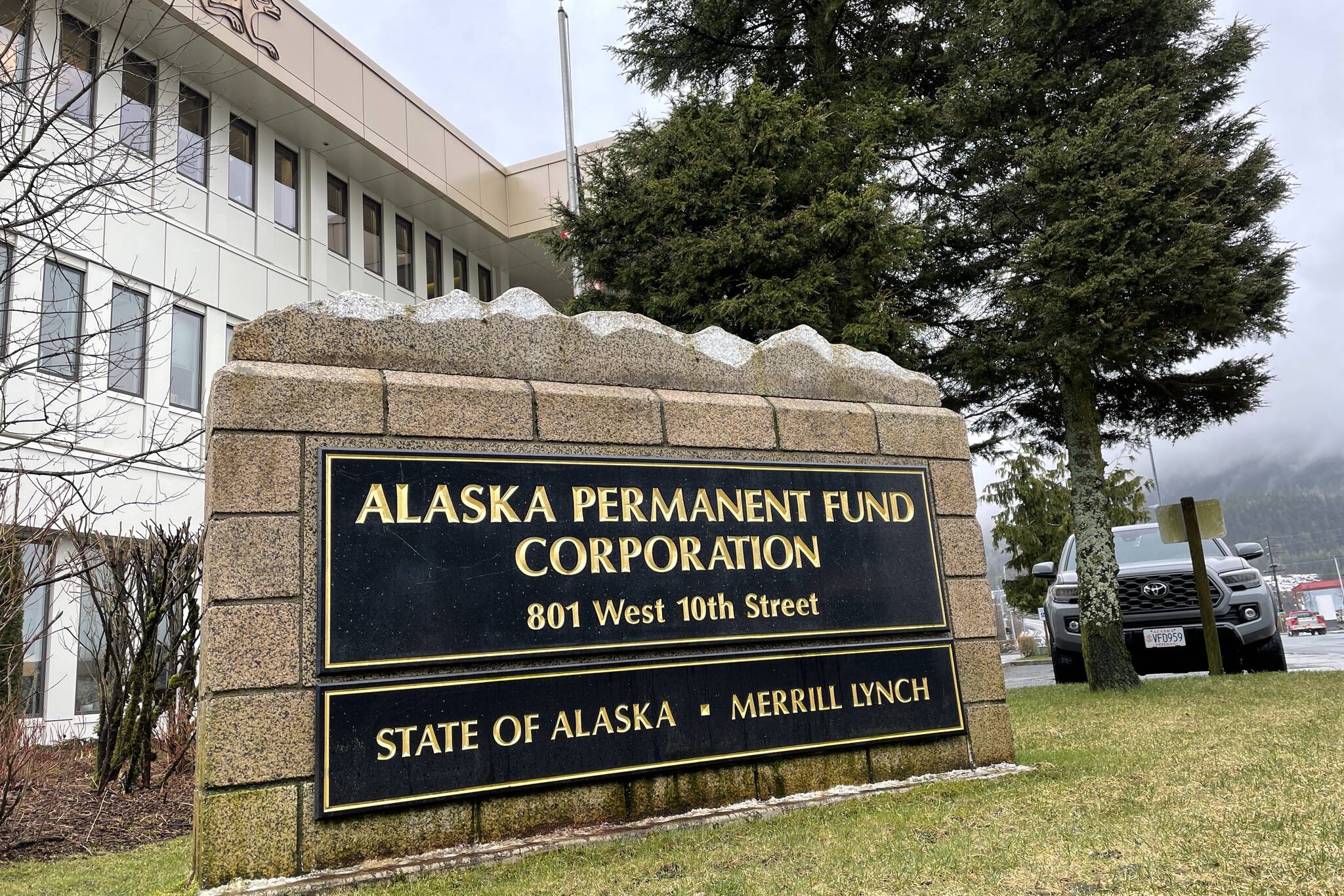
For the first time in a decade, the Alaska Permanent Fund Corp., source of more than half of Alaska’s general-purpose state revenue, posted negative investment returns for an entire fiscal year.
As of June 30, the last day of the just-ended Fiscal Year 22, the fund reported having earned minus-1.32% over the preceding 12 months.
The decline will not have an immediate negative effect on state finances, but continued losses over multiple years would reduce the amount of money available each year for state services and the Permanent Fund dividend.
Between June 30, 2021, and June 30, 2022, the fund’s market value declined from $81.8 billion to $77.3 billion. That decline includes withdrawals and deposits, as well as the investment loss.
Those figures are from the fund’s monthly performance report for June, released this week, and contained unaudited, preliminary figures that also include withdrawals and deposits, not just investment gains and losses. Final figures are expected later this month.
Each year, the fund attempts to earn at least 5% plus the cost of inflation, the minimum necessary to keep the fund’s inflation-adjusted value constant. Over the past year, the fund would have had to earn 14.06% to keep pace with inflation and withdrawals. Instead, it lost money on its investments for the first time since fiscal year 2012.
Reasons for loss
Chief Investment Officer Marcus Frampton said the biggest reason for the loss is “the stock market.”
Between June 30, 2021, and June 30, 2022, the Dow Jones Industrial Average, a key indicator of public markets in the United States, fell by almost 11%. More than a third of the Permanent Fund is invested in public equities, mostly stocks in the United States.
That has caused many public investment funds to post significant losses. CalPERS, the California public pension fund, posted a loss of 6.1% during the just-ended fiscal year.
Frampton noted that despite losing money overall, the Permanent Fund Corp. did better than its contemporaries, beating benchmarks in a down market and generally losing less money than they did.
“I’m encouraged by that,” Frampton said, “because anyone can make money in an up market by taking more risk. But then to have beaten the benchmark in an up year like last year and then beat it in a down year, this year, I’m really encouraged by how our portfolio managers navigated the two very different markets.”
One notable failure was in the Permanent Fund’s special-opportunity investments, which include investments where the Permanent Fund offers a company money for an ownership share that can later be converted into cash when the company starts selling public stocks.
If the Permanent Fund had hit its benchmarks on those investments, it would have earned a 22% return on $4.6 billion. Instead, it earned only 1.85%.
Frampton said that’s attributable to the fact that the Permanent Fund has invested heavily in biotechnology and medical companies particularly hard-hit during the recent stock market declines.
The Permanent Fund invested about $130 million into a company called Denali Therapeutics in 2013, then saw the value of its investment grow by 700% or 800%, Frampton said.
At the start of the fiscal year, the fund still held about $400 million in Denali Therapeutics’ stock, only to see its value fall by about half.
“That one position was a couple hundred million of loss,” Frampton said.
“With hindsight, we wish we had sold more aggressively, like a year ago,” he said.
Frampton said that with hindsight, he would have invested more into real estate, which the Permanent Fund keeps as a hedge against inflation.
Short-term effects limited, but long-term effects possible
In the short term, the one-year downturn will have limited effect on the Permanent Fund and on state finances.
In 2018, state lawmakers created an annual transfer from the Permanent Fund to the state treasury in order to pay for both the Permanent Fund dividend and state services amid falling oil prices.
Last year, that withdrawal to the treasury was about $3.1 billion.
Another $222 million was withdrawn for operating costs, said Alexei Painter, director of the Legislative Finance Division, and about $718 million in oil royalties was deposited into the fund.
Investment returns, rather than oil deposits, are the biggest factor in whether the fund gains money or loses money.
Creating an automatic transfer was intended to discourage lawmakers from taking larger amounts of money from the fund, something allowed with a simple majority vote of the House and Senate, plus the assent of the governor.
The transfer is limited to 5% of the fund’s average value over five years. The average is calculated by skipping the most recent year, then taking the five years immediately before it.
If the current downturn lasts only one year, that smoothing effect means the average transfer won’t change significantly.
“We are invested in the long term,” said Paulyn Swanson, a spokesperson for the corporation.
Over the past three years, the fund has averaged 9.33% returns, below the target of 9.98%. Over the past five years, the fund has averaged 9.03%, slightly above the target.
Asked whether he believes the downturn will continue, Frampton said that with the Federal Reserve raising interest rates and an unstable geopolitical situation, “it’s a pretty ominous setup for the markets to have.”
Over the next 10 to 15 years, he said the Permanent Fund is set up to succeed, “but I think the setup for investors right now, on like a one-to-two-year outlook, is pretty tough. So it would not surprise me if there are more difficult periods in the next year or two.”
• James Brooks is a longtime Alaska reporter, having previously worked at the Anchorage Daily News, Juneau Empire, Kodiak Mirror and Fairbanks Daily News-Miner. This article originally appeared online at alaskabeacon.com. Alaska Beacon, an affiliate of States Newsroom, is an independent, nonpartisan news organization focused on connecting Alaskans to their state government.
