
A resolution intended to declare an Alaska Native language emergency is advancing in the Alaska Senate, but without its most important word.
On Thursday, the Senate State Affairs Committee voted to approve House Concurrent Resolution 19 after stripping the word “emergency” from the document.
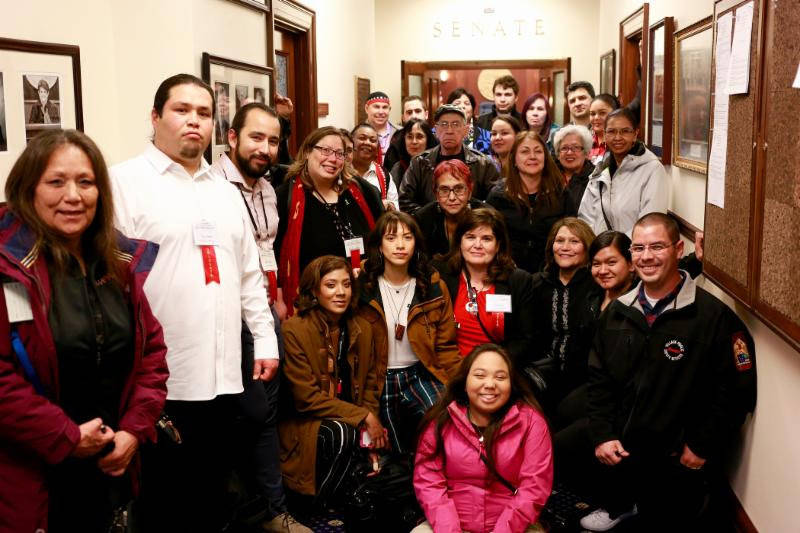
The changes prompted the annual Tribal Assembly of Central Council Tlingit and Haida Indian Tribes of Alaska delegates to adjourn for a march to the Capitol. Assembly delegates filled the committee room, and the crowd spilled into the hallway, though only three were allowed the time to speak to the committee. (A previous session of public testimony was held Tuesday.)
“We are coming before you, but we are not coming before you on our knees,” said Paulette Moreno, First Grand President of the Alaska Native Sisterhood and one of the marchers, speaking to lawmakers about the group’s determination.
As originally drafted, HCR 19 — written by Rep. Dan Ortiz, I-Ketchikan — follows a recommendation of the Alaska Native Language Preservation and Advisory Council to declare a linguistic emergency in Alaska. While it isn’t within the power of the Legislature to declare such an emergency, HCR 19 advised the governor to do so.
No longer.
The new version stresses that the need to preserve Alaska Native languages is “urgent,” but no longer uses the word “emergency.”
The original text of HCR 19 passed the House in a 34-4 vote on March 19.
In a prepared statement Thursday, the Central Council said it “objects to and protests the changing of the wording from ‘recognizing a linguistic emergency’ to ‘recognizing an urgent need for language revitalization.’
As Lance Twitchell, a tribal citizen and member of the language council, told lawmakers, many of Alaska’s 20 Native languages are in imminent danger of extinction.
David Boxley, a Tsimshian born and raised in Metlakatla, testified that when he was born, there were 150 people in his community who could speak the area’s language fluently. Today, there are five.
Language is a key element of Alaska Native culture, Boxley explained, and even under the best-case scenario, “we are all going to witness the end of an unbroken line of fluent speakers.”
On Friday, Sen. Kevin Meyer, R-Anchorage and the committee chairman, said committee members agree that language preservation is important, but they were wary of the word “emergency.”
“I think in most people’s minds, when you think of an emergency, you think of a fire, a flood, a major disaster like that,” he said.
In Thursday’s hearing, Twitchell explained that the language emergency is the result of a major disaster: the deliberate, often-violent suppression of Native culture and languages by religious and governmental figures in the 19th and 20th centuries.
“I work day and night to figure out ways that we can create more speakers, and a big part of that has to do with structures that been imposed upon indigenous peoples,” he said.
The entire idea of an emergency is that something has happened that shouldn’t have happened, he added.
“If there was ever a reason to call something an emergency, I can’t think of a better reason,” Boxley said.
Meyer, speaking Friday, said he wants to make sure the word “emergency” isn’t overused in communications with the governor.
“Certainly losing one’s language is a concern and we need to deal with it as quickly as possible,” he said.
Boxley and Twitchell each said they don’t want a dispute over a single word to distract from the larger issue and keep the measure from advancing.
“We just ask you: Don’t stand in our way,” Twitchell said.
HCR 19 awaits a vote of the full Senate.
• Contact reporter James Brooks at jbrooks@juneauempire.com or 523-2258.
