
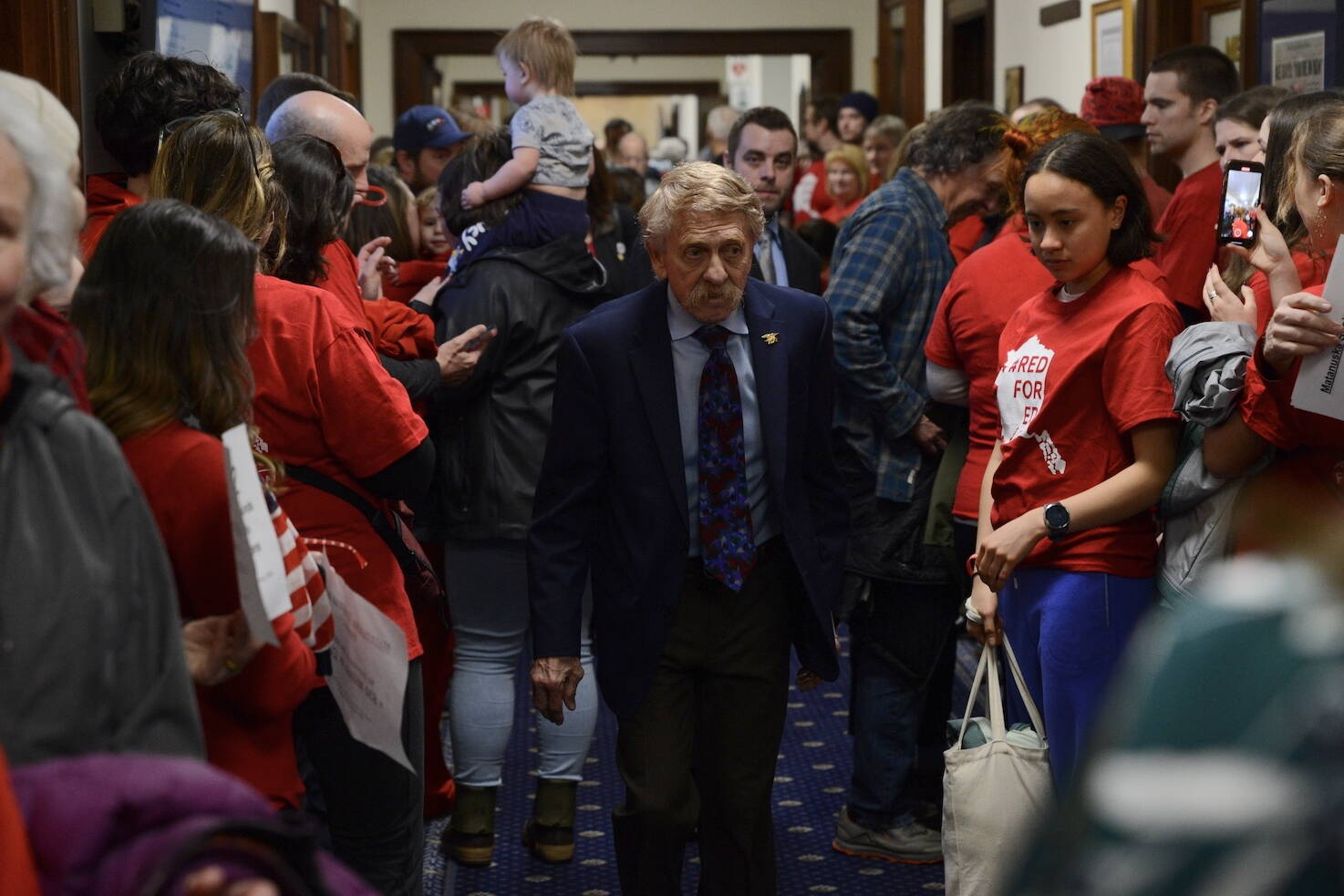
Alaska legislators have voted to ban large signs in the state Capitol, a move that followed large protests over Gov. Mike Dunleavy’s decision to veto a multipart education bill.
Under a new policy, visitors to the Capitol “are permitted to hand-carry a paper-based poster board or placard type sign up to 11×17 inches in the Capitol corridors and lobby.”
The policy prohibits signs on sticks and posts — all signs must be held by hand.
“A sign will be confiscated if it is used to disturb, or used in a manner that will imminently disturb, the Alaska State Legislature, one of its houses, a committee, a member, or a public employee in the performance of their duties,” the new policy states.
The new sign rules were approved Sept. 26 in a 9-0 vote of the Legislative Council, a joint House-Senate committee that makes decisions for the Legislature outside the normal session.
Large numbers of protesters crowded the Capitol in March, urging lawmakers to override the veto. That override failed by a single vote.
The nonpartisan Legislative Affairs Agency administers the state Capitol. Its director, Jessica Geary, told lawmakers that the policy came about because “during this past session, we had an incident with some protesters that carried signs into the Capitol and held them up and were somewhat disruptive during one of the committee hearings.”
By email, Geary said, “there was some concern during the BSA funding debate when protestors brought signs into the building and held them up, in some cases blocking the view down the hallway and of the security cameras, which was a concern to our security officers. Some of these protestors brought signs into a House Finance Committee meeting and held them up.”
Tom Klaameyer is president of the Alaska chapter of the National Education Association, a union that helped organize the protest.
“NEA-Alaska believes that the voices of Alaskans should be heard on matters of great importance, particularly when it comes to decisions that impact our students. However, we understand and take seriously the security concerns of those who have chosen to serve as elected officials,” he said by email. “Public education advocates have and will continue to use our collective voice to support an increase to the BSA and retirement security for public servants, so all children have high-quality educators in their schools.”
Speaking to the Legislative Council, Geary said the new policy came together after legislative staff contacted officials at other capitols and asked about their policies.
“The 11-by-17 sign was what was standardly used, I think, because it’s large enough to display the message, but not too big to be able to cause too much of an obstruction of the visual field,” Geary told lawmakers.
LAA attorney Emily Nauman said that in order to comply with the First Amendment, the policy has to be “content-neutral” — signs can’t be limited based on what they say.
An early draft of the sign rules included a ban on “vulgar language,” but that was removed because of First Amendment concerns.
Sen. Jesse Kiehl, D-Juneau, asked whether the restrictions extend to messages on T-shirts and buttons, and Sen. Click Bishop, R-Fairbanks, asked whether a message on “a Superman cape” would also run afoul of the new rule.
Nauman said that in a committee room, enforcement of the rule is up to the chair of the relevant committee.
“I think there’s — as we’re all aware through other discussions we’ve had here — there’s a balance of people being able to speak to their government in a way that’s meaningful to them and be heard, versus impeding work of the Legislature,” she said.
Rep. Dan Saddler, R-Eagle River, said he anticipates that there will be edge cases and enforcement questions in the future.
“The rules keep honest people honest, and dishonest people or bad actors will try to abuse the rules. So we’re probably likely to be back to resolve, to refine these in the future, but I do applaud the desire to maintain, through policy, some decorum for legislative business,” he said.
Voting in favor of the new policy were Sens. Elvi Gray-Jackson, D-Anchorage; Matt Claman, D-Anchorage; Kiehl, D-Juneau; Gary Stevens, R-Kodiak; Donny Olson, D-Golovin; and Reps. George Rauscher, R-Sutton; Dan Saddler, R-Eagle River; Cathy Tilton, R-Wasilla; and Kevin McCabe, R-Big Lake.
• James Brooks is a longtime Alaska reporter, having previously worked at the Anchorage Daily News, Juneau Empire, Kodiak Mirror and Fairbanks Daily News-Miner. This article originally appeared online at alaskabeacon.com. Alaska Beacon, an affiliate of States Newsroom, is an independent, nonpartisan news organization focused on connecting Alaskans to their state government.
