
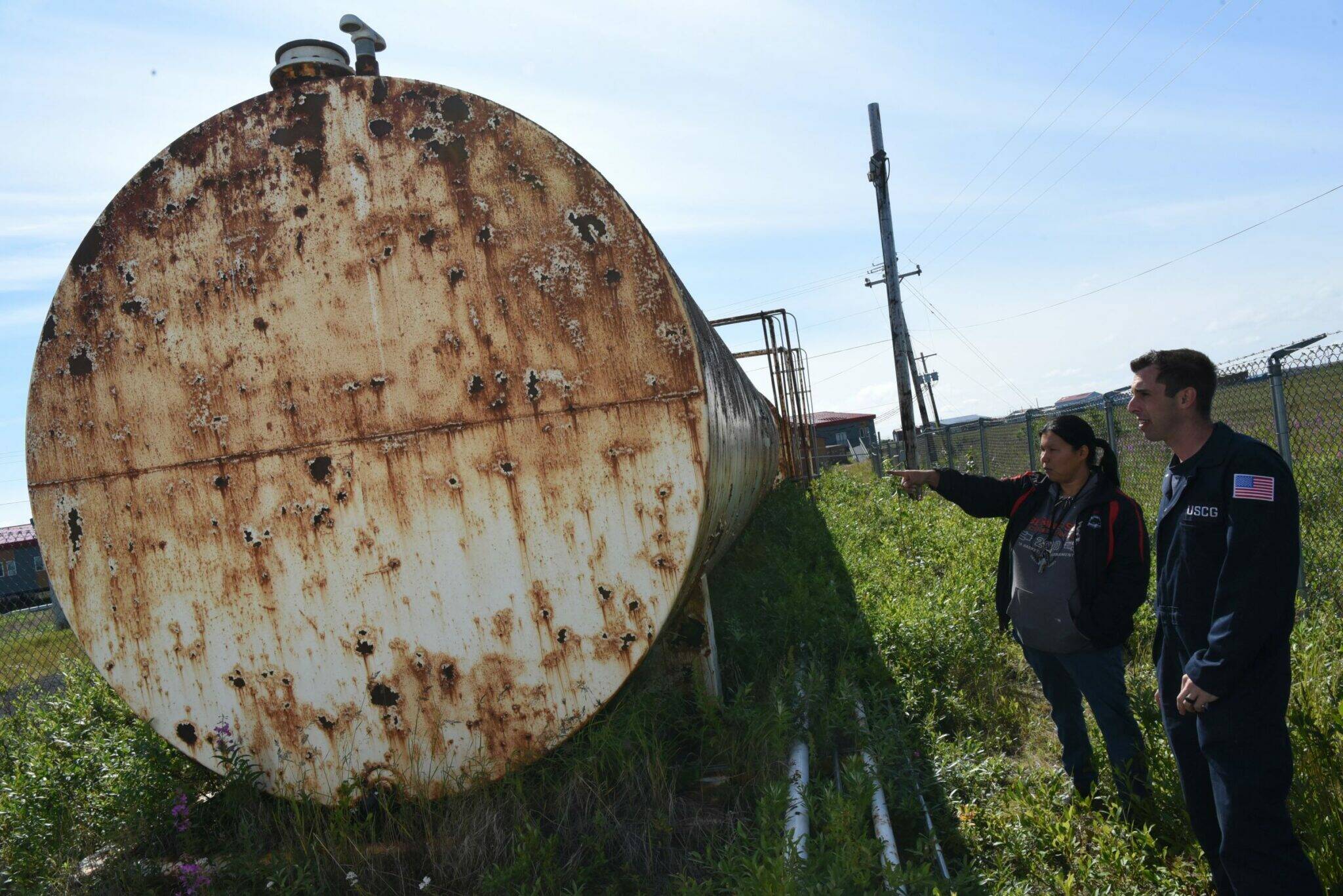
Thousands of aboveground tanks that store diesel fuel and other petroleum products would no longer be regulated by the state, under a proposal from the Alaska Department of Environmental Conservation.
The proposal is to repeal regulation of what are known as Class 2 facilities, which are scattered throughout the state and store between 1,000 and 420,000 gallons of non-crude oil products such as diesel, heating oil and gasoline.
If state regulation is repealed, those Class 2 facilities will no longer be required to register their storage tanks with the state and the department will no longer track them, the Department of Environmental Conservation’s notice said.
To the Environmental Protection Agency, the official end of that state activity would be an important loss.
“The state had been an important partner in helping regulate these types of facilities,” said Bill Dunbar with EPA’s Region 10 office.
The Department of Environmental Conservation said its regulation of those facilities – amounting to Inventorying and tracking – actually stopped in mid-2020 because of budget constraints.
The fiscal 2021 budget, which covered the 12 months starting July 1, 2020, eliminated the funding for the position held by an employee who collected the registration information, said Rebecca Spiegel, a department regulations supervisor.
Data collected by the department on these facilities was transferred in 2021 to the Department of Commerce, Community and Economic Development’s Division of Community and Regional Affairs, she said. The division maintains a database of bulk fuel facilities.
There were 967 Class 2 facilities registered with the Department of Environmental Conservation, Spiegel said. Among those facilities were 4,297 tank records, though it is not clear that all of those were active, she said.
State regulation of such storage facilities was short-lived, as Spiegel described it. The program started in 2017, and it is not required by any law, she said.
“There is no statutory mandate or requirement that these facilities be regulated in any way,” she said. “The department does want to remove regulations that are not currently being utilized or enforced and are not required by statute.”
State regulation of these aboveground tanks is also considered duplicative because federal agencies have authority over them, she said.
The EPA regulates those aboveground tanks with capacities over 1,320 gallons, she said, and the U.S. Coast Guard conducts regular inspections of them.
Dunbar, however, said the EPA considered state regulation of those tanks to be “critical” rather than redundant, saying it provided needed information to federal officials.
The Coast Guard’s inspections of the fuel sites are conducted as part of the summer Arctic operation. The Coast Guard Sector Anchorage Marine Safety Task Force has inspected hundreds of sites. However, it has not reached a large swath of Interior Alaska or the Southeast Alaska panhandle, according to the Division of Community and Regional Affairs’ database.
In the summer of 2021, the Coast Guard’s Marine Safety Task Force inspected 128 fuel sites in 95 communities. In the summer of 2022, it inspected a somewhat smaller number, about 55 sites in 15 communities in the Nome region and about 50 sites in 20 communities in the Bethel region.
Public comment on the state’s proposed regulation repeal is open through July 24. As of Tuesday afternoon, no comments had been submitted.
The Department of Environmental Conservation continues to regulate other types of oil- and fuel-storage facilities, including underground tanks.
• Yereth Rosen came to Alaska in 1987 to work for the Anchorage Times. She has reported for Reuters, for the Alaska Dispatch News, for Arctic Today and for other organizations. She covers environmental issues, energy, climate change, natural resources, economic and business news, health, science and Arctic concerns. This story originally appeared at alaskabeacon.com. Alaska Beacon, an affiliate of States Newsroom, is an independent, nonpartisan news organization focused on connecting Alaskans to their state government.
