
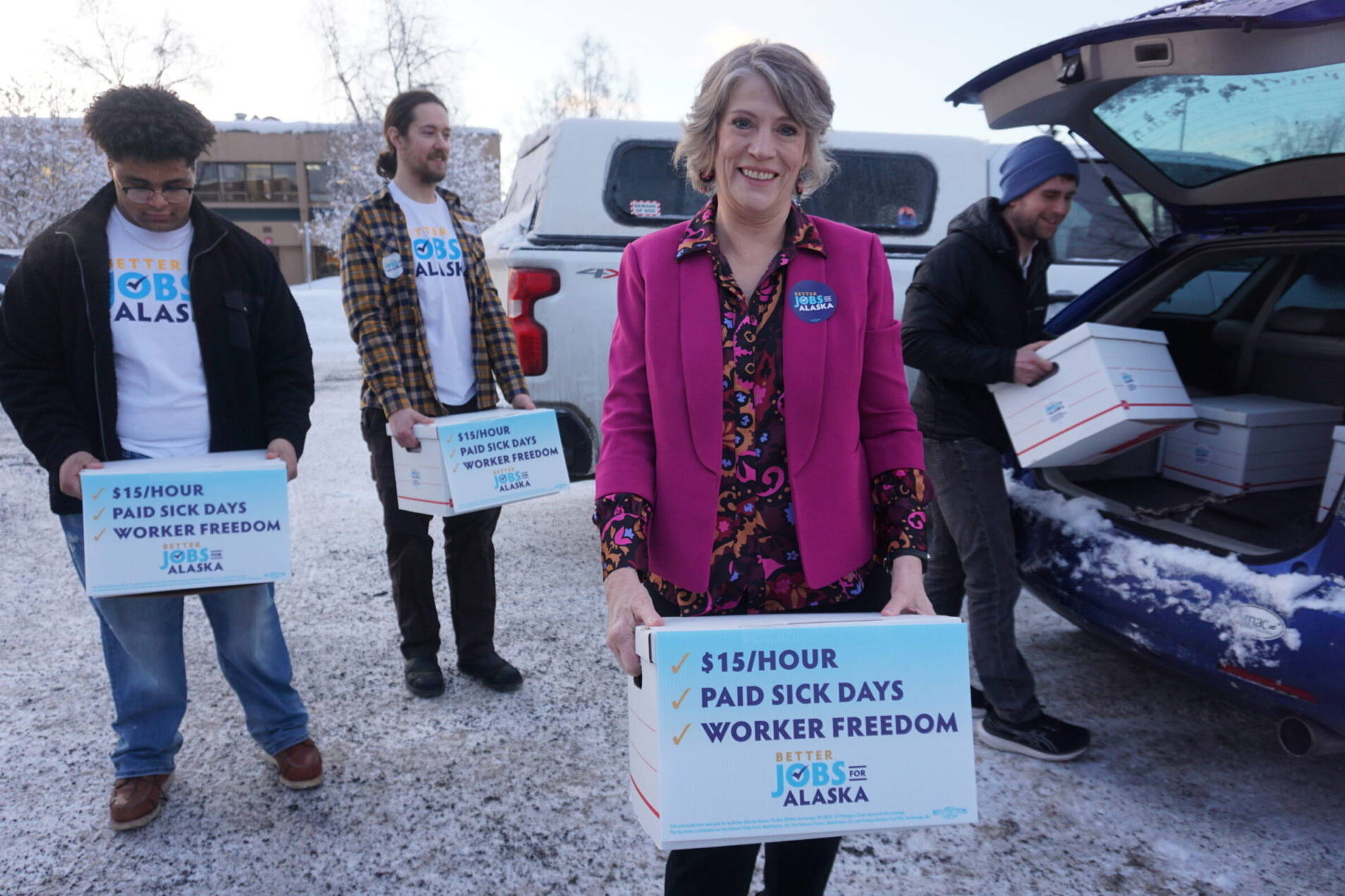
Supporters of a ballot initiative that would increase the minimum wage increase, mandate paid sick leave and provide other worker protections submitted more than 40,000 petition signatures to the Alaska Division of Elections on Tuesday, bringing their cause one step closer to a decision by voters.
The group, called Better Jobs for Alaska, brought boxes of signed petitions to a Division of Elections office in East Anchorage.
The initiative proposes to hike the state’s minimum wage, currently at $11.73 an hour, to $13 an hour next year, $14 an hour in 2026 and $15 an hour in 2027. Thereafter, the minimum wage would increase with inflation, according to the initiative.
“Over 32,000 Alaskan workers, in households with 22,000 children, will get a raise by 2027 when this goes to $15 an hour,” Ed Flanagan, a former state labor commissioner who is one of the primary sponsors of the initiative, said at a news conference held Tuesday at the Alaska AFL-CIO office in Anchorage.
To qualify for the November ballot, there must be at least 26,705 signatures of registered voters – equivalent to 10% of the total who voted in the last statewide general election – with signers meeting legal requirements for geographic diversity, according to the Division of Elections.
If the signatures are verified, this would be the third time in 22 years that a minimum wage increase will have qualified for the statewide ballot. Voters in 2014 approved a ballot initiative that established a stepped increase in the minimum wage to its current rate. A petition drive more than 10 years earlier resulted in enough signatures to get the measure on the ballot, but the Legislature in 2002 passed a similar bill, making the initiative moot.
“Hopefully, the third time’s the charm. Frankly we didn’t go high enough the last time,” Flanagan said at the news conference.
Joelle Hall, president of the Alaska AFL-CIO and another leader of the campaign, said the initiative campaign is a necessity for this issue.
“This is the only way the minimum wage gets raised in this state,” she said at the news conference.
An increase in the minimum wage would affect more than those at the lowest pay levels, Hall said.
She cited as an example the Teamster-represented school bus drivers who are entitled, by contract, to starting pay of twice the minimum wage. “This will help us attract and keep those bus drivers,” she said. “There’s lots of ways this reaches a lot of the people maybe who aren’t necessarily making $14 an hour right now. It has a big ripple effect.”
Salaried employees who do not get overtime pay, such as managers at fast-food restaurants, will also benefit because they are entitled to pay that is equivalent to at least twice the minimum wage, Flanagan added.
The initiative has other worker-friendly elements aside from the pay increase. It would mandate paid sick leave and would prevent workers from being compelled to attend or listen to employer meetings or messages about politics or religion.
The importance of paid sick leave was highlighted during the COVID-19 pandemic, initiative supporters said. Without it, sick employees may be exposing coworkers or, especially in the food industry, customers, they said.
Rebecca Reiss, a caregiver for elderly and disabled people, said the lack of paid sick leave presents “an impossible set of choices” for workers like her.
“Do I stay at home with a sick kid, knowing my client goes all day without care? Even if I do stay home, can someone cover my work? How will I pay the bills without any benefits? These are things we need to fix,” Reiss, who lives in Wasilla, said at the news conference. She had her own health crisis that caused so much economic hardship last year that she and her daughter lost their apartment, she said.
The employer-messaging provision addresses what has become an increasingly important subject nationally, said Patrick FitzGerald of the Alaska Teamsters Local 959.
“A lot of people are unfamiliar with the practice of captive audiences. That is essentially when an employer is able to share their influence with their employees, and there is nothing their employees can do about it, whether it is religious connotation, political or anti-union discussions,” FitzGerald said at the news conference.
The Alaska ballot initiative became the first in the nation to address the issue, he said.
For initiative sponsors, one task in coming months will be preventing what they characterized as legislative interference.
In 2003, the year after lawmakers passed a nearly identical bill, causing the minimum wage initiative to be dropped from the ballot, the Legislature repealed important provisions: an inflation adjuster that would have increased pay over the years and a requirement that Alaska’s minimum wage be at least $1 above the federal minimum.
“This was an act of cynicism breathtaking even for the Legislature” Flanagan said.
In 2014, “the House majority tried to do the same damn thing. They must have thought we were stupid or asleep,” Flanagan said. While the House passed a substantially similar bill that would have removed the minimum-wage initiative from the ballot, “fortunately, the Senate majority said no,” he said.
The 2014 initiative passed with nearly 70% of the vote, and Flanagan said he believes support for the current initiative remains similarly high.
Some business groups opposed previous efforts, and that opposition may resurface this year.
The Alaska Chamber has not yet taken a position on the ballot initiative, said Kati Capozzi, the organization’s president.
The issue is to be discussed at an upcoming board meeting, Capozzi said. The chamber is still evaluating the initiative and trying to sort out “unintended consequences and potential pitfalls,” especially for small businesses and certain sectors like the seafood and tourism industries, she said.
• Yereth Rosen came to Alaska in 1987 to work for the Anchorage Times. She has reported for Reuters, for the Alaska Dispatch News, for Arctic Today and for other organizations. She covers environmental issues, energy, climate change, natural resources, economic and business news, health, science and Arctic concerns. This story originally appeared at alaskabeacon.com. Alaska Beacon, an affiliate of States Newsroom, is an independent, nonpartisan news organization focused on connecting Alaskans to their state government.
