
At the initial publication of this article the Empire had not received a response from the Department of Commerce, Community and Economic Development. The department has since contacted the Empire and this article has been updated to reflect that change.
Senators voted to authorize Gov. Mike Dunleavy’s plan for distributing federal relief money Wednesday, for now bringing an end to a legal battle which has prevented the funds’ dispersal for almost a month.
After a brief floor session Wednesday morning and without much fanfare, the 31st Alaska Legislature adjourned “sine die” for the last time, marking the end this year’s regular session. Senators had remained in Juneau to vote on HB 313, a bill passed Tuesday by the House. Constitutional rules said the two bodies couldn’t vote on the same day, and since they finished their work first, several House members were on a plane out of town Tuesday evening.
Senators voted 19-1 to ratify revised program legislative requests, or RPLs, the legal mechanism chosen by Gov. Mike Dunleavy to distribute over $1 billion in federal relief money.
“Today we’ve got a ratification bill dealing with over $1 billion coming to us from the federal government,” said Sen. Bert Stedman, R-Sitka. “It has 137 RPLs involved in this; $568 million to 123 communities across the state; further funding for schools airports, fisheries, public safety.”
Lawmakers were called back to Juneau by a lawsuit that alleged allocating federal money to certain programs using RPLs would violate the state constitution. Legislative lawyers had warned lawmakers that while the RPL process was appropriate for some of the programs the governor had proposed, RPLs couldn’t be used for certain things like community aid and small business loans. Despite the warnings, lawmakers approved the RPLs in the joint Legislative Budget and Audit Committee.
The following day Eric Forrer and attorney Joe Geldhof, both of Juneau, filed a lawsuit against Department of Revenue Commissioner Lucinda Mahoney. Not long after the lawsuit was filed, lawmakers were told by caucus leadership to return to the Capitol.
[Lawsuit brings lawmakers back to Juneau ]
By reconvening to approve the governor’s distributions, legislators hope to satisfy the issues raised by Forrer’s lawsuit.
According to his attorney, Forrer doesn’t believe the Legislature’s actions this week do satisfy the state constitution but he does not plan to take action that might hold up the funds. The bill passed Wednesday was not an appropriation bill but a ratification, with the latter being merely an approval of an action already taken.
An appropriations bill would have to be built by lawmakers from the bottom up, and would be open to amendments once it reached the floor. Given the circumstances created by the COVID-19 pandemic that’s a process that could take up to 30 days Senate President Cathy Giessel previously told the Empire.
Before voting on the bill, several senators said they too felt an appropriations bill would be more appropriate, but only Lora Reinbold, R-Eagle River, actually voted against the bill.
“This is setting a bad precedent for the future, that federal funds coming in are not an appropriation, this doesn’t even pass the sniff test,” Reinbold said. “I would like to know who made the decision that it was not an appropriation bill.”
Furthermore, Reinbold warned the bill didn’t actually fix issues raised by the lawsuit and would likely be challenged in the future.
Reinbold also attempted to add four amendments onto the bill, but was ruled out-of-order by Giessel. Two of Renibold’s amendments called for $1,000 stimulus payments to Alaskans, another a full Permanent Fund Dividend and another would have lifted the governor’s emergency declaration which she called “unconstitutional.”
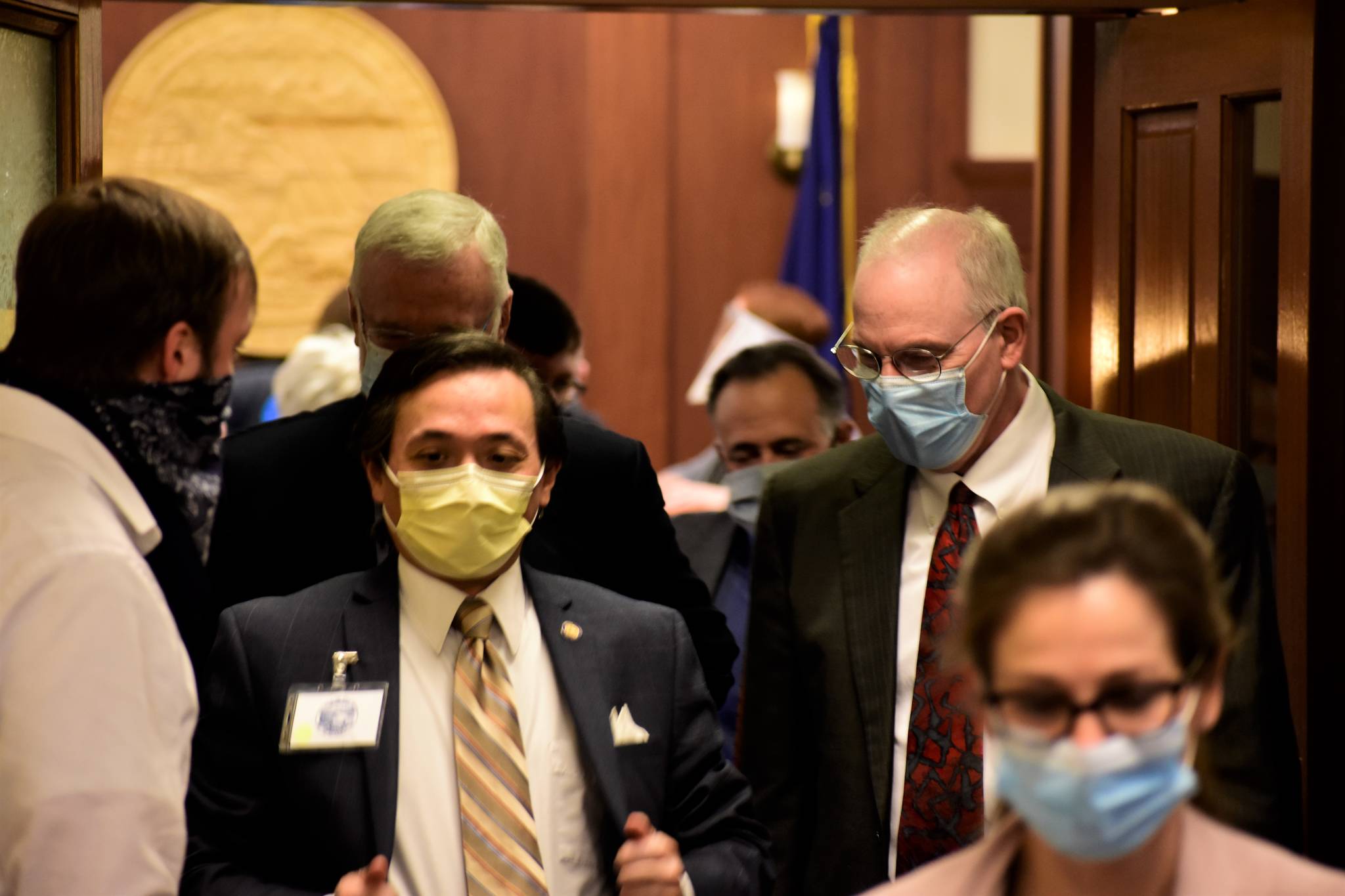
Sens. Scott Kawasaki, D-Fairbanks, and Bert Stedman, R-Sitka, leave the floor of the Alaska State Senate after voting to approve Gov. Mike Dunleavy’s distributions of over $1 billion in federal relief money. The senate adjourned “sine die”, meaning indefinitely, closing out the 31st Legislature. Wednesday, May 20, 2020. (Peter Segall | Juneau Empire)
Hoping for guidelines
Before voting, Stedman said he hoped checks would be sent out by the close of business Friday. In an email, Dunleavy spokesperson Jeff Turner said the governor intended to sign the bill as quickly as possible once it was returned to his office.
“The distribution process will begin Friday, May 22,” Turner said.
The governor’s RPLs include over $500 million in direct payments for local municipalities to be used to help local governments combat the pandemic. But while the funds have been given a lot of latitude for use, exactly how they can be used isn’t entirely clear yet.
“Across the board, there’s more uncertainty than we’d like,” said Nils Andreassen, executive director of the Alaska Municipal League. “From the (U.S. Treasury Department) guidance there is a lot to work with to determine what are allowable expenditures.”
Before receiving money, cities will have to sign grant agreements with the Department of Commerce, Community, and Economic Development. Grant agreements will outline the terms of receiving funds, Andreassen said, but do not provide much guidance for use except to follow federal guidelines.
[Cities can’t make it on current revenues]
City officials have said there is a need for money to replace lost revenue, which currently can’t be done with CARES Act money. But federal lawmakers have heard cities’ complaints and have responded with legislation to retroactively expand the use of funds to do just that.
Sen. Dan Sullivan, R-Alaska, introduced a bill to expand the use of CARES Act money earlier this month. On May 13, Sullivan said in a video statement he had a productive conversation with President Trump about the matter. Sullivan’s bill has bipartisan support, including Sen. Lisa Murkowski, R-Alaska.
Andreassen said he was hoping to see that legislation passed.
“It was encouraging to see (Treasury) Secretary Mnuchin say the white house was open to changing the guidelines to be open for lost revenue,” Andreassen said. “It would further the latitude governments had.”
In the meantime, Andreassen said his organization, which helps to coordinate information for local governments in the state, would be updating its website with an FAQ section and additional information on acceptable use of funds.
The governor’s proposal issues money to cities and boroughs in three tranches over several months. Previous versions of the governor’s plan had listed April and May first, and Oct 1 as the final distribution date. In an email, DCCED spokesperson Glenn Hoskinson said it was still the intent of the department to send the next payments out on July and Oct. 1, as stated in the governor’s original plan.
• Contact reporter Peter Segall at psegall@juneauempire.com. Follow him on Twitter at @SegallJnoEmpire.
