
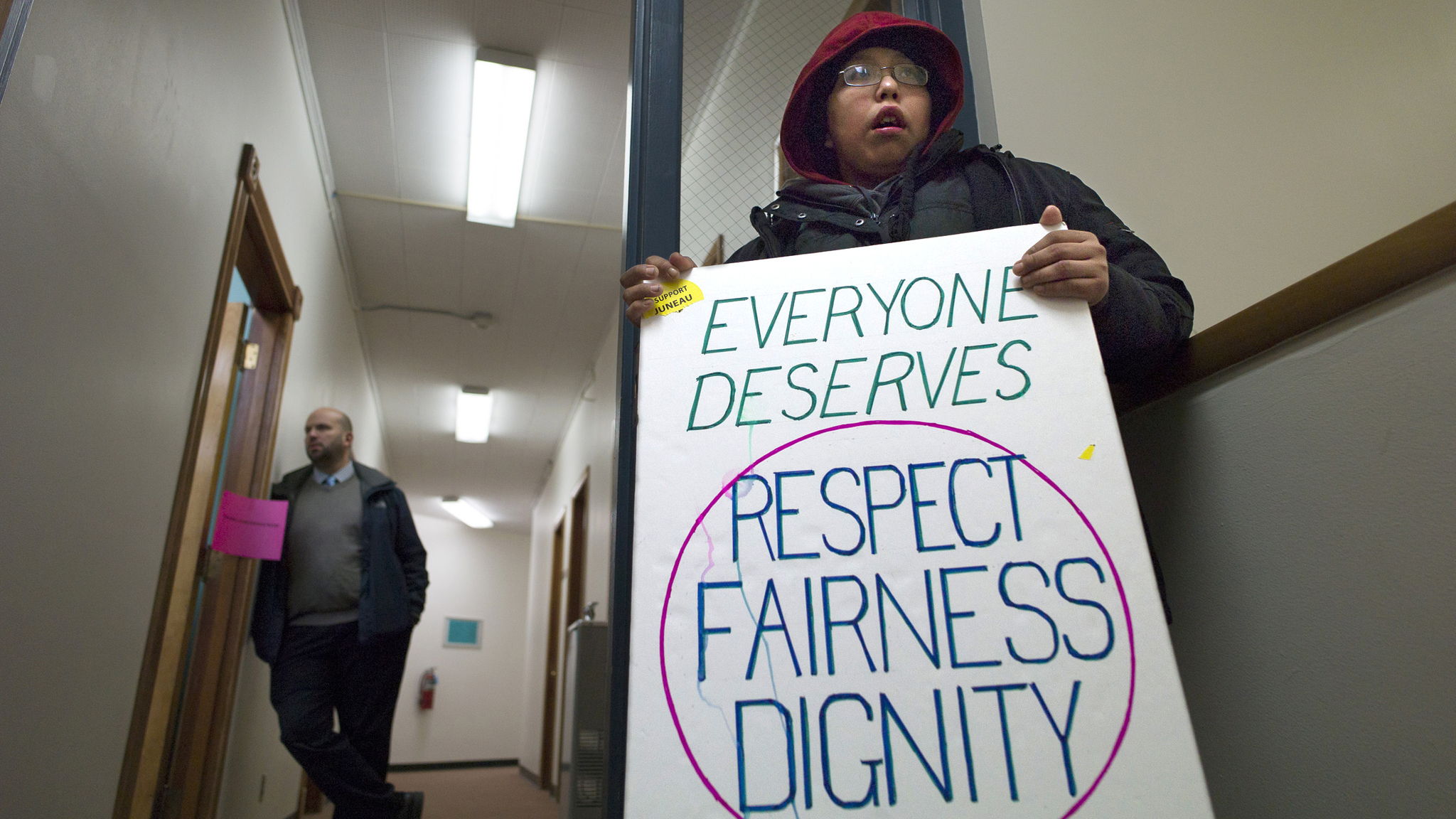
A lack of consensus was the only commonality after more than two hours of sometimes-emotional testimony from nearly 50 Juneau residents regarding a proposed ordinance that would ban homeless people from sleeping in entryways downtown.
Ordinance 2016-44 was set for public hearing Monday night in an Assembly Chamber so crowded that the overflow was sent to two separate rooms upstairs, to listen in and be summoned down if they had signed up to speak. More than 150 people attended the meeting in all for two controversial topics: a ban on camping downtown and a resolution in support of the Juneau Access Project.
And speak they did, with most who chose to make a public comment opposing the camping ordinance and most downtown business owners supporting it. The speakers did agree on one thing: There is a problem of aggressive behavior that has been escalating since last summer in the downtown core and it is affecting businesses there.
But what, if anything, the City and Borough of Juneau should do about it was passionately debated. City Manager Rorie Watt said the ordinance, which would prohibit camping on private property in a narrowly defined geographic area in downtown Juneau, is not an outright ban as it allows property owners to give permission for homeless people to sleep in the doorways of their businesses.
Watt said the ordinance is intended to be a “small piece of a larger puzzle” to include other measures to combat homelessness. The city is also exploring a year-round campground and warming stations, but none of those steps will be in place this winter. The ordinance would not take effect until April 15, when the Thane Campground opens for the summer, Watt said.
As the clock ticked toward midnight, the Assembly members postponed any deliberation until Feb. 13. At that meeting, they stressed, they will not take any more public comment but will come prepared with questions for the Juneau Police Department and other stakeholders.
The ordinance was proposed by downtown business owners including Phil Wheeler, owner of the Alaskan Fudge Company, and Tanja Cadigan of Caribou Crossing, who took the issue to Mayor Ken Koelsch in early December. Koelsch established an “ad hoc committee on homelessness” comprised of city officials, a downtown police officer and a handful of downtown business owners and then brought a draft ordinance to the Assembly.
Nearly 90 people signed up to testify at the public hearing Monday. It was difficult to determine the precise levels of support or opposition for the ordinance, since a number of those who signed up did not register their reasons for testifying. Gauging by the sign-up sheet, supporters of the ordinance prevailed by a 3 to 2 margin; conversely, speakers opposed the measure by a 2 to 1 margin.
Many business owners who spoke expressed frustration at a worsening situation downtown that has eroded their compassion and affected their economic survival.
Perhaps the most blunt was Jaimie Rountree, who said the general public is unaware of how “nasty” the situation has gotten — a situation she said includes campers urinating and defecating, shooting up drugs, having sex in public and “vomiting” in doorways.
“It’s hard to be empathetic when you’re cleaning up after people who choose to do horrible, disgusting things,” she said.
Cadigan told the Assembly she wants to be able to operate her business comfortably and safely, and described a recent situation where her young female employee was confronted by five men yelling profanities.
“I find myself in a really difficult position,” said another business owner Tracy LaBarge, who said she hears negative comments “constantly.” “We’ve got to clean up downtown,” she said.
Pat Race, of downtown’s Alaska Robotics, opposed the ordinance, which he said has divided the community unnecessarily. Race, like others in attendance, said the city has other ordinances in place that it doesn’t enforce effectively, and asked the city to look for more long-term solutions first.
“It’s on us (business owners),” Race said. “We have turned a blind eye to the problem for so long.”
Many of those who spoke against the ordinance argued that it will, in effect, criminalize homelessness; violating the ordinance is an infraction that will result in escalating fines and then court appearances.
“This is not a camping ban, this is a survival ban,” said Kara Nelson, who described meeting a man on her way into the meeting who had been severely beaten while out on the streets.
Many opponents argued for compassion.
“We cannot close our eyes and ears … to the cries for help,” said Sandra DeLong. “These are people. They deserve respect, they deserve compassion, they deserve help, not vindictiveness.”
Others told Assembly members that the ordinance was simply misguided, including Heidi Brocious, an associate professor in social work at the University of Alaska Fairbanks, who brought a packet of research to hand out “because that is how I roll.”
”Everything I see shows me this isn’t going to work,” Brocious said, citing research on citations that show they are not effective deterrents.
Local homeless shelter and soup kitchen The Glory Hole has taken an official position opposing the ordinance, although one board member spoke in support Monday. Shelter director Mariya Lovishchuk asked the Assembly to postpone its decision until there are workable plans for alternatives such as a year-round campground.
She argued more ordinances aren’t necessary, since the current trespassing ordinance could be easily enforced with a $2 sign on business doors.
Lovischuk and others cautioned the Assembly that the camping ordinance would be viewed as a “regressive” law by the U.S. Department of Housing and Urban Development and would put funding applications in severe jeopardy.
Everett Johnson, who is homeless, challenged the Assembly members to spend three nights on the streets, saying “You think you’re scared? I’m more afraid of all of you.”
Johnson said his wife died in his arms under a downtown bridge, and shared his experiences of constantly being told to move along.
“You all have a warm bed,” he said. “Not me. Not me. I brought my bed with me. My sleeping bag, that’s all I have. That’s all I have.”
Correction: An earlier version of this article erroneously stated The Glory Hole had taken no official position on the camping ordinance. The board of directors did vote to oppose the ordinance. The article has been updated to reflect the change.
• Reporter Liz Kellar can be reached at 523-2246 or at liz.kellar@juneauempire.com.
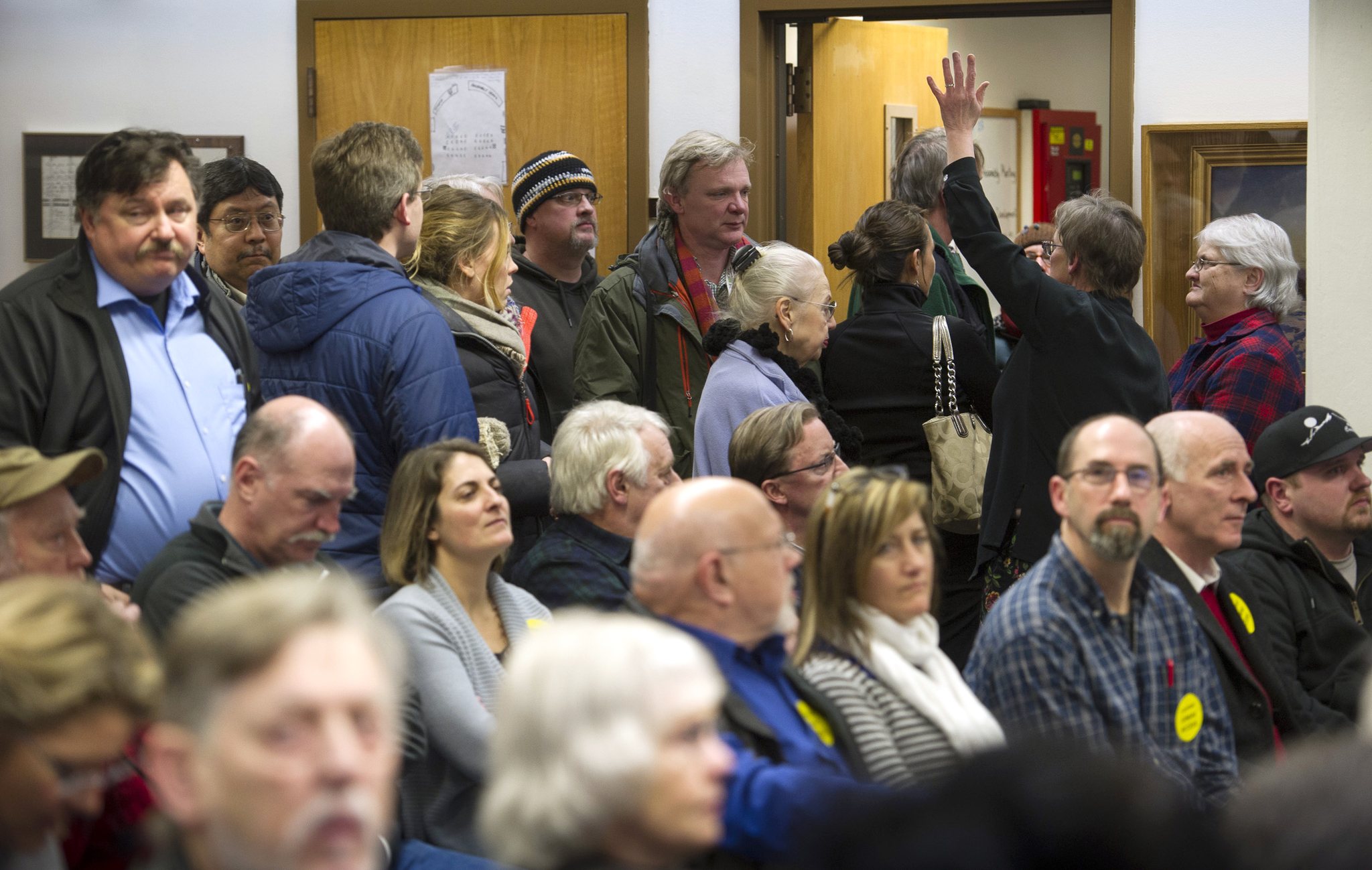
Deputy City Manager Mila Cosgrove, hand up, escorts an overflow of residents to the Mayor’s Conference Room to listen to Juneau Assembly members take up the Juneau Access Road resolution and an homeless camping ordinance during their meeting on Monday, Jan. 23, 2017. (Michael Penn | Juneau Empire)

Deputy City Manager Mila Cosgrove, left, City Manager Rorie Watt and Municipal Attorney Amy Mead listen as Juneau Assembly members take up the Juneau Access Road resolution and an homeless camping ordinance during their meeting on Monday, Jan. 23, 2017. (Michael Penn | Juneau Empire)
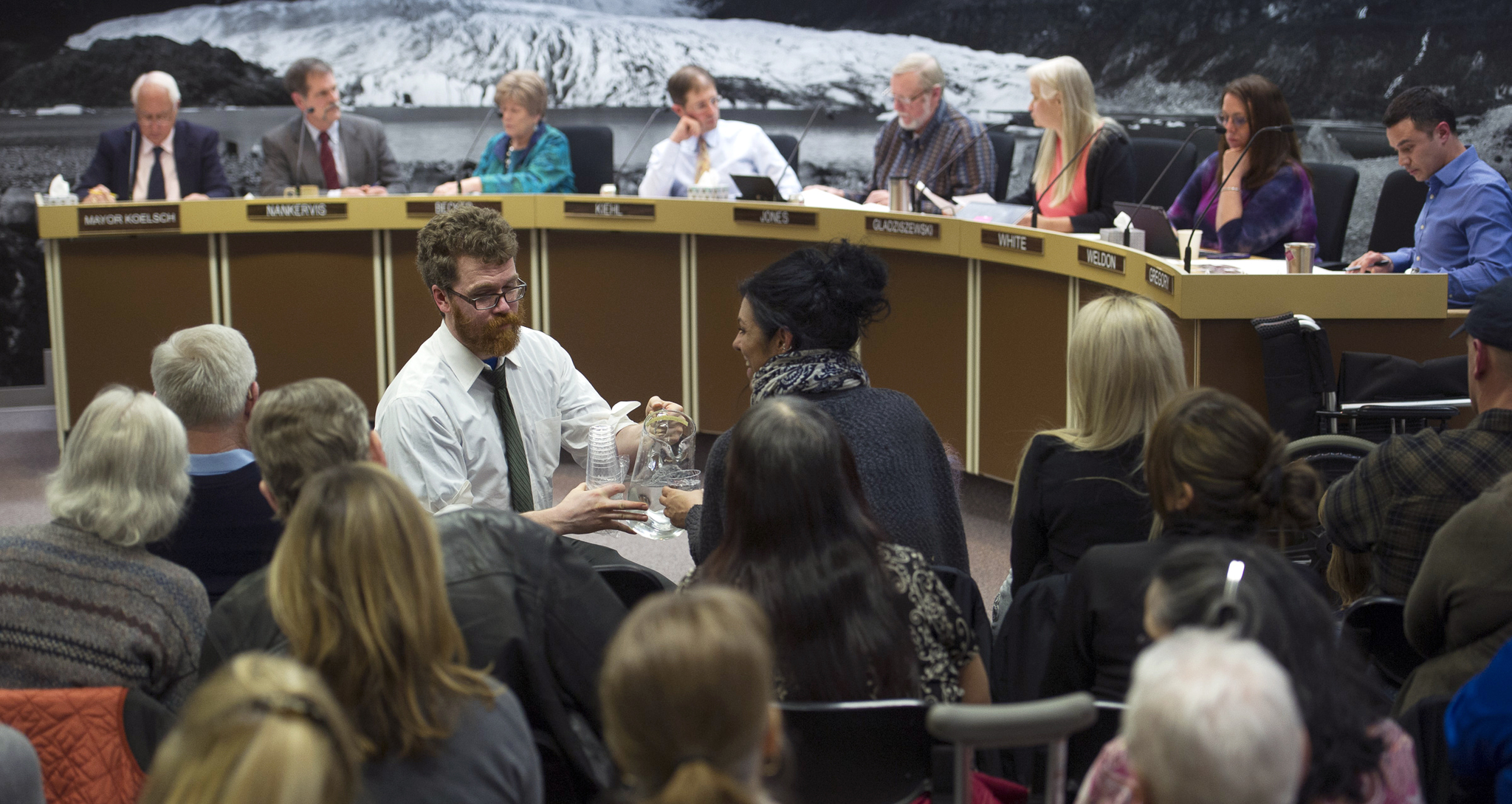
Rep. Justin Parish serves water as Juneau Assembly members take up the Juneau Access Road resolution and an homeless camping ordinance during their meeting on Monday, Jan. 23, 2017. (Michael Penn | Juneau Empire)
