
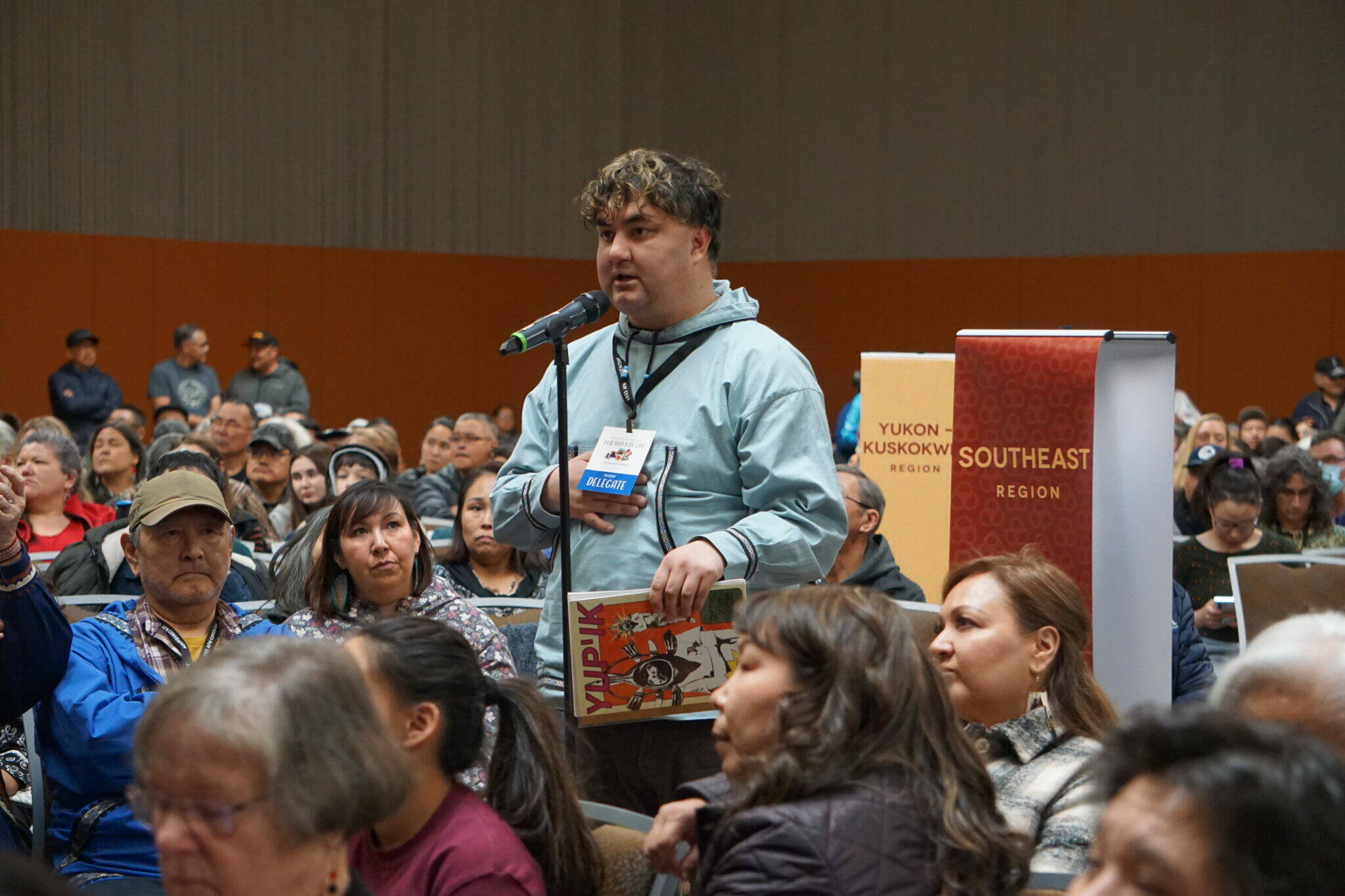
Members of this year’s Alaska Federation of Natives conference in Anchorage voted Saturday to ask Congress and the federal government to protect and increase subsistence hunting and fishing rights for rural Alaska Natives.
The request puts the state’s largest Alaska Native organization at odds with the state government, whose constitution forbids laws that give rural residents a greater subsistence right than urban residents and likely forbids giving Natives a preference over non-Natives.
AFN has already sided with the federal government in a subsistence-fishing lawsuit against the state of Alaska, and Saturday’s resolution suggests the disagreement may grow into hunting and trapping and outlast the court case.
Conference attendees approved 28 of the 29 resolutions on the agenda, including one calling for the preservation of Alaska’s new ranked choice voting system. Opponents of the system were active outside the convention, gathering signatures for a proposed ballot measure that seeks its reversal.
Another resolution, supported by the Alaska chapter of the American Civil Liberties Union, advocates an independent federal investigation into Alaska Native deaths within Alaska state prisons and jails.
Alaska Natives make up 22% of the state’s population but more than 41% of Alaska’s prison population. Last year, 18 people died in state prisons and jails; half of those were Alaska Native.
The lone resolution to not pass a final vote was one asking the Environmental Protection Agency to not grant further extensions of water treatment waivers for urban municipalities. That proposal was withdrawn to a committee for further work.
Past AFN conventions have seen delegates divided by resolutions. Since 2019, three regional Alaska Native corporations and two large tribal groups have quit AFN.
Last year, extensive debates over salmon shortages put some Native groups at odds.
This year’s resolution debates were much more sedate and finished an hour ahead of the schedule set on the official agenda.
Subsistence issues — those covering the traditional harvest of fish and game for personal, noncommercial use — garnered the most attention during the three-day convention.
Before Saturday’s votes, delegates spent hours on Friday afternoon discussing the need to preserve traditional subsistence fishing amid a drastic decline in salmon returns to mainland Alaska rivers.
Under the 1980 Alaska National Interest Lands Conservation Act, the federal government guarantees subsistence preferences for rural Alaskans, but not Alaska Natives specifically. AFN delegates contend that Alaska Natives should be granted special permission, something the state rejects.
“A Native-only preference is a non-starter for the state and questionable under both the state and federal constitutions,” said Patty Sullivan, communications director for the Alaska Department of Law.
The state and federal government are also currently fighting in court over who should have management authority over fisheries in rivers that flow within federal parks and preserves.
As part of its defense, the state has argued that a federal judge should reexamine a series of cases known collectively as Katie John, after an Ahtna elder who waged a lengthy legal battle.
The Katie John decisions underpin current subsistence management, and AFN has joined the federal government in arguing that they should continue to stand.
For its part, the state says that it is being forced into revisiting Katie John because of federal actions, not because it wants to overturn precedent.
The ongoing disputes remain unresolved in federal district court in Anchorage. If the judge rules in favor of the federal government and AFN, current precedent will remain.
That isn’t good enough, some Alaska Natives said at the convention, which is why they’re pushing for congressional action that would grant more rights for rural Alaska Natives.
• James Brooks is a longtime Alaska reporter, having previously worked at the Anchorage Daily News, Juneau Empire, Kodiak Mirror and Fairbanks Daily News-Miner. This article originally appeared online at alaskabeacon.com. Alaska Beacon, an affiliate of States Newsroom, is an independent, nonpartisan news organization focused on connecting Alaskans to their state government.
