
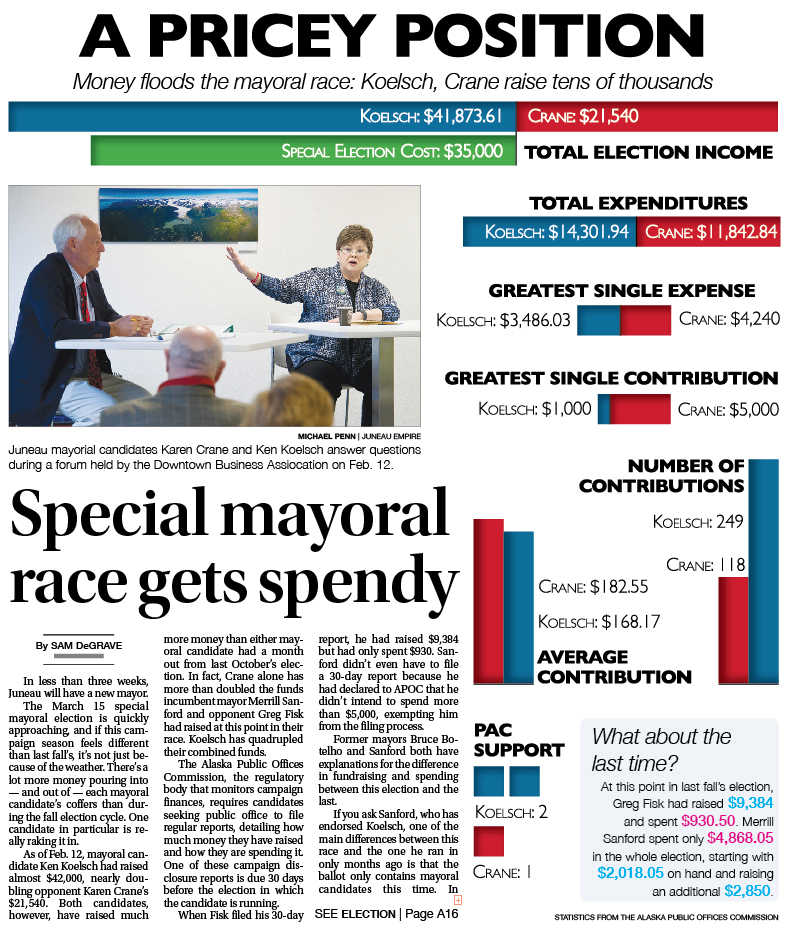
In less than three weeks, Juneau will have a new mayor.
The March 15 special mayoral election is quickly approaching, and if this campaign season feels different than last fall’s, it’s not just because of the weather. There’s a lot more money pouring into — and out of — each mayoral candidate’s coffers than during the fall election cycle. One candidate in particular is really raking it in.
As of Feb. 12, mayoral candidate Ken Koelsch had raised almost $42,000, nearly doubling opponent Karen Crane’s $21,540. Both candidates, however, have raised much more money than either mayoral candidate had a month out from last October’s election. In fact, Crane alone has more than doubled the funds incumbent mayor Merrill Sanford and opponent Greg Fisk had raised at this point in their race. Koelsch has quadrupled their combined funds.
The Alaska Public Offices Commission, the regulatory body that monitors campaign finances, requires candidates seeking public office to file regular reports, detailing how much money they have raised and how they are spending it. One of these campaign disclosure reports is due 30 days before the election in which the candidate is running.
When Fisk filed his 30-day report, he had raised $9,384 but had only spent $930. Sanford didn’t even have to file a 30-day report because he had declared to APOC that he didn’t intend to spend more than $5,000, exempting him from the filing process.
Former mayors Bruce Botelho and Sanford both have explanations for the difference in fundraising and spending between this election and the last.
If you ask Sanford, who has endorsed Koelsch, one of the main differences between this race and the one he ran in only months ago is that the ballot only contains mayoral candidates this time. In addition to the mayoral seat, there were two Assembly seats and two Juneau Board of Education seats up for grabs during the last general election. Eleven candidates were running for the various seats, and Sanford said that helped to limit the amount of money any one candidate could raise.
“The pot of money going into the candidates is the same as before; it’s just going to two people instead of six or seven or eight,” Sanford told the Empire on Friday in a phone interview.
Four-term mayor Botelho, a Crane supporter, offered a slightly different take on Crane and Koelsch’s phenomenal fundraising.
“This is a highly contested race where there are clear philosophical differences on the future of the Assembly, so it’s not surprising this is generating a lot of interest and a lot of campaign contributions,” he said by phone Friday. He also noted that the “condensed” nature of the special election likely has candidates ahead of where they might be at the 30-day point during a regular election cycle.
Though Koelsch has raised almost double what Crane has, he has not outspent her by the same margin. In his 30-day report, Koelsch declared that he had spent about $14,000. Crane, on the other hand, had spent close to $12,000. This is important because Botelho said that candidates typically begin pulling out all the stops as the election draws nearer. This week, he estimates, residents will begin to hear more radio spots and see more ads in the newspaper.
As the number of days until the election dwindles, though, the election can become a war of attrition in which the candidate with the most money wins the most exposure.
“I think what you find generally is that the candidate who spends the most is the one who gets elected,” Botelho said.
Though she is trailing slightly in spending and significantly in fundraising, Crane said that her campaign has all the money it needs to be competitive, and it is on track to hit its fundraising goal, which she wouldn’t disclose. Crane said she doesn’t want to make a big deal about money though because “it’s not the issue on this campaign.”
“I think the winner is going to be whoever gets the most voters out,” she said. “There is some money tied to that, but it’s not everything.”
According to Botelho, most mayoral candidates typically spend about $25,000 to $30,000 on their elections. Crane is quickly closing in on those numbers. Koelsch has already surpassed them by a wide margin, which he said is “humbling.”
“People clearly appreciate the point of view,” he said in a Thursday phone interview. The way he sees it, the amount of money he has raised shows how many people disagreed with the Assembly’s decision to hold a special election, a venture that will cost the city about $35,000.
“You might look at it in that the money that I’ve raised was freely given,” he said. “The money for the special election was taken from every taxpayer in town. There’s a huge difference there.”
Though the $35,000 special election does come out of the city’s budget and ultimately out of taxpayers’ pockets, there is a silver lining to this special election: economic stimulation. Between the cost of the special election — more than half of which will pay election workers’ wages — and the money being spent by the Crane and Koelsch campaigns, this election will have a “positive” economic impact on the city, according to Brian Holst, director of the Juneau Economic Development Council.
“I think you could safely say, ‘yes, it’s a positive impact,’ but I think you’d be going out on a limb to say that it’s a significant impact,” Holst said Friday. “You certainly could make the case that it’s a $100,000 boost to the economy.”
And one Juneau resident in particular has felt the benefit of the special election. Daryl Miller, the owner of Commercial Signs and Printing, has had a busier couple of weeks than he anticipated when he printed the last election sign for the fall elections. His company prints many of the campaign signs each election. In fact, Crane and Koelsch have already spent a combined $6,341.27 at Miller’s printing shop.
Miller said that he sees the special election as a “double-edged sword.” As a taxpayer and Juneau citizen, he is a little concerned whether it will impact the city’s fiscal standing as it heads into uncertain economic times. But “from the business side, it’s been great,” he said.
• Contact Sam DeGrave at 523-2279 or at sam.degrave@juneauempire.com.
