
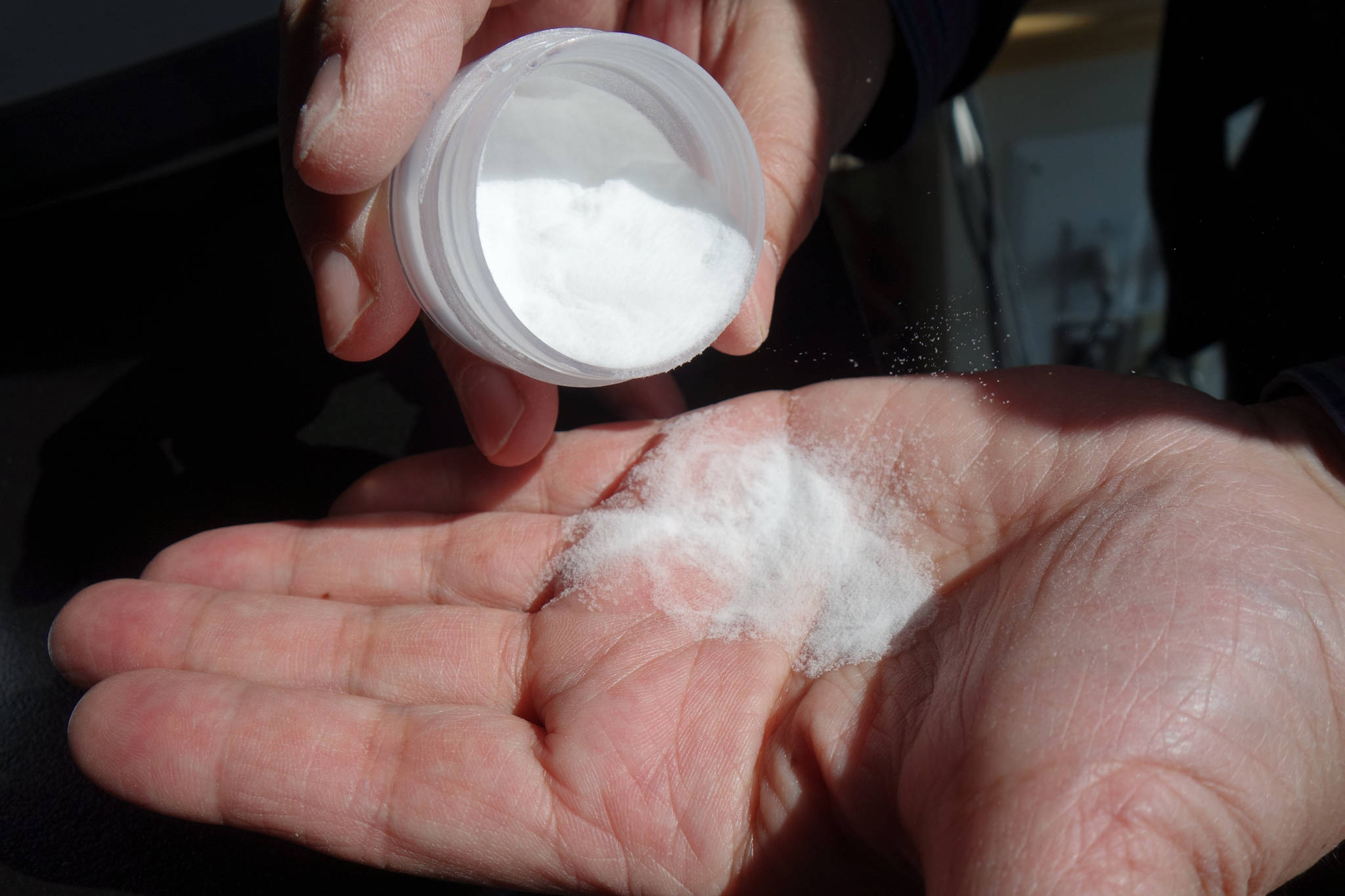
A team of researchers has a plan to slow the melting of northern sea ice using a sand-like substance.
Leslie Field is an inventor trained in chemical and electrical engineering who lectures at Stanford University in California. She and her team-member Alex Sholtz of the non-profit group Ice911 recently presented at the University of Alaska Fairbanks in front of a dozen scientists who work on northern sea ice.
Field and Sholtz shared their idea of spreading hollow glass beads over ice that floats on the northern ocean. After field testing the material on the surface of frozen lakes, they saw it increases sea ice’s reflectivity and can slow its melting. That, in turn, could help slow the Earth’s warming.
Northern sea ice has been on the wane since satellites have allowed us to observe it in the late 1970s. Though relatively few people have seen the ice floating on the northern oceans, scientists have many times pointed out sea ice’s function as the refrigerator of the world. The blue-white mass the size of a continent grows in thickness and extent during the polar winter and shrinks in spring and summer. Sea ice reflects sunlight and prevents the dark ocean from absorbing heat.
The Ice911 team is hoping to slow the summer loss of sea ice, and perhaps restore it over time, by making it melt less with the application of their reflective dust.
The powder is mainly silica in the form of hollow glass spheres, each smaller than a period. It’s available commercially in large amounts, and Sholtz showed results of tests of quail and small fish eating it with no apparent problems.
As one possible deployment method, the researchers envision blowing the white sand from a device mounted on the backs of large ships to coat newer sheets of sea ice, in order to make them brighter. They figure a thin layer can increase the reflectivity of ice by 50 percent.
Field targeted northern sea ice after watching Al Gore’s “An Inconvenient Truth” in 2006. She figured an engineering solution might be the way to go in restoring sea ice to what it once was.
“Ninety-five percent of the Earth’s heat shield is gone,” Field said, citing a NOAA Arctic Report Card number of the decline of thicker, multi-year sea ice since 1985. “No natural process is going to bring that back.
“By slowing ice melt in strategic areas, we can restore arctic ice,” she said.
Alaska researchers who attended Field’s and Sholtz’s talk have their doubts about the feasibility of the idea.
“Ice911 is doing this for noble reasons, but I sense a disconnect between what pencils out well on paper and how it could be implemented on a practical basis,” emailed University of Alaska Fairbanks oceanographer Seth Danielson, who has spent the past few summers shipboard on the Bering and Chukchi seas, studying the warming ocean waters and the creatures affected by them.
Danielson wonders how blowing out glass beads would work in such a windy place, and points out that icebreakers used would themselves decrease the reflectability of the pack ice field as they broke through it.
Rob Rember of the International Arctic Research Center pointed out that the large ships the team proposes using both consume a lot of carbon and spew a good deal of greenhouse gases.
“The large icebreakers we use for our expeditions consume about 35 tons of diesel fuel per day,” he said.
Field listened to those experts and tried to enlist them as team members for her effort, which she hopes will be a reality by 2022.
“Is this a massive endeavor? Yes, but look at what we’re fighting against,” Field said.
• Since the late 1970s, the University of Alaska Fairbanks’ Geophysical Institute has provided this column free in cooperation with the UAF research community. Ned Rozell (ned.rozell@alaska.edu) is a science writer for the Geophysical Institute.
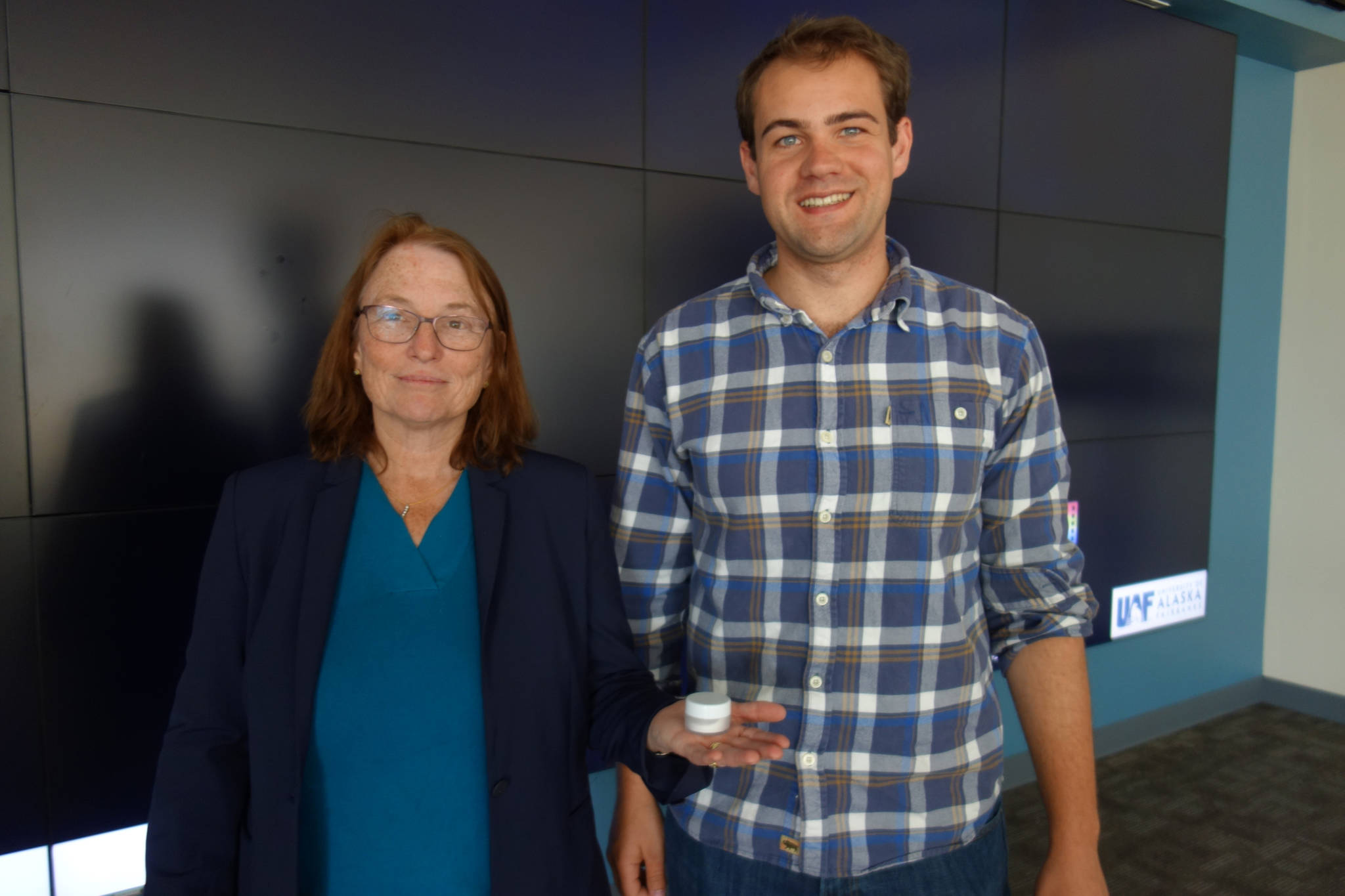
Leslie Field and Alex Sholtz of the group Ice911. (Courtesy Photo | Ned Rozell)
