
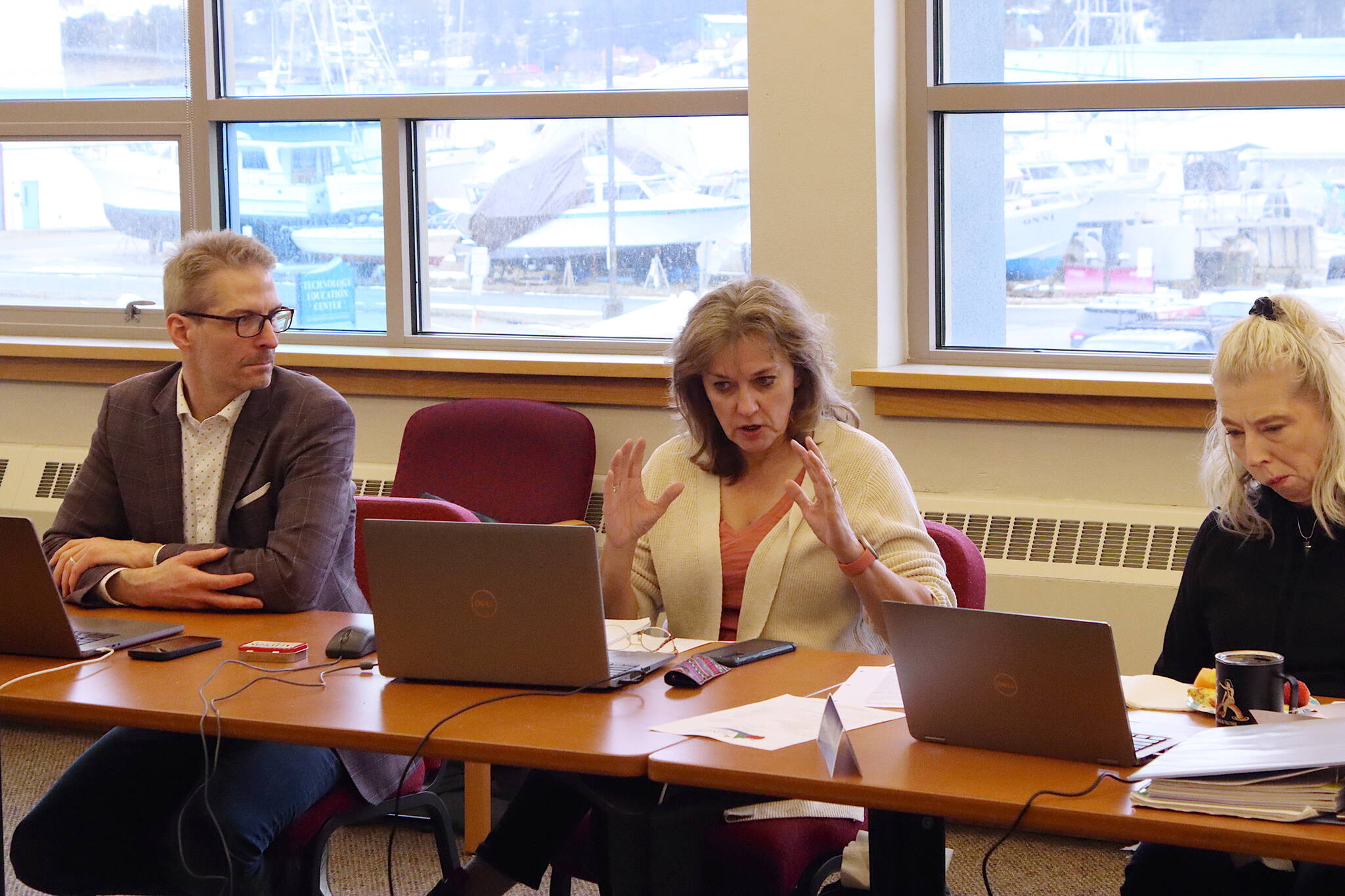
Putting students in grades 10-12 at Thunder Mountain High School, those in grades 7-9 and special programs at Juneau-Douglas High School: Yadaa.at Kalé, and K-6 students at elementary schools is the restructuring option Juneau School District leaders said Saturday they want to take a more in-depth look at to help solve its budget crisis.
The plan, which would take effect during the coming school year, would close both of Juneau’s existing middle schools and — for now — keep all elementary schools open. Sixth-grade students would be reclassified as elementary students instead of middle school students, while ninth-graders would become middle school rather than high school students.
The restructuring also resolves one of the biggest concerns expressed by high school students, who said a proposal to consolidate them at JDHS would mean inadequate parking for students with vehicles. But because TMHS would not be large enough for all students in grades 9-12, the revised plan includes only grades 10-12.
The district is facing a March 15 deadline for submitting a plan — including the time needed for state education officials to review and approve it — to the Juneau Assembly. While some school board members expressed concern about making such sweeping changes in such a short time, other board members and top district administrators emphasized a solution that balances the books has to be submitted in time, and there will be opportunities for later adjustments.
“We’re in analysis paralysis,” said board Vice President Emil Mackey during a work session Saturday at JDHS that lasted more than four hours. “We need to pick a model and then we do what we do every single budget process after that — we add back into the model what we want.”
But with District Superintendent Frank Hauser telling the school board he hoped they could agree on a single option to study further and refine by the end of the meeting, some members said they still needed further information about the data presented and possible impacts of the changes proposed.
“We’re so close to making a big decision we need to dig into some of these assumptions,” said board member Elizabeth Siddon, citing among other data Hauser’s assertion in recent weeks that consolidating the high schools will save the district about $1.3 million a year.
There will be ripple effects from consolidation that affect the district financially and/or otherwise, said Kristin Bartlett, the district’s chief of staff. Transportation costs, for example, will increase if students have to be bused to schools further from their homes for instance, although that might be offset at least somewhat by changing the district policy for walking distances (half a mile for elementary students, one mile for secondary students).
“Of course any time you do that you’re increasing safety concerns,” she said.
While the concern about such details, and impacts on students and teachers, is understandable, the district isn’t in a situation where everything can be analyzed and answered before the deadline, said Lisa Pearce, a financial analyst who uncovered the deficit facing the district after she was hired in December to help weather the crisis. She said adjustments to address impacts of the restructuring can occur later.
“What I believe that frustration is being driven up by mostly is the lack of time to be able to prepare,” she said. “Right now you’re up against a wall, you need to be doing this…If you adopt whatever program you decide to go on you then have five years from the end of this spreadsheet — you’ve bought yourself that time. Good, bad or otherwise, you’ve bought yourself that time. You don’t have time right now, that is not on your side.”
The school board is next scheduled to consider its budget and restructuring plan at a special meeting at 5:30 p.m. Thursday in the JDHS library. A special Assembly meeting to introduce ordinances providing the loan and taking over shared costs is scheduled at 11:45 a.m. Friday.
Pearce’s analysis, first presented to the board in early January, found the deficit was largely the result of a multitude of accounting errors in projecting both revenue and expenses. Board members, without referring to her by name, have implicated former administrative services director Cassee Olin, who resigned Dec. 1, for the errors. Mostly flat per-student state funding for the past decade and declining student enrollment are also cited as significant factors resulting in the shortfall.
The district is facing immense deficits both immediately and longer-term, beginning with a projected $7.9 million for the current fiscal year ending June 30. However, it appears that may be resolved with a $4 million zero-interest loan from the city to be repaid within five years, along with the city paying for $3.9 million of maintenance and other “shared costs” of city-owned buildings used for both municipal and school district purposes.
The bigger concern is future years, starting with a projected “status quo” deficit of $9.7 million for the coming fiscal year, which assumes a number of factors that could vary such as enrollment and state funding — and that the city will be willing to cover $1.6 million in “shared costs.” Similar deficits could occur in future years without adjustments to income and spending — plus the district will need to start repaying its loan to the city the year after next.
Those deficits could be reduced if the city agrees to keep funding an additional $2.3 million or so in “shared costs” each year (for a total of roughy $4 million) — not a certainty as some Assembly members have said taking on such costs may mean raising property taxes to pay for it. Additional relief could come with an increase in the state’s per-student funding formula — a $300 increase in a current legislative bill that seems the be starting point in negotiations this session would provide more than $1 million to the district.
However, that still leaves a sizable gap — roughly $2 million to nearly $6 million under different scenarios presented so far by Hauser — with the option singled out by the school board on Friday in a middle range. Additional savings would have to come through measures such as layoffs that would increase class sizes and eliminating non-required programs.
District officials have spent the past five weeks in a flurry of meetings to review details of the crisis, a range of possible solutions and get public feedback about the situation. Board members on Saturday were presented with plenty of additional figures about various district programs — ranging from special education to charter schools — and how they could be affected under differing restructuring options.
The additional data is simply reinforcing the positions of some board members about options they prefer or refuse to support. David Noon, elected to the board last October, said he remains opposed to consolidating the high schools due both to comments from parents and students at recent meetings who overwhelmingly rejected the idea, as well as data showing revenue to the district in future years will drop the most under the most dramatic restructuring scenarios due to how state funding is calculated.
“If we make decisions based on projections that have been assembled in a very rapid way, in a very rough way, we run the risk of boxing ourselves into a position we can’t get out of if those costs increase or the savings diminish, or if the revenue situation from the state changes,” he said. “We box ourselves into a situation we can’t get out of. We make the problem much worse.”
A countering argument was offered by board President Deedie Sorensen who, reiterating previous comments, said consolidating the high schools may ultimately be in the best interests of students and teachers because the two schools are currently spread thin in terms of occupancy.
“I don’t think we have two comprehensive high schools right now,” she said. “I think we have two high schools that are grossly understaffed. We are relying on a whole range of online courses to provide electives to students who should be able to get those electives in an in-person class. As (pupil-teacher ratio) goes up, which is going to have to, the number of available options at each one of our high schools goes down.”
• Contact Mark Sabbatini at mark.sabbatini@juneauempire.com or (907) 957-2306.
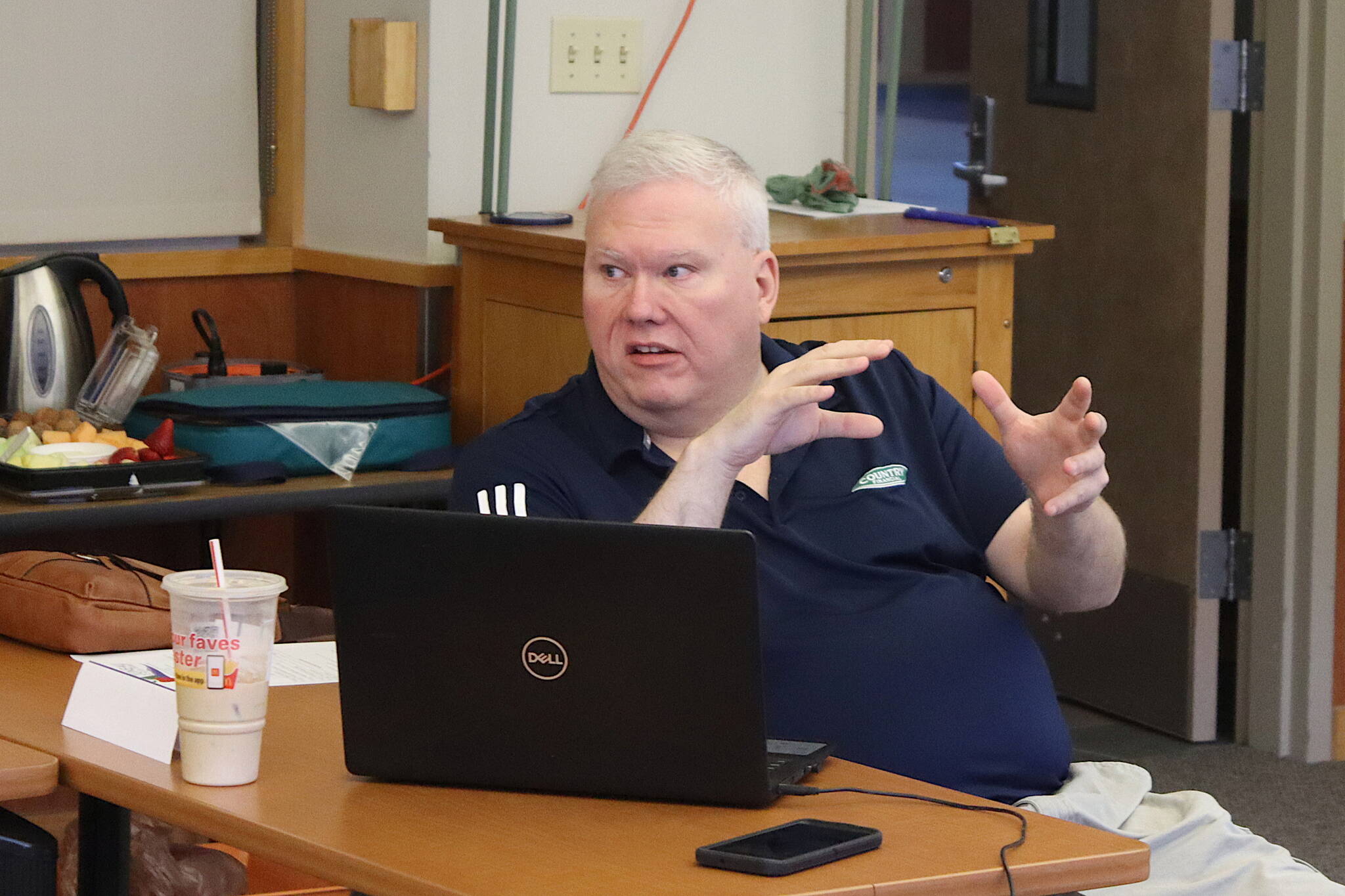
Juneau Board of Education Vice President Emil Mackey urges other board members to select a restructuring option for the district to pursue in order to resolve its financial crisis during a work session Saturday at Juneau-Douglas High School: Yadaa.at Kalé. (Mark Sabbatini / Juneau Empire)
